


The Inverse Bailout: Why the Government Needs AI More Than AI Needs the Government
The U.S. government isn't trying to own AI because it's a good investment. It needs to. The labs aren't failing — the government is. Here's the inverse bailout nobody is calling by its real name, and the blind spot that makes the whole thesis collapse.

Governments don't usually go looking for equity stakes in private companies. They show up when something is failing. Airlines after 9/11. Banks in 2008. Automakers in 2009. The pattern is consistent enough that we gave it a name: the bailout.
What's happening with U.S. frontier AI labs is not a bailout. The labs aren't failing. The government is.
That reframe changes everything about how you read the bipartisan push, from Bernie Sanders' 50% stock tax bill to Trump's conversations with Sam Altman on Air Force One, to get the federal government a piece of frontier AI. This isn't industrial policy. It's fiscal desperation wearing a tech optimism mask.
The Stake Is Bigger Than It Looks
The framing coming out of Washington is generous. Citizens as stakeholders. AI wealth distributed to the public. A sovereign fund that pays dividends to American households.
That's not wrong. It's just incomplete.
The TAM for intelligence is infinity, a case I've made elsewhere. Intelligence isn't a tool; it's a substrate. Every economic activity, every decision, every creative act runs on it. Which means the companies building the intelligence layer aren't building software companies. They're building the infrastructure that every other business runs on top of.
 Tom Frazier
A 50% government equity stake in those companies isn't ownership of a tech firm. It's a claim on the cognitive infrastructure of the global internet.
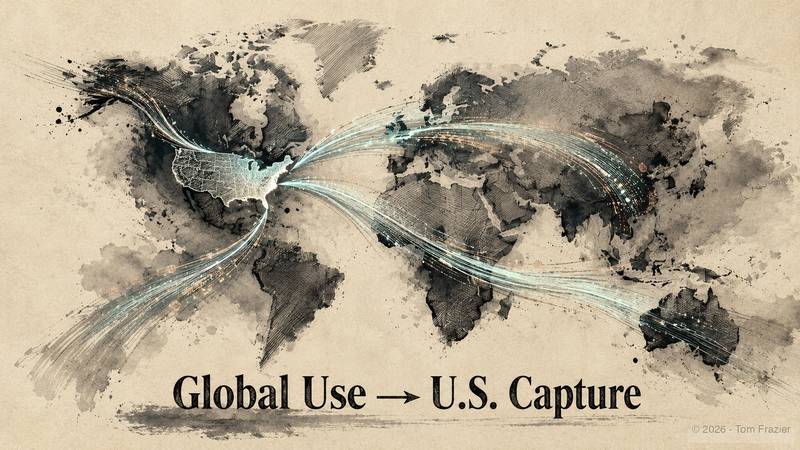
The digital public isn't just Americans. It's Western society; anyone connected to the internet, running their business, communication, and commerce through AI-enabled tools built by U.S. labs. That user base represents billions of people and trillions in annual economic activity. A meaningful revenue rake on that activity would pull capital into the United States at a scale that makes any prior trade mechanism look small. Any monetary mechanism, too.
Politicians see this. That's why the conversation is happening at all.
The Math Politicians Are Running
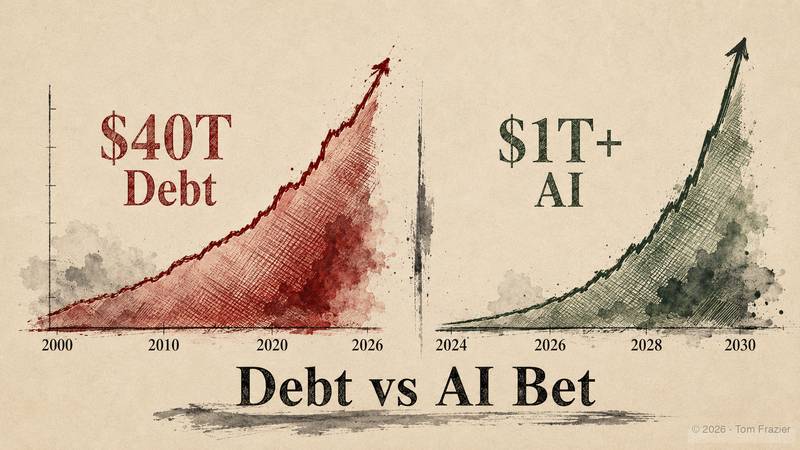
OpenAI is currently valued at over $850 billion and reportedly preparing for an IPO as early as September 2026. A 50% sovereign position at that valuation puts the government's stake at north of $425 billion in OpenAI alone. Extend that logic across the other frontier labs and you're looking at well over $1 trillion in sovereign equity.
Now look at the other side of the ledger.
U.S. federal debt is approaching $40 trillion, with the ceiling raised to $41.1 trillion just last year. The Congressional Budget Office projects net interest on the national debt will hit $1.04 trillion in fiscal year 2026 alone. That's $7,700 per household per year just to service interest on a debt the American people didn't vote for and didn't spend.
Penn Wharton's budget model puts the outer limit of sustainable federal debt at roughly 210% of GDP. Without structural intervention, that ceiling gets tested within 20 years.
The math politicians are running isn't complicated. If the intelligence layer generates the revenue growth the optimistic forecasts project, a 50% sovereign stake compounds at a rate that outpaces debt accumulation. It doesn't fix the debt. It forgives the people who created it, by making the number irrelevant.
The Bipartisan Tell
When Bernie Sanders and Donald Trump agree on something, stop and pay attention.
Sanders' American A.I. Sovereign Wealth Fund Act proposes a one-time 50% stock tax on frontier AI companies. Not on profits. On equity itself. Trump's administration has been in active discussions with OpenAI since early 2025 about a donated equity stake seeding a Public Wealth Fund. Different mechanisms. Same destination.
This isn't ideological alignment. It's diagnostic. When opposite ends of the political spectrum converge on the same structural answer, the underlying problem is usually so large that no ideology can escape it.
The underlying problem is the debt. The political class on both sides created it.
Neither side has a mechanism to address it that doesn't require someone taking the blame.
AI equity is the exit ramp that skips that conversation entirely. If it works, the returns cover the sins. If it doesn't, the blame diffuses. That's the actual logic.
It's not about the American people becoming AI stakeholders. It's about the political class finding a way out of a fiscal hole they dug together.
The Blind Spot
The entire thesis depends on one thing: U.S. labs win.
Not just win today. Win consistently, long enough and broadly enough that the sovereign equity position appreciates faster than the debt compounds. That's the model. Everything else is details.
Three scenarios break it.
China pulls ahead.
DeepSeek V4 trails U.S. labs on benchmarks but remains cheaper, ships open source, and has shown that Chinese labs can close the algorithmic efficiency gap faster than export controls can widen it. Brookings notes that if the race came down to compute, the U.S. holds the decisive advantage; America's hyperscalers are spending $650 billion on AI capex in 2026 alone. The race doesn't come down to compute. If Chinese labs pull ahead on capability, deployment, or adoption in key global markets, money flows east. The U.S. sovereign position doesn't appreciate. It depreciates. The mechanism inverts.
Open source compresses the moat.
The intelligence layer generates revenue only if it's also a proprietary layer. Open source models from DeepSeek, Meta, and others are eroding that assumption one release at a time. If the best models become freely available and inference costs approach zero, the revenue projections underpinning the thesis collapse. Not to zero. To a different number than the one politicians are running.
Token efficiency outruns revenue growth.
As I've written on AI's surge pricing problem, the economic model of frontier AI currently depends on scarcity: compute, inference capacity, proprietary capability. If token efficiency improves dramatically, usage grows while revenue per unit shrinks. The government ends up holding equity in companies with surging adoption and compressed margins. Not a bad business. Just a different one than the bailout thesis requires.
 Tom Frazier
None of these are tail risks. DeepSeek wiped $2 trillion from U.S. equity markets in a single day in January 2025. The market recovered. The structural question didn't.
A $1 trillion sovereign bet on American AI dominance is a concentrated risk on a single geopolitical outcome. That's worth saying clearly before the paperwork is signed.
The China Mirror
America made a good call when it didn't build a CBDC.
China went the other direction. The digital yuan is structural surveillance infrastructure, not a side effect of monetary policy. Financial behavior feeds behavioral scoring. Behavioral scoring feeds access to services. Access to services feeds compliance. That's not a bug in the Chinese model. It's a feature of centralized control dressed up as modernization.
The U.S. pushed back on that. Correctly.
And regardless of how the CBDC question resolves globally, whether some nations adopt it, all do, or none do, Bitcoin is the inevitable transaction layer between nation states. It's neutral, permissionless, and structurally incapable of being weaponized for surveillance. The U.S. recognized this. A strategic Bitcoin reserve as an interoperability layer between sovereign financial systems is coherent policy precisely because it doesn't require trusting the counterparty. Whatever currency each nation chooses domestically, Bitcoin sits above the politics as the interchange no government can co-opt.
 Tom Frazier
The AI equity push is the same instinct as a CBDC wearing different clothes. It's ownership rather than currency, but the structural outcome is identical: the government gains structural control over the infrastructure everyone else depends on.
Consider what that actually means at the individual level. Google already uses Gemini AI to filter, summarize, and organize Gmail. Hundreds of millions of Americans run their personal and professional communications through that layer. If the U.S. government holds a 50% equity stake in the frontier AI companies powering tools like that, every email you write, every thread it summarizes, every response it suggests passes through infrastructure the government half-owns. That's not a hypothetical privacy concern. That's the structure of the deal being discussed.
The road to centralized AI control doesn't require calling it that. It just requires holding the equity.
Capitalism didn't die when governments bailed out the banks. But it bent.
The moral hazard calculus shifted. The implicit backstop became explicit. Risk markets changed permanently.
The same dynamic applies here, except the asset being backstopped isn't a financial institution. It's the infrastructure of human intelligence, deployed globally.

The Alignment Problem Nobody Is Talking About
The argument isn't that government shouldn't benefit from AI growth. It should. Tax the revenue. Build a sovereign fund through public markets participation. Find a mechanism that distributes the upside without concentrating control.
But ownership is a different thing than participation. And the logic being applied here has a fracture in it that nobody in Washington appears to have noticed.
Right now, the conversation focuses on a handful of frontier labs: OpenAI, Anthropic, xAI. But AI development isn't staying in a handful of frontier labs. Google has Gemini. Meta has Llama. Amazon has Bedrock. Apple has on-device models. Every major enterprise software company is building or acquiring AI capability. In five years, meaningful AI models will be embedded in thousands of companies across every sector.
So the question isn't just whether a 50% government stake in today's frontier labs is a good idea. The question is what the policy logic demands next. If the principle is that intelligence infrastructure warrants sovereign ownership because of its societal impact, that principle doesn't stop at OpenAI. It extends to every company that builds a consequential AI model. Which is going to be most of them.
You can take the position that the government should only own the frontier labs and exempt everyone else. But that's not a principled framework; it's picking winners and calling it policy. You'd be handing a structural advantage to incumbents while taxing out the next generation of builders before they start.
Alternatively, you can follow the logic to its conclusion: a government that owns 50% of the intelligence layer of the economy owns, effectively, 50% of everything that runs on it. That's not capitalism with guardrails. That's something else.
Capitalism isn't dead yet. But the question being asked in Washington right now, dressed up as fiscal innovation and AI optimism, is whether we'd like to change that.
Nobody is framing it that way. They should be.


