

The US Got Bitcoin Right. Now It Needs to Protect It.
El Salvador made Bitcoin legal tender. By 2024, 92% of Salvadorans weren't using it. The US took the opposite approach — reserve asset, not currency. That distinction is why the Satoshi Settlement thesis is now tracking reality. And why an executive order isn't enough.

El Salvador tried to make Bitcoin a currency. It failed. By 2024, 92% of Salvadorans weren't using it for transactions, and by January 2025 the government quietly dropped legal tender status under IMF pressure.
The United States looked at that experiment, drew the opposite conclusion, and formalized it as the Strategic Bitcoin Reserve. Bitcoin isn't a currency. It's a reserve asset.
That distinction is the entire argument, and the US got it right.
The Experiment That Failed
El Salvador's play was ambitious. In September 2021, President Nayib Bukele made Bitcoin legal tender: mandatory acceptance for all merchants, government taxes payable in BTC, a state-backed wallet called Chivo to hold it all together. The pitch was financial inclusion, cheaper remittances, first-mover credibility in the digital economy.
None of it landed.
By 2024, 92% of Salvadorans weren't using Bitcoin for day-to-day transactions. Most merchants accepted it because the law required it, not because anyone was asking. The Chivo wallet became a case study in coerced adoption: people downloaded it for the $30 signup incentive, then stopped. By early 2025, El Salvador needed a $1.4 billion IMF bailout. The IMF had conditions. Bitcoin's legal tender status was one of them. The Legislative Assembly voted 55-2 to strip it.
The failure wasn't Bitcoin's. It was the category. El Salvador tried to solve a consumer payments problem with settlement infrastructure. Bitcoin was never built for high-volume, low-value, daily transactions on a base layer that settles in blocks, not milliseconds. Forcing it into that role was like using a freight rail to run a courier service.
What the US Did Differently
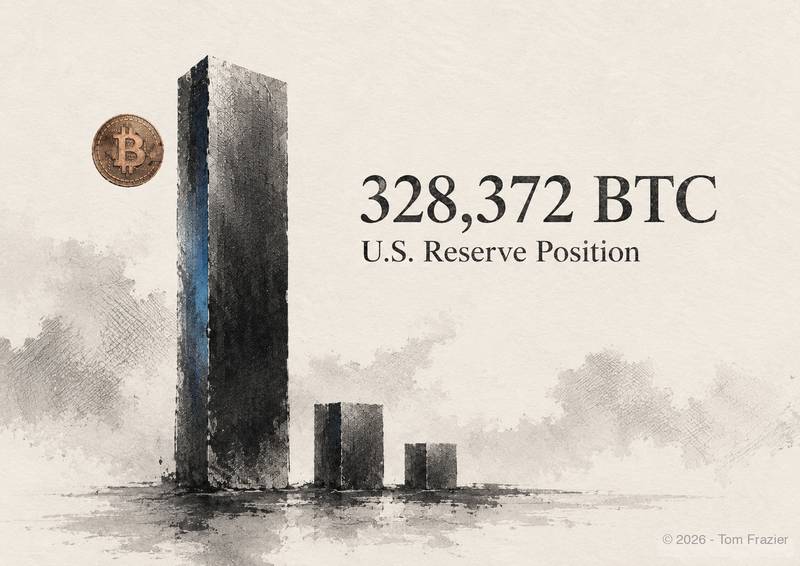
On March 6, 2025, President Trump signed an executive order establishing the US Strategic Bitcoin Reserve. The government holds approximately 328,372 BTC, roughly $25.4 billion as of May 2026. The order includes a no-sell mandate on Bitcoin specifically. It cannot be liquidated. It sits alongside gold, oil, and strategic pharmaceuticals as a national reserve asset.
The US didn't try to pay taxes in Bitcoin. No merchant mandates. No wallet app. It designated Bitcoin a reserve asset and put it in a vault.
It's a completely different thesis about what Bitcoin is. El Salvador called it a currency and tried to run it through a consumer economy. The US called it an asset and parked it in the same drawer as gold. One of those classifications maps to what Bitcoin actually does at scale. The other doesn't.
The US classification is right. And the implications go well past domestic monetary policy.
From Peer-to-Peer to Nation-to-Nation
I've written before about the Satoshi Settlement thesis: the dollar's reserve reign is structurally ending, the multipolar alternative fails without a neutral intermediary, and Bitcoin is the only settlement layer available that no nation owns and no government can weaponize.
 Tom Frazier
The US Strategic Bitcoin Reserve is the first formal move by a major economy that is consistent with that thesis.
Most coverage misses why. Satoshi Nakamoto's 2008 whitepaper carried a specific title: "Bitcoin: A Peer-to-Peer Electronic Cash System." Peer-to-peer meant consumer-to-consumer. Individuals transacting directly, no banks in the middle. That was the design intent, and it's where most of the early adoption energy went.
But peer-to-peer consumer transactions aren't where Bitcoin found its highest-value use case. The trust problem Bitcoin actually solves best isn't between two individuals who don't know each other. It's between two nations whose monetary systems are fundamentally incompatible and who have no neutral ground on which to settle.
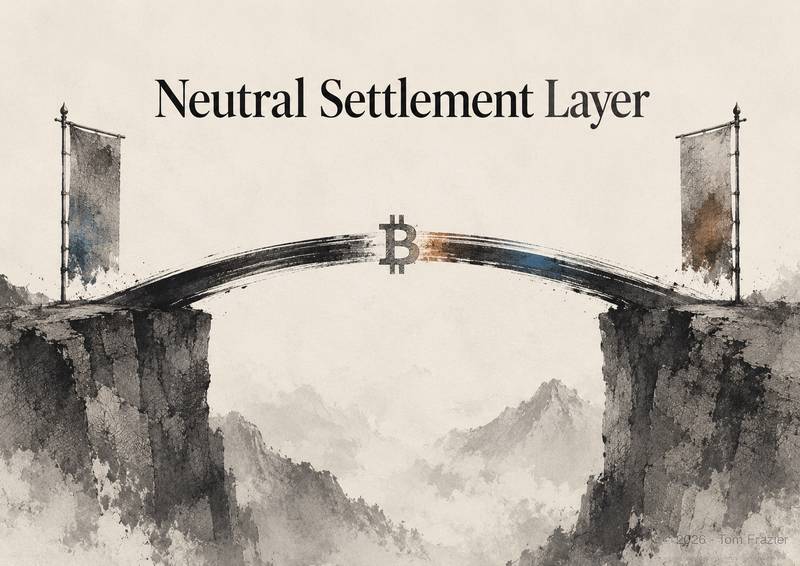
Nation-to-nation is where the counterparty risk is largest, where the settlement amounts are most consequential, and where no neutral infrastructure has ever existed. Gold played that role for centuries. The dollar inherited it. Both depend on political trust that is now visibly eroding: through sanctions, SWIFT exclusions, and tariff threats that have pushed even allied nations toward the exit.
Bitcoin requires none of that trust. It settles on identical mathematical terms for every party, regardless of their relationship. That's what neutral settlement infrastructure looks like. Nation-states holding Bitcoin as a reserve asset isn't a contradiction of Satoshi's vision. It's the pivot to where that vision matters most.
The First-Mover Advantage Is Real
In a world where trade eventually settles in Bitcoin, the nations holding more BTC now are structurally better positioned. This isn't a price prediction. It's arithmetic.
The US holds approximately 328,372 BTC. No other major economy is close. Most haven't moved at all. If the Satoshi Settlement plays out, the US enters that transition already holding the asset that denominates the new system. That's the second-order consequence worth understanding: it's not just that the US has Bitcoin. It's that every other nation starting from zero has to acquire it from someone. In a post-dollar settlement world, that asymmetry compounds.
El Salvador holding Bitcoin as legal tender was a payment experiment. The US holding Bitcoin as a strategic reserve is a geopolitical bet. Different game, different stakes, different time horizon.
The One Thing That Could Unwind It
The Reserve is real. The positioning is real. But it lives in an executive order, and executive orders get reversed.
The BITCOIN Act of 2025 (S. 954), introduced by Senator Cynthia Lummis and Representative Nick Begich, would codify the Reserve into law. It targets one million BTC over five years, held for a minimum of 20 years, with quarterly public reporting and a restriction on sales to debt reduction only. As of mid-2026, the bill is in the Senate Banking Committee. It hasn't moved to the floor. It hasn't passed.
The permanence gap is the problem.
A future administration hostile to the thesis could dissolve the Reserve with a new order. Everything that makes it significant: the no-sell mandate, the custody structure, the signal to other nations that the US is treating Bitcoin as infrastructure. All of it rests on a document one president created and another can undo. Lummis has framed the BITCOIN Act as transforming "the president's visionary executive action into enduring law." That's exactly right. The executive order created the position. Legislation is what makes it a commitment.
There's a counterargument worth naming. The Reserve was built from forfeited assets: Bitcoin seized through criminal and civil proceedings, not appropriated from taxpayers. That makes it easier to defend politically. Nobody spent public money on this; it was already sitting in federal custody. But "easy to defend" and "protected by law" are not the same thing. An administration that wanted to reverse it could liquidate the holdings just as easily as this one consolidated them. The absence of a statutory floor is a real vulnerability, not a theoretical one.
One Step on the Journey
The Satoshi Settlement was always a long-arc thesis. Not a price prediction. Not a date when the dollar collapses. A structural argument about where the world is headed as dollar credibility erodes, multipolar trade increases, and the need for a neutral settlement layer grows into something no existing system can satisfy.
The US Strategic Bitcoin Reserve is not the destination. It's the first credible proof point that the thesis is tracking reality. A government large enough to matter has looked at Bitcoin, classified it correctly, and positioned itself accordingly. Most of the world is still debating whether to take it seriously.
El Salvador tested the wrong model and paid for it. The US is running the right experiment.
Whether it holds depends entirely on whether Congress has the conviction to codify what an executive order started. The strategic logic is sound. The legal protection isn't there yet. That's the fight worth watching.
The question is whether this becomes law before the next reversal becomes possible.


