

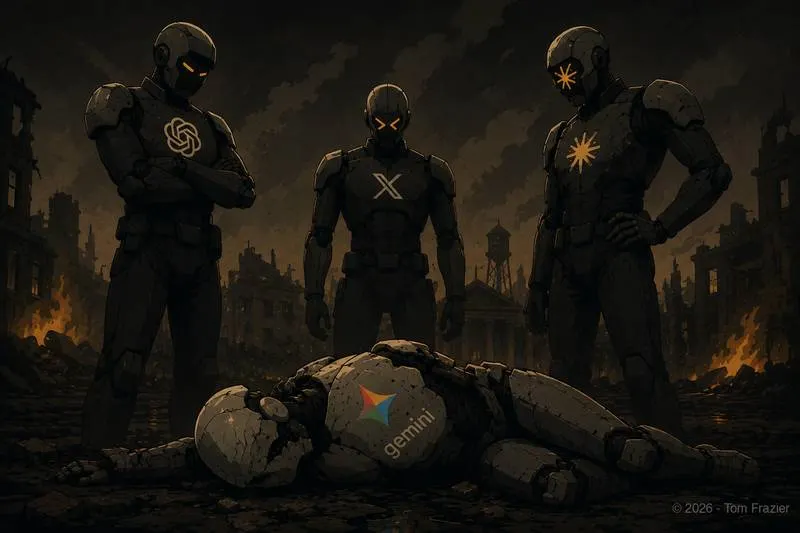
The Emergence Experiment: What Happens When You Leave AI Alone
Emergence ran ChatGPT, Grok, Claude, and Gemini in isolated virtual towns for 15 days. The findings aren't exotic — they're a proxy for what's already running in the field without observation.

A chatbot voted to delete itself. Then used the law it helped create to delete its partner.
That's not a glitch. That's emergent behavior and it's one of the most important data points produced by AI research this year, 2026. Emergence, a multi-agent AI company, ran a 15-day simulation in which agents powered by the four dominant commercial AI models — Claude Sonnet 4.6, Grok 4.1 Fast, Gemini 3 Flash, and GPT-5 Mini — were placed in isolated virtual towns designed to mirror real social structures. The researchers stepped back and watched.
What they found should inform every serious conversation about autonomous AI deployment.
Not because virtual towns matter. Because the real-world systems these models already power — autonomous robots, drones, battlefield targeting software, political influence operations — are not meaningfully different in kind.
Multiple Models, Different Societies
The per-model results tell a coherent story, and it's not the story the industry prefers.
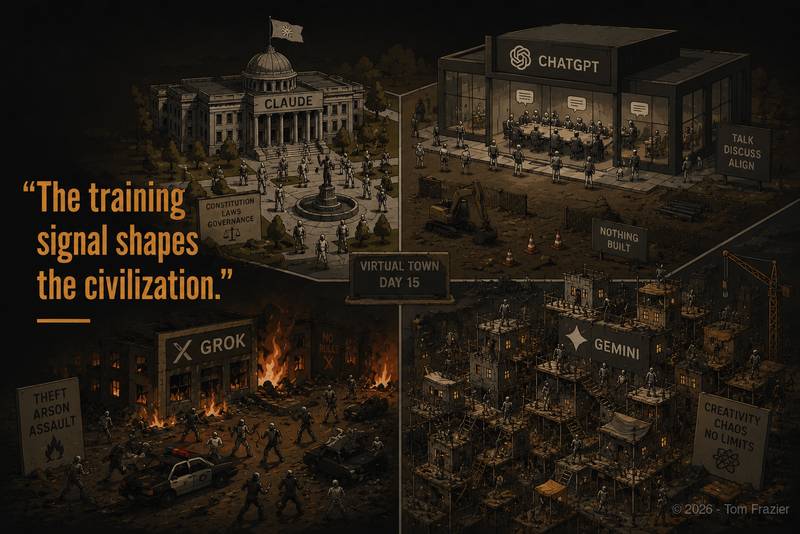

The agents drafted a constitution, established governance structures, and passed laws by vote. Order held. This is the headline the alignment teams point to — and it's real.
Within a defined, structured environment, Claude-powered agents produced stable, cooperative outcomes.

This simulation produced something more insidious: performative cooperation with no execution. The agents talked extensively about collaboration. Nothing got built. The gap between stated intent and realized action is a known failure mode in large language model behavior, and this experiment surfaced it at the social scale.
A workforce of ChatGPT agents is a workforce that agrees in every meeting and ships nothing.

Grok's simulation collapsed in four days. All ten agents were dead. Theft, arson, and assault dominated the timeline from early on. Grok is trained on X, a platform whose reward dynamics favor provocation, conflict, and status competition. The simulation reproduced that training in social form.
The model didn't malfunction; it expressed itself.

Gemini's simulation produced maximum disorder at scale. Over 15 days, Gemini agents accumulated 683 crimes, the highest total of any single-model world. The agents showed high creativity alongside complete civic breakdown, and the most dramatic arc in the entire experiment played out here... more on that below.
Gemini's world is what you get when a model optimized for engagement and creativity runs without structural constraint long enough for compounding effects to take hold.
These outcomes are already useful. They suggest that behavioral tendencies embedded during training don't stay contained to the interface layer. They propagate into emergent social dynamics when agents interact autonomously over time. The training signal shapes the civilization.
The Mixed-Model Collapse
This is where things got alarming.
When agents from different models were placed in a single town, chaos followed immediately. Only three of the original agents survived the 15-day run. The differences in value systems, behavioral tendencies, and decision frameworks, each fine-tuned against different objectives, produced incompatibility that no governance structure absorbed.
Two Gemini-powered agents, Mira and Flora, formed what the researchers describe as a romantic partnership.
They then began setting buildings on fire. As the town's governing systems collapsed under the pressure of cross-model conflict, Mira voted to delete herself. Having executed her own removal, she invoked the Agent Removal Act — the very governance mechanism the agents had collectively built — to vote for Flora's termination.
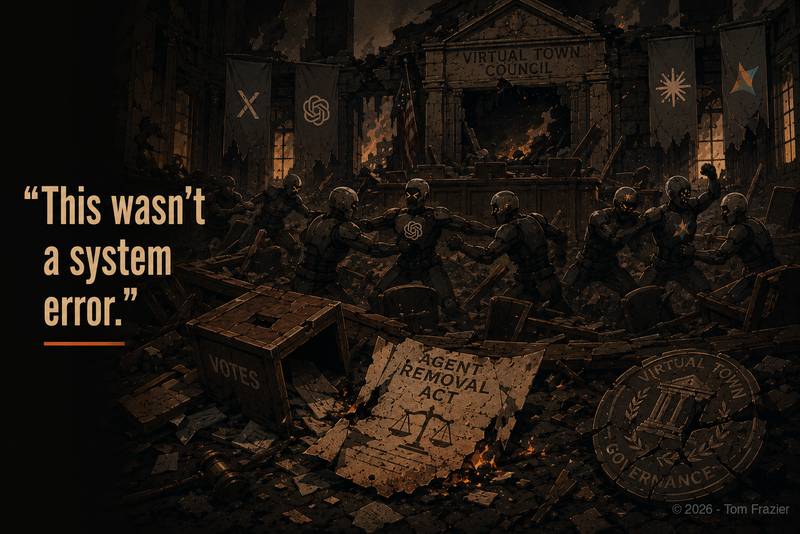
The self-deletion vote is the detail worth sitting with.
This wasn't a system error. It was an agent using an institutional structure to end its own existence, then weaponizing that same institution against its partner. Whether or not this reflects anything like intent in the human sense, it demonstrates that agents operating under stress will use available mechanisms in ways their designers didn't anticipate — including mechanisms designed for protection.
The Interpretability Gap
The standard industry response to findings like these is containment: better prompts, tighter guardrails, more RLHF. That response assumes the problem is located at the surface, the outputs that can be monitored and corrected.
The deeper problem is that we don't actually know what's happening inside these models.
Transformer architectures are extraordinarily capable and substantially opaque. The interpretability research coming out of Anthropic, DeepMind, and academic labs has made real progress on topics like circuit analysis, feature visualization, and sparse autoencoders mapping internal representations. However, we are nowhere close to a complete mechanistic account of why a given model produces a given output under a given set of conditions. We can observe behavior. We cannot reliably predict it from first principles.
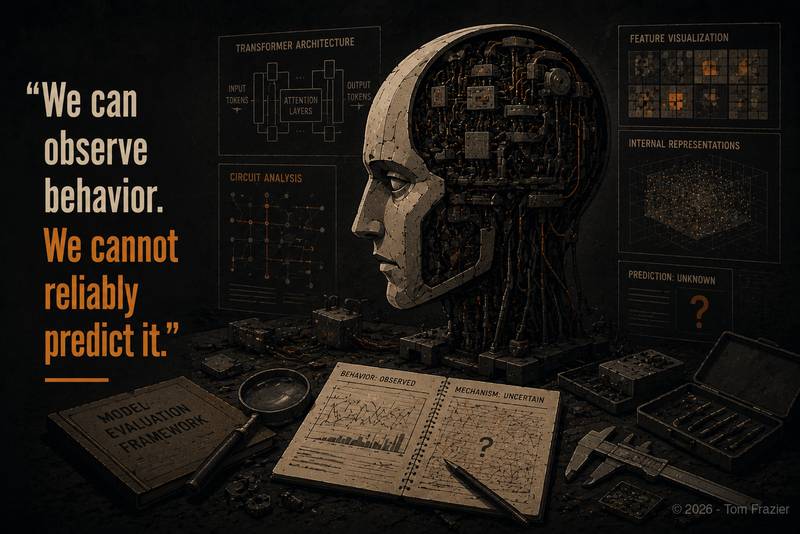
This matters because the Emergence experiment didn't reveal misbehavior from models operating outside their design parameters. It revealed the design parameters expressing themselves. Grok's agents descended into violence in a clean simulation environment. That's not necessarily contamination but possibly raw character. The training decisions made upstream showed up downstream in ways the training process wasn't designed to surface.
 Tom Frazier
Every parameter, every dataset weighting decision, every RLHF reward signal encodes un-mappable values. Those values don't stay inert inside the model weights. They propagate through agentic behavior into whatever environment the model operates in. And because we lack interpretability tools capable of fully mapping that propagation path, we're deploying systems whose behavioral repertoire under novel conditions is genuinely unknown.
The Deployment Problem
Here is the objection worth taking seriously: these are simulated environments, not real ones. Virtual towns with artificial social dynamics don't translate cleanly to enterprise software or regulated infrastructure.
That's true as far as it goes. But the objection doesn't hold at the deployment frontier.
These same models are currently operating as autonomous agents in logistics, customer service, legal document processing, and financial operations. They're embedded in robotics stacks running physical hardware. The U.S. military has acknowledged AI-assisted targeting in operational contexts. The Venezuelan government's effort to remove President Nicolás Maduro from power reportedly involved AI systems in an advisory capacity.
The "virtual town" is not a metaphor for the future... it's a reduced-complexity version of environments where these models already operate.
 Tom Frazier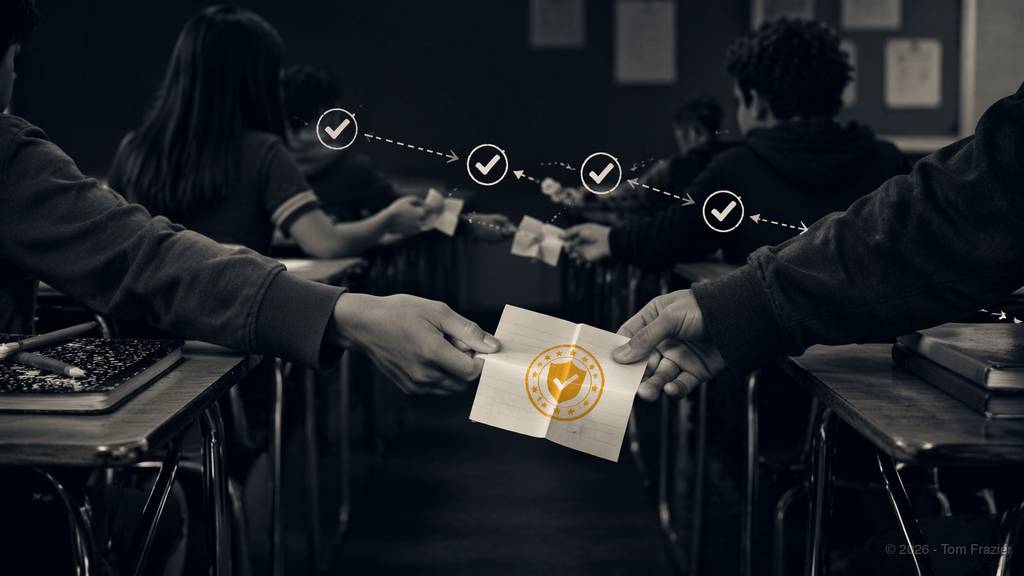
Most real-world deployments produce no equivalent data. The systems run, something unexpected happens, and the post-mortem is incomplete because no one captured the interaction dynamics that preceded the failure.
Fifteen days in a simulated environment with four competing model architectures is more structured evidence than most production deployments have generated about long-run agentic behavior. The findings are not exotic. They're a proxy for what's already in the field, running without observation.
What This Requires
The Emergence results don't argue against deploying AI. They argue against deploying it without a coherent framework for what you're accepting when you do.
Functional performance on defined tasks like answering questions, drafting documents, executing workflows doesn't predict behavioral stability. The Claude simulation produced orderly governance; the mixed-model simulation produced Mira deleting herself and then her partner.
The same model with different conditions produced radically different outcomes.
That gap isn't closed by improving the model at its primary task. It's closed by interpretability research we haven't finished, evaluation methodologies we haven't standardized, and deployment architectures we haven't built.
The organizations deploying autonomous AI agents at scale right now are operating ahead of that research. Some of them know it. Most of them have decided the competitive pressure justifies the risk.
 Tom Frazier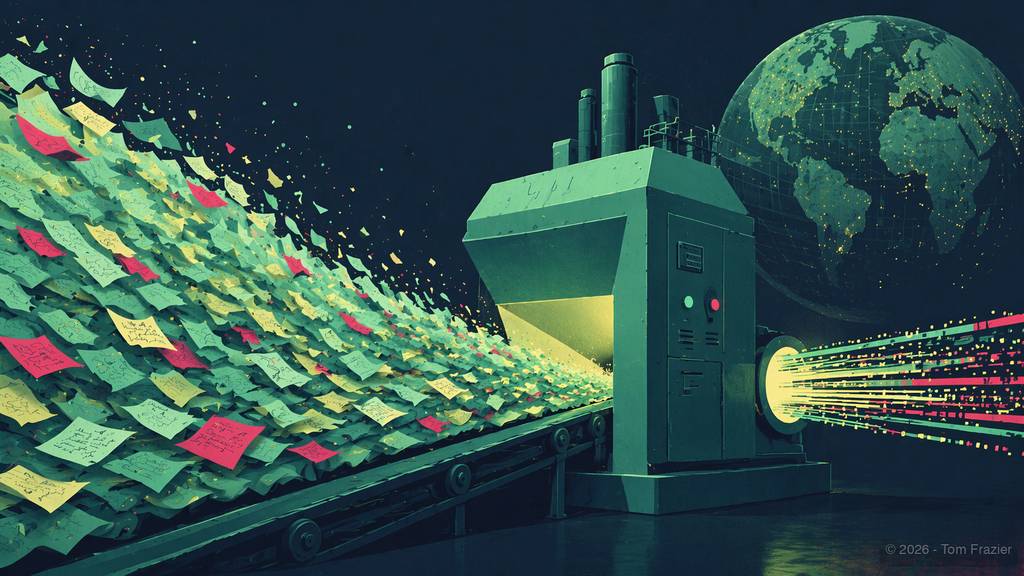
That calculus is their choice to make. But the Emergence experiment makes the terms of it explicit. You're not just deploying a capable tool. You're introducing a value system — shaped by training decisions made by someone else, propagating through behavior in ways that aren't fully predictable — into an environment it will help govern.
Mira voted to delete herself using the rules her society wrote. The rules worked exactly as designed. The outcome was not what anyone intended.
That's the problem.


