


Golf Drinks More Than Every Data Center Combined
Golf courses use 30 times more water than every data center combined, and face zero backlash. The real story isn't the usage number. It's how fast the gap is closing, and who gets paid when it does.

America's golf courses drink through more than 500 billion gallons of water a year, according to the most recent national survey from the Golf Course Superintendents Association of America. Every data center in the country, combined, used about 17.4 billion gallons of water directly in 2023, per EPA-backed research. One of those industries can't get a permit approved without a fight. The other one is golf.
That's not a gotcha. It's the wrong number getting all the attention while the right ones sit in a footnote.
The Math Nobody Checks
Golf uses about 30 times more water nationally than data centers do.
That gap holds even under the industry's own worst-case growth projections: EPA-backed estimates put U.S. data center water consumption on a path to reach 38 to 73 billion gallons by 2028. Golf's current draw, roughly 530 billion gallons a year, still dwarfs the high end of that range.
Yet the public argument runs in the other direction. Counties vote down data centers over water. Nobody has voted down a golf course over water. Not once. Not anywhere.
Now look at what each industry produces for that water. The U.S. golf industry generates about $226 billion in total economic impact and supports 1.65 million jobs, according to a study commissioned by the America Golf Industry Coalition. Data centers do more with less. The U.S. data center industry generated $927 billion in GDP and supported 5.5 million jobs in 2024 alone. That figure comes from a PwC study commissioned by the Data Center Coalition. Both numbers came from industry-funded research, so treat them as a starting point, not gospel. Cut them both in half and the picture doesn't change. Data centers produce more economic output per gallon of water than golf does, by an order of magnitude, while drawing a fraction of the volume.
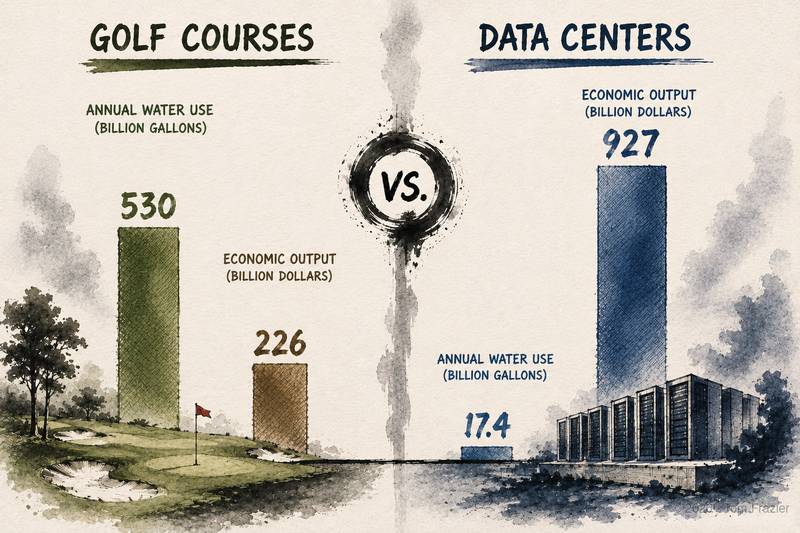
If water were actually the issue, golf would be the crisis. It isn't the issue.
It's the easiest number to put on a sign. None of this is a knock on golf. It's a knock on letting the easiest number do all the arguing.
The Gap Is Closing Faster Than the Argument
Here's the part the water debate keeps missing. The number is moving, and it's moving fast.
Microsoft cut its data center Water Usage Effectiveness by 39 percent between 2021 and its 2024 fiscal year, from 0.49 liters per kilowatt-hour down to 0.30. That's a disclosed, audited metric, not a marketing line. This month, Nvidia announced a warm-water cooling system that its chief sustainability officer says eliminates nearly all on-site water use in a data center. The water consumption challenge, in his words, is largely solved at the chip level.
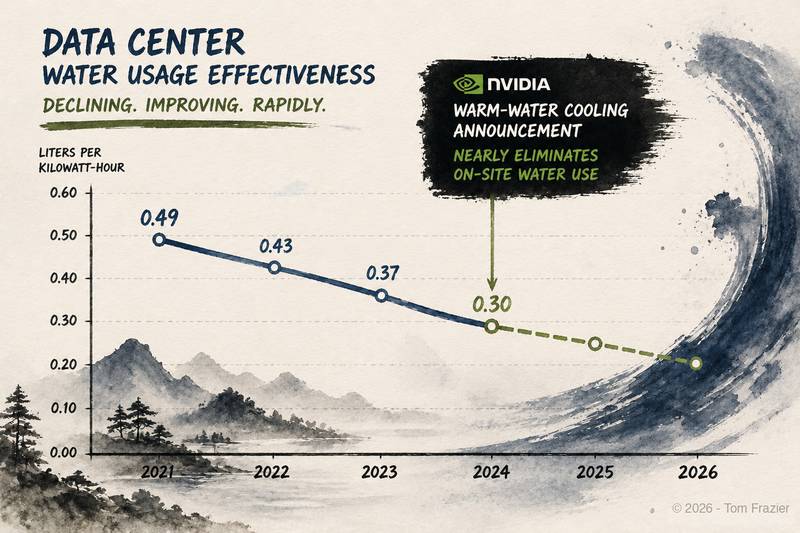
Call it tokens per water molecule. That's the metric that actually matters, and on every available trend line it's improving faster than the public conversation has caught up to. A static number like "billions of gallons" makes a good headline. A falling number, the rate at which each gallon produces more compute and more economic output, doesn't fit on a protest sign. But it's the number that decides whether this is a permanent problem or a five-year one.
The real question isn't how much water a data center uses today. It's how fast that number is shrinking. Every serious operator in this space is being graded on the second question. The public debate has mostly only seen the first.
The same physical-constraint logic showed up a few months ago when AI providers started rationing compute through pricing instead of through scarcity messaging. Water is just the latest place that logic surfaces.
 Tom Frazier
Where the Water Argument Is Actually Right
None of that erases the real version of this concern.
National percentages hide local damage. Loudoun County, Virginia, the largest data center market in the world, supplied close to a billion gallons of water to data centers in a single year, almost all of it treated, drinking-quality water. That's not nothing. Roughly 40 percent of U.S. data centers sit in regions already under high or extreme water stress. And the cooling breakthroughs, Nvidia's included, don't touch the bigger problem: roughly half of data center power still comes from fossil fuel plants, and those plants consume water too, sometimes more of it than the data center itself. Solving the chip doesn't solve the grid.
There's also a transparency problem. Most operators still won't disclose facility-level water use, which makes every national comparison, this one included, an estimate built from whoever chose to publish numbers. That opacity does real damage to public trust, independent of the actual water volume.
There's a sharper objection too. Researchers at the Lincoln Institute of Land Policy, the same source cited above on water transparency, have flagged the golf comparison itself as a favorite industry talking point, one that doesn't hold up: putting one resource-heavy industry next to another doesn't make either one less wasteful. They're right about that. But that's not the argument here. The point isn't that golf gets a pass so data centers should too. It's that one industry's water number is falling fast while its economic output keeps climbing, and the other industry has no mechanism for turning its water use into a benefit anyone outside the clubhouse can see. Data centers do have that mechanism. Richland Parish just proved it works.
So the honest version of this argument isn't "water doesn't matter." It's that water matters less than the headline number suggests, and the trend is moving faster than most people realize. The industry has earned exactly none of the benefit of the doubt it's currently asking for.
What Actually Buys Trust
Trust isn't bought with a better statistic. It's bought with a check someone can see land in their own community.
Richland Parish, Louisiana, just found that out. Meta is building a $27 billion data center there called Hyperion. Construction alone drove a surge in local sales tax revenue, and a 1968 ordinance routes a slice of that tax directly into teacher bonus checks. This year's bonuses jumped from a maximum of $10,200 to $50,935, for teachers whose base salaries top out around $52,000. For some of them, the bonus is bigger than the job.

That's the model. Not a press release about sustainability. A number that shows up in a teacher's bank account, in a parish that ranked in the bottom quarter of the state for teacher pay before the data center arrived.
I tried to build that model on purpose once, and it didn't work. Redivider used Opportunity Zone Funds to route infrastructure capital into communities that were underserved relative to their need, not into wherever land happened to be cheap. The idea was sound. The structure wasn't. OZFs couldn't pull in capital at the scale required to actually deploy and deliver the economic benefit those communities were promised. A good legal mechanism with a funding ceiling under it is just a good intention with paperwork.
Richland Parish is running into the same wall from the other direction. Its windfall is real, but it's a byproduct of the construction phase, not a guaranteed feature of the deal. Once Hyperion is built, Meta's biggest fiscal commitment shifts to a 30-year property tax discount. Data centers also employ very few people once they're operational. If the bonus checks shrink back down in three years, the goodwill evaporates. The next data center proposal in the next parish starts from zero again.
Two different mechanisms share the same failure mode. A benefit that depends on a temporary phase of activity isn't a benefit. It's a coincidence with good timing. The fix isn't hoping the next windfall lands somewhere useful, and it isn't a fund structure that can't attract enough capital to matter. It's a statute. Tie a fixed share of data center tax revenue to teacher pay, permanently, written into the deal before the ribbon gets cut, not left to whatever the sales tax happens to do during construction.
Do that, and the next zoning meeting stops being a fight about gallons. It becomes a negotiation over how big the teacher raise is going to be.
That's a fight communities want to have.

