


The MVP Is Dead
The MVP is dead. Not because building got easier, but because the thing it used to force you to do, prove demand, doesn't take weeks anymore. Here's what replaces it.

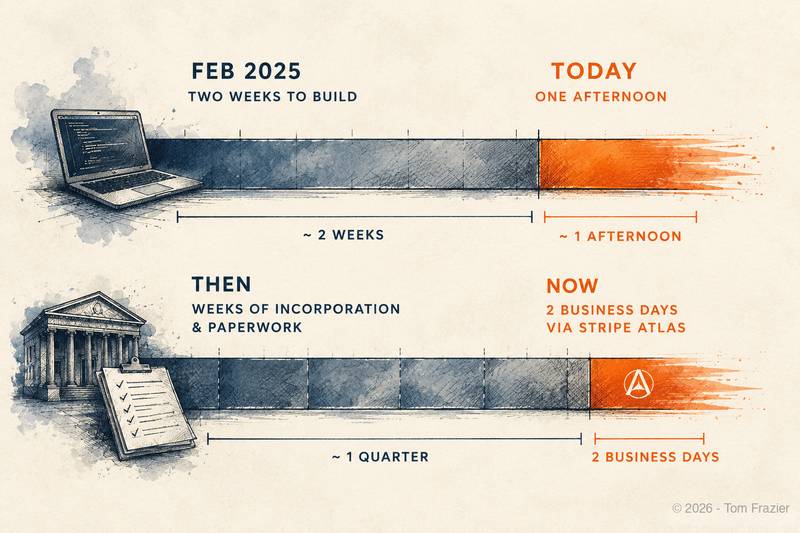
The MVP is dead. Not because building got easier. Because the thing it used to do for you, force weeks of finding out whether anyone wanted what you were building, doesn't take weeks anymore. I built FitFam, a fitness accountability app, over two weeks while recovering from two surgeries last year.
The same build today takes an afternoon.
When the gate disappears, proving demand doesn't go away. It just has to happen faster.
Both Halves Collapsed
Building wasn't the only thing that got fast. Starting the company did too.
Run the math on what used to gate a founder before they touched a customer: weeks of building, plus weeks of incorporating, banking, and paperwork before you could legally take a dollar. That used to eat the better part of a quarter. Today, applying to form a company through Stripe Atlas takes under ten minutes, and Stripe incorporates you within two business days. Pair that with a build that takes an afternoon instead of two weeks. The on-ramp that used to filter out the unserious just collapsed into a single weekend.
That's the part most people miss when they talk about AI lowering the barrier to building. The barrier on the business side dropped at the same moment as the barrier on the product side. Two gates. One collapse.
- Feature: you can build and incorporate in a weekend.
- Benefit: you can test an idea for the cost of a Saturday.
- Benefit of that benefit: the cost of being wrong just stopped being the thing protecting you from being wrong.
Speed removed the friction that used to force the question. It never answered the question for you.
What the MVP Was Actually For
The MVP was never really a validation tool.
It was a side effect of how long building took.
For most of the last fifteen years, building took long enough to force founders into the market by accident. Six months of building meant six months of talking to people, whether you meant to or not. You demo to friends. You built in public. Somebody tells you it's wrong before you ship. The MVP got credit for that discipline.
It didn't earn it. The discipline came from the clock, not the framework.
Take away the clock and the discipline goes with it. That's what changed. Not the wisdom of testing an idea on real people before you commit to it. The thing that used to force you to do it.
This Isn't a One-Off
FitFam isn't a fluke. I've watched this pattern repeat.
In 2024, over a year before FitFam, I built The Tickle Pickle, a daily kids' podcast that grew out of my daughter's joke book. The first version went from idea to a working system in a single weekend. That used to require a content team, voice actors, and an editor on payroll. It ran a full year and topped 250,000 downloads by month eight. The audience was still there. What wasn't there anymore was a little girl who moved on from joke books. We were the founding team, and the founding team quit before the audience did.

It wasn't a startup. It was a dad project that happened to prove the same thing a startup would have: the system held up the entire time. Two different products, two different years, two different endings. Same pattern. A weekend instead of a department, and the thing that decides whether it lives or dies was never the build.
It isn't just me. A CNBC reporter spent 24 hours at a hackathon in Singapore last fall and found the identical shift happening to founders who'd never built anything before. The organizers had a phrase for it. “We've lowered the barrier, but raised the bar.” The engineering difficulty that used to separate winners from everyone else mostly disappeared. What separates them now is whether the thing they built was worth building in the first place.
The Counterargument, Taken Seriously
Here's the obvious objection:
doesn't building still teach you something an idea alone can't?
Of course it does. You learn what's technically possible. You learn what the thing actually feels like once it exists, not just how you described it in your head. That part of building was never wasted time, and speeding it up doesn't waste it either.
But notice what that objection defends. It defends building as a learning tool for the founder. It says nothing about whether anyone besides the founder wants the thing built. Those are two different questions, and the MVP era let founders answer the first one while quietly believing they'd answered the second.
You can go one of two ways once that gate disappears. The first path is comfortable. Keep building and tell yourself you'll test demand once the thing is finished. That's the old habit, and it's exactly what most people will default to. The other path flips the order: prove someone besides you wants this before you spend the weekend. Or treat the build itself as the fast, cheap version of that proof, not the finished product.
What Replaces the MVP
Proof of Demand is the discipline that has to replace the MVP's accidental version of it.
Proof of Demand isn't a survey, and it isn't a focus group. It's getting a stranger, someone with no reason to be polite to you, to commit something real before or immediately after you build: money, a signature, a waitlist they had to give something up to join, a yes that costs them something.
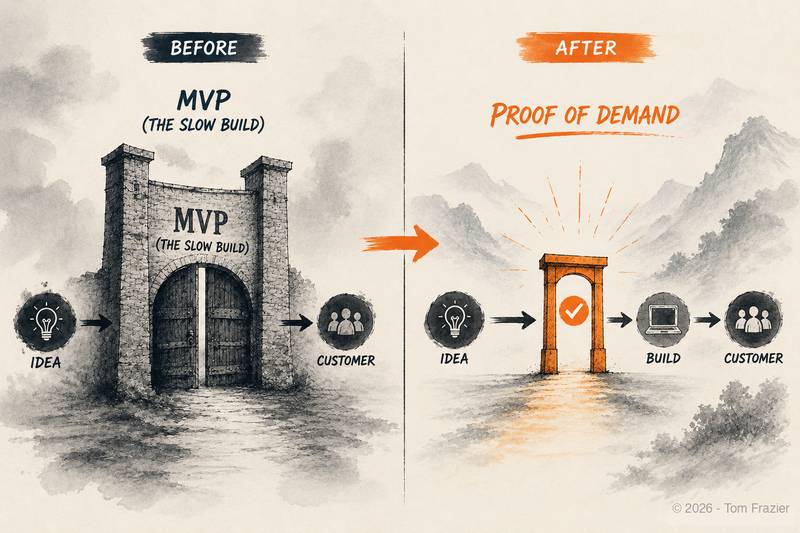
If you build first anyway, the rule doesn't change. Only the deadline does. You don't get a quarter to find out if anyone cares anymore. You get the week after the build weekend, while the energy is still there and before the next idea steals your attention. Run the demand test like it's the most urgent thing on your list. It now is.
The MVP didn't disappear because anyone decided it should. It disappeared because the thing propping it up got pulled out from under it. That's worth sitting with for a second, because it's easy to hear all of this as loss. It isn't.
You can test more ideas, for less money, in less time, than at any point in the history of starting a company. That's not a smaller opportunity. It's a bigger one, handed to more people than ever had access to it before.
It's just different. The old playbook protected you by accident, through sheer slowness. The new one only protects you if you go looking for the proof on purpose. That's a fair trade. Slowness never made anyone's idea good. It just made bad ideas expensive enough that people gave up on them before they noticed. Now they're cheap.
So go find out fast, while it still costs you almost nothing to be wrong.


