


Board Meeting Toolkit Builder: Govern Like the Pros
Most founders treat board meetings like a dentist appointment... necessary, uncomfortable, over fast. A well-run board meeting is one of the highest- leverage hours in your year. The system is the difference.

Phase 5 — Long Term Success
The metrics that actually matter and the governance systems that keep a board meeting from becoming theater.
It is a Serial Entrepreneur's Playbook From Idea To Long-Term Success.
Board Meeting Toolkit
Organize and executing board meetings with efficiency and compliance.
Most founders treat board meetings like a dentist appointment. Necessary, uncomfortable, over as fast as possible. That's a poor state of mind. A well-run board meeting is one of the highest-leverage hours in your company's year. The difference between the two isn't the people in the room. It's the system running the meeting.
Entity Type Changes the Starting Line
Know what the law requires before you build anything. This is not a one-size-fits-all answer.
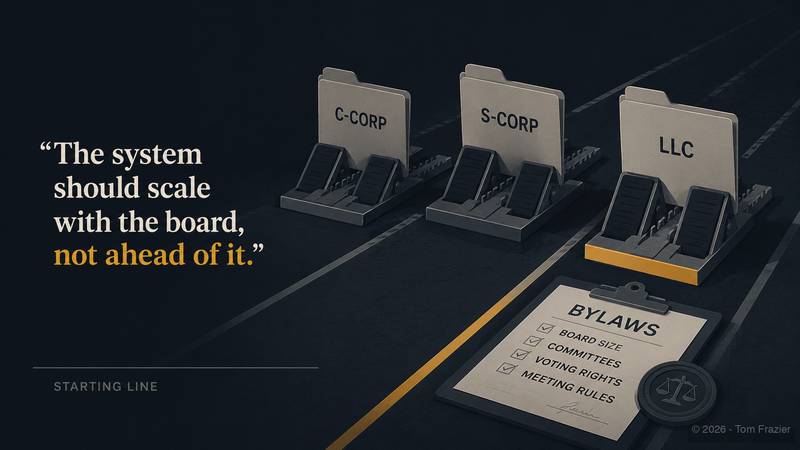
C-Corps carry the heaviest formal load
Every state requires at least one annual board meeting. Directors get elected by shareholders, minutes must be kept for every meeting, and the board carries fiduciary duties of care, loyalty, and good faith. Director count is set in your bylaws, but most states require at least one. Public companies stack audit, compensation, and nominating committees on top of that baseline.
S-Corps run close behind
Annual board and shareholder meetings are mandatory in most states. Minutes are required. Directors are elected by shareholders. Delaware, Kansas, Nevada, North Dakota, and Oklahoma don't legally require board meetings, but skipping them in any state is a governance risk you don't want to carry into a growth round.
One meaningful structural difference: S-Corps allow Written Consent to Action. Directors sign off on decisions without convening, provided the requisite approvals are obtained and the consents are filed with the corporate minutes.
LLCs are the most flexible
Most states don't require LLCs to hold formal board meetings at all. The operating agreement governs. If yours specifies meeting requirements, those are binding. If it doesn't, you should still run meetings, because governance gaps compound, and nobody finds them at a convenient moment.
Board size follows a pattern too. A three-person board at seed moves fast and often handles decisions informally. Five-person boards, the right structure through most of Series B, need deliberate process to avoid gridlock. Beyond seven directors, committees become the only way real work gets done between full meetings. The system should scale with the board, not ahead of it.
Article 3 of this series covered how to design and compose a board that fits your stage. This article picks up where that one ends: you've got the right people in the seats. Here's how to run the room.
 Tom Frazier
The Minimum Compliance Floor
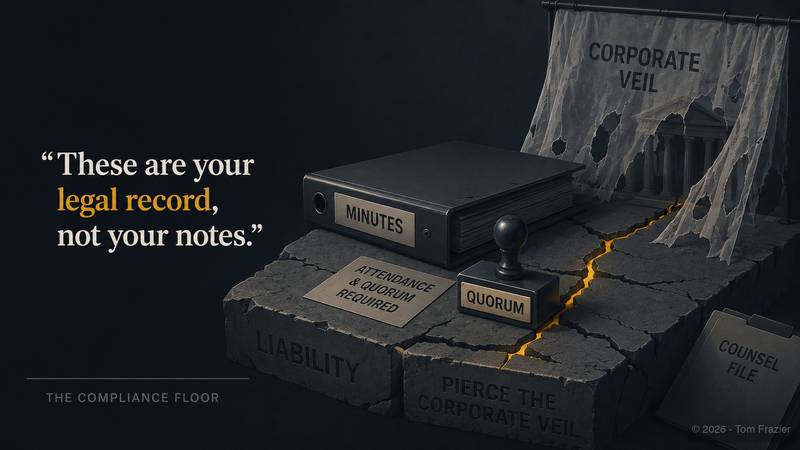
Every organization has a floor of requirements. Miss it, and you create liability, pierce the corporate veil, or hand opposing counsel exactly what they need.
Annual meeting
Most states require at least one per year. Your bylaws should name the date, or the mechanism for scheduling it. If your bylaws require shareholder approval of certain decisions, those decisions cannot be made outside a properly convened meeting. Full stop.
Notice requirements
Your bylaws and state law determine how far in advance directors must be notified. The range runs from 48 hours for special meetings to 60 days for annual meetings, depending on jurisdiction and meeting type. Notice must state the date, time, location, and in many cases the agenda. A calendar invite sent the day before is not notice. It is a problem waiting to surface.
Quorum
A meeting without quorum is not a meeting. No valid decisions. No binding minutes. Quorum is defined in your bylaws, typically a majority of seated directors. Confirm it at the start of every meeting, on the record.
Minutes
These are your legal record, not your notes.
The ABA puts it plainly: minutes are often the first thing a plaintiff's lawyer requests, and what they find can determine whether a legal challenge stays at the company level or reaches board members personally. Minutes capture who attended, whether quorum was present, motions made, votes taken, conflicts disclosed, and actions assigned. Nothing your attorney tells the board goes in there.
Document retention
Minutes, resolutions, consents, and notices must be stored and accessible. Most states require corporate records to be kept indefinitely. A secure, organized document repository is a compliance requirement, not an administrative nicety.
Fiduciary duties
Every director owes duties of care, loyalty, and good faith. Duty of care means being informed before voting. Duty of loyalty means disclosing and stepping back from conflicts. Good faith means no self-dealing. None of this requires a committee or outside counsel. It requires preparation and documentation that shows the board took these duties seriously.
For the full compliance picture at the company level, The Compliance Playbook covers the regulatory and operational layer. This article is about what the board itself must do to stay clean.
 Tom Frazier
What a Good Board Meeting Actually Requires
Compliance is the floor. A productive meeting is the payoff. Most boards operate somewhere between the two, closer to the floor than they should be.
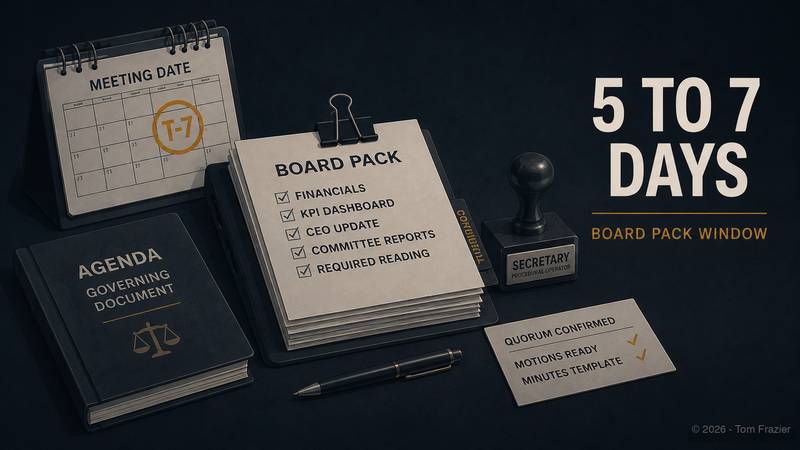
The board pack goes out 5 to 7 days before the meeting
Not 24 hours. Not the morning of. Directors who show up without reading the materials can't fulfill their duty of care. A meeting spent reading slides aloud is not a board meeting. It's a waste of everyone's time and proof that the system isn't working.
The board pack should include: the agenda, prior meeting minutes, a CEO report, financial statements (P&L, balance sheet, and cash flow), department highlights relevant to current decisions, and pre-reading on any items coming to a vote.
The agenda is the governing document for the meeting
Not a suggestion. Items not on the agenda shouldn't become voting items without a motion to amend and a recorded vote approving the addition. Ad hoc votes on unnoticed items are exactly what gets challenged in litigation later.
The corporate secretary is the most underrated person in the room
Their job is not taking notes. It's procedural compliance: confirming quorum, managing the formal record, tracking motions and votes, flagging conflicts of interest, and producing minutes that hold up to scrutiny. The secretary should be organized and neutral. Never the most opinionated person in the room. Never someone with a stake in the decisions being made.
Minutes go out within 5 to 7 days
Not weeks later. Not at the next meeting. Promptly, while memory is fresh and the record still reflects what was actually decided. They get reviewed at the following meeting, corrected if needed, and formally approved. Once approved, they're permanent.
The Board Meeting Toolkit Checklist
This is the operational infrastructure every board needs before a single meeting is called to order. Build it once. Run it indefinitely.
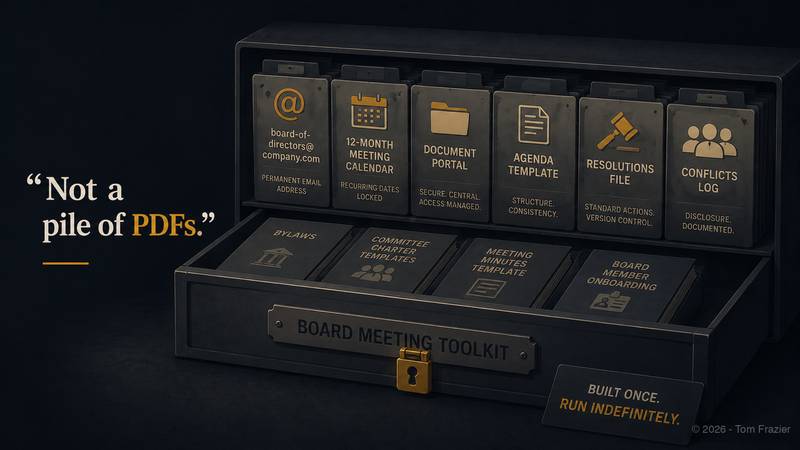
1. A board-of-directors@ email address A dedicated distribution list for all board communication. Every notice, board pack, resolution, and update runs through one address. Nobody gets left off a thread. No "I didn't receive it" at the moment it matters most.
2. A 12-month meeting calendar with notice reminders Set the full year of meeting dates at the first meeting of the fiscal year, or in January if you run on a calendar year. The calendar should include:
- Tentative dates for all regular board meetings (quarterly is standard for most private companies; monthly for early-stage)
- Automated reminders tied to your bylaw notice requirements. If your bylaws require 10 days' notice, reminders fire at T-14, T-10, and T-7
- A board pack circulation reminder at T-7
- A separate reminder for the annual shareholder meeting if applicable
- Placeholder dates for any committee meetings if your governance structure includes them
3. A secure document portal Board materials don't belong in email attachments or a shared folder with unclear permissions. Use a dedicated board portal (BoardVantage, Diligent, or a restricted SharePoint/Drive with explicit access controls and audit logging), or at minimum a restricted folder with version history. Every board pack, set of minutes, resolution, and consent document lives here. When your acquirer's lawyers request records during due diligence, you send them a link. Not a pile of PDFs.
4. A template board agenda
Here is the structure that holds up legally, runs efficiently, and gives the board what it needs to govern:
- Call to Order Chair confirms the meeting is called to order and establishes the record date.
- Confirmation of Quorum Corporate Secretary confirms directors present and absent. Quorum declared on the record.
- Conflict of Interest Disclosures Directors disclose any conflicts related to agenda items before discussion begins.
- Review of Previous Meeting Minutes Board pack distributed T-7. Directors have read in advance.
- Comment Period on Previous Minutes Corrections, additions, or clarifications noted.
- Approval of Previous Minutes Motion, second, vote, recorded.
- CEO Report State of the company, key developments since last meeting, priorities for the period ahead.
- Department Highlights Brief updates from relevant functional leaders. Pre-read in board pack. Discussion only on flagged items.
- Financial Review P&L, balance sheet, cash flow. Presented by CFO or CEO. Questions and discussion.
- Items Requiring a Vote Each item presented individually. Motion, discussion, second, vote, recorded. Any director may abstain or dissent; dissent noted in minutes.
- Executive Session (as needed) Board meets without management present to discuss CEO performance, sensitive matters, or items requiring private deliberation.
- Review of Action Items Prior action items reviewed for status. New action items assigned with owners and deadlines.
- Confirm Next Meeting Date Date confirmed, scheduling conflicts surfaced.
- Adjournment Motion, second, time recorded.

I've put all of this into a beautiful and simple template for you to use for your own board meetings.
5. A resolutions file For decisions made between meetings via written consent, maintain a resolutions file with the signed consents, the date, and the vote count. These are part of the corporate record. Treat them as minutes.
6. A conflicts of interest log A running document tracking disclosed conflicts by director, meeting date, and how they were handled. This is your audit trail for fiduciary duty compliance.
The Counterargument: "We're Too Small for This"
Every early-stage founder gets here eventually. The version I hear most often goes something like this:
We have three directors. We all know each other. Our meetings are a Zoom call and a Slack thread. We don't need all this.
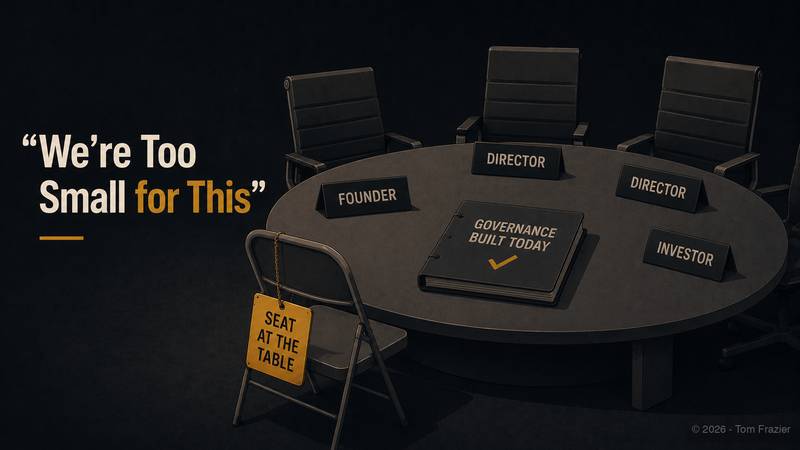
That thinking is exactly what makes governance gaps dangerous. Small companies don't get destroyed by governance failures at exit. They get destroyed during the growth they needed to reach exit. A pierced corporate veil at Series A. A dispute over what was voted on six months ago. A potential acquirer who walks away because the board records are a mess.
The system described here doesn't require an expensive governance platform or an outside administrator. It requires a mailing list, a restricted folder, a calendar, and a template. Setup takes an afternoon.
Governance is also a signal. Article 3 made the point that board composition broadcasts your priorities to investors, potential buyers, and every employee paying attention. The same is true of how you run the room. Investors and acquirers who sit in a well-run board meeting recognize it immediately. So do the ones sitting in a poorly run one. The record you build now is the reputation you carry into every transaction that follows.
What to Do This Week
1. Audit your current board documentation. Pull the minutes from your last three meetings. Check that quorum was confirmed, conflicts were disclosed, motions were recorded with vote counts, and action items were assigned with owners. If any of those elements are missing, document what you know and flag the gaps to your attorney.
2. Set up the board-of-directors@ mailing list and document portal. If neither exists, build them today. A Google Group and a restricted shared drive folder is enough to start. The goal is one auditable channel for all board communication and records.
3. Lock in your 12-month meeting calendar. At your next board meeting, or by written consent before it, set the full year of dates. Build the notice reminders into your calendar system. The first board pack goes out 7 days before the meeting. Not the morning of.
This is the second and final article in Phase 5 — Long Term Success. You can access the AI tool below.
Use the Board Meeting Toolkit Builder GPT to govern link the pros. A free AI tool just for subscribers. ⤵️
This article is why I built the Board Meeting Toolkit Builder GPT. It will help with specialized assistance in organizing and executing board meetings with efficiency and compliance.
Advanced Board Meeting Preparation and Strategy
Common Questions About Board Meeting Toolkit Builder
How can Board Meeting Toolkit Builder ensure our board meetings are compliant with legal and regulatory standards?
Board Meeting Toolkit Builder offers a thorough compliance checklist tailored to your business type and location, ensuring all legal and regulatory requirements are met.
Our board meetings often lack focus. Can Board Meeting Toolkit Builder help streamline our agenda?
Board Meeting Toolkit Builder specializes in crafting structured and focused agendas, highlighting key discussion points and objectives, to ensure meetings are efficient and goal-oriented.
Can Board Meeting Toolkit Builder help with the varying expertise levels among our board members?
Board Meeting Toolkit Builder provides clear, comprehensive materials and guidance tailored to all expertise levels, ensuring every board member is well-prepared and informed.
We struggle with strategic planning in board meetings. How can Board Meeting Toolkit Builder assist?
Board Meeting Toolkit Builder aids in developing strategic meeting content, offering insights and tools for effective long-term planning and decision-making processes.
How can Board Meeting Toolkit Builder handle the unique challenges of our specific industry?
Board Meeting Toolkit Builder adapts its tools and advice to fit the unique needs and challenges of different industries, ensuring relevance and efficacy in board meeting preparation and execution.
This post is for subscribers only
Sign up now to get access to the post.
Already a member? Sign in


