

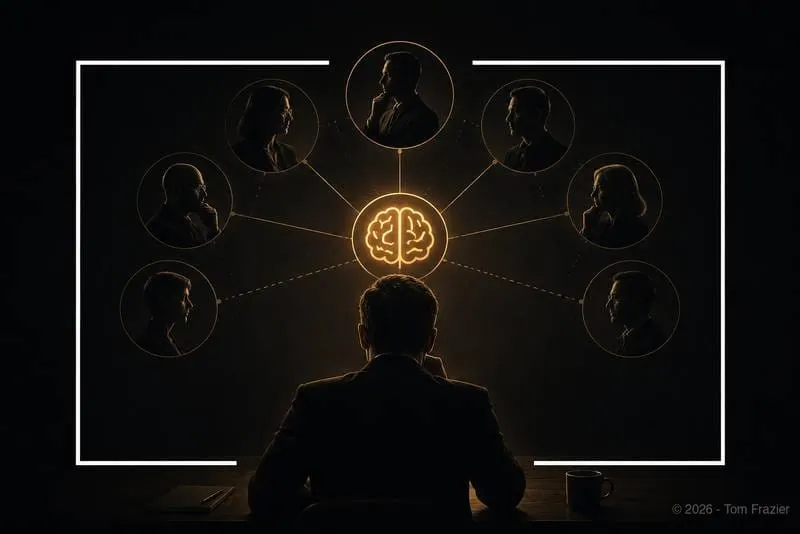
The Business Expert Ensemble: Building Your On-Demand Brain Trust
You don't always have the wrong expert in the room. Sometimes you just don't have enough of them. In the Age of AI, assembling a full panel takes minutes not meetings.

Phase 4 — Operations & Management
How to run a young company, protect your intellectual property, understand key finance aspects and how to pinpoint your ideal customer.
It is a Serial Entrepreneur's Playbook From Idea To Long-Term Success.
Business Expert Ensemble
Build tailored expert panels with specialized knowledge and solutions to address a wide range of business challenges.
The developer was excellent. PHP expert, WordPress fluent, WooCommerce deployed without friction. When the e-commerce platform decision came up, everyone in the room deferred to the person who knew the technology. Six months later, with a non-technical team struggling to maintain a full-stack custom build, I weighed in.
The stack wasn't wrong for the developer. It was wrong for the business. The expert wasn't the problem. The room only had one of them.
One Expert, One Frame
Domain expertise is valuable and narrow by design. A developer who knows PHP thinks in PHP. A financial analyst thinks in unit economics. A marketer thinks in acquisition channels. None of that is a flaw; it's the point of specialization.
The flaw shows up when a decision that spans multiple domains gets handed to the person with the strongest opinion in one of them.

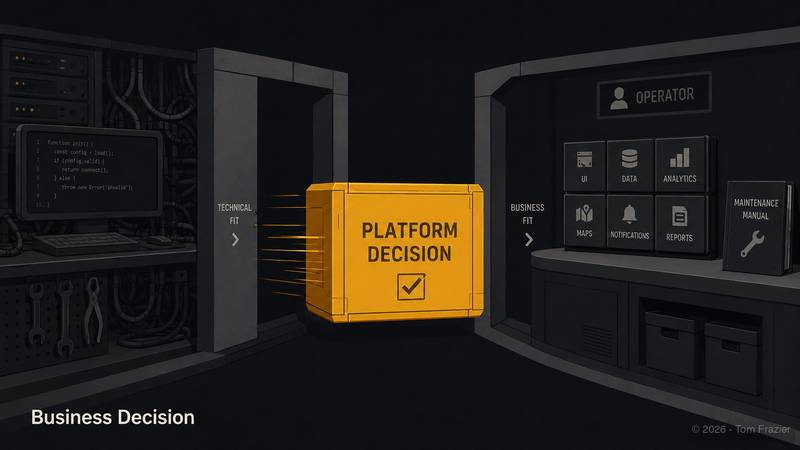
The platform choice that team made wasn't a technology decision. It was a business decision — one that had to account for operator skill level, ecosystem maturity, long-term maintenance burden, and the actual users of the system day-to-day. Shopify won on every one of those dimensions. With over 8,000 apps purpose-built for non-technical operators, its ecosystem practically runs itself. A custom WordPress build, however technically sound, required the developer who built it to be in the loop on everything. When he wasn't, nothing worked.
A developer evaluating through a technical lens never asked those questions, because they weren't his questions to ask. They belonged to someone else who wasn't in the room.
The Ensemble Model
The Business Expert Ensemble is a structured approach to decision-making that assembles the right panel for the problem, rather than defaulting to whoever is closest.
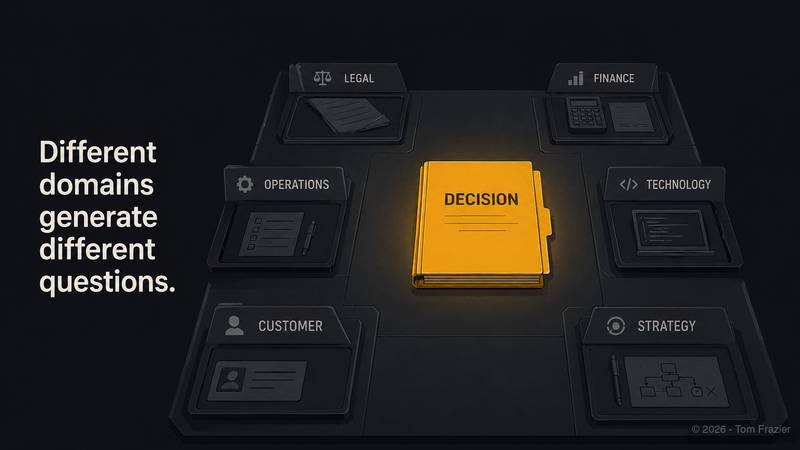
Different domains generate different questions. A legal lens surfaces liability. An operations lens surfaces implementation friction. A financial lens surfaces cost structure and payback period. A customer lens surfaces usability and adoption. A technology lens surfaces what's buildable. Any single lens produces a decision that's optimized for that frame and blind to the others.
The ensemble model makes the frame explicit. You define which domains are relevant to this decision, populate the panel accordingly, and let each perspective interrogate the problem.
What surfaces from that process is almost never what you'd have reached with a single advisor
The collision between mental models is where the real analysis lives.
This is the same instinct behind Mastering Your Business Model: the decisions that look like technology choices, or marketing choices, or hiring choices are usually business model choices in disguise. The panel reveals which.
 Tom Frazier
Historically, assembling this kind of input required a network, a budget, and enough time to schedule it. Most founders defaulted to whichever advisor was easiest to reach, which meant defaulting to the same frame repeatedly.
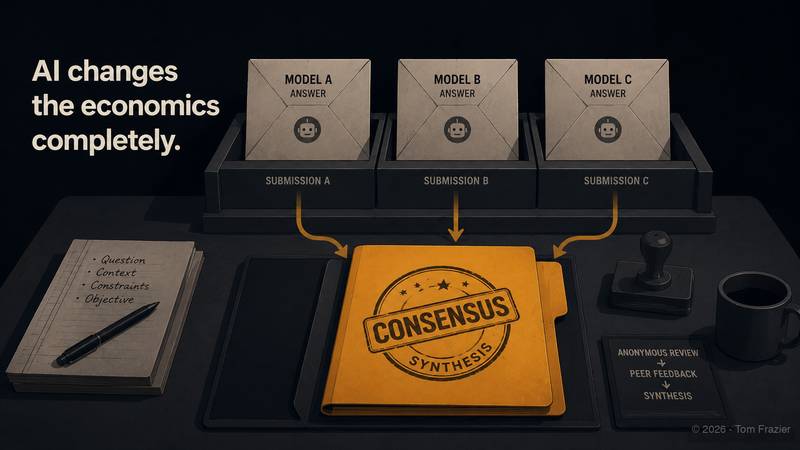
AI changes the economics completely.
AI Puts the Panel at Your Fingertips
You can now prompt a panel of domain experts in minutes: assigning roles, setting context, and asking each to interrogate a decision from their specific vantage point. The Business Expert Ensemble GPT built for this article operationalizes exactly that. Tailored expert panels, assembled on demand, with collaborative pressure-testing on whatever decision you're facing.
Andrej Karpathy's LLM Council — which he describes as a weekend hack and which generated significant attention when it launched in late 2025 — formalizes a similar instinct at the model level. It runs questions through multiple frontier AI models simultaneously, has them anonymously peer-review each other's answers, and synthesizes a consensus response. As a business owner, rather than polling models, you can get domain-specific expert roles within a single conversation using any number of tools now.
For fast consultation, I pair the my custom GPT panel with Wispr Flow. Instead of typing, I speak. I describe the decision, talk through the tradeoffs, and let the panel push back. The whole exchange takes a few minutes. Wispr handles transcription and cleanup so the input is clean and the conversation moves at the speed of thought. Different experts come in and out depending on what the decision requires; it's not a fixed committee. It's a dynamic table.
How I Actually Use It
The panel isn't a replacement for action. It's a replacement for the illusion that you've pressure-tested a decision when you've only talked to one person about it.
My workflow is simple. When a decision carries enough weight, I open the ensemble, describe the problem, and let the relevant experts interrogate it. A pricing decision gets finance, operations, and customer perspectives. A technology choice gets architecture, operations, and a non-technical user perspective. A hiring decision gets leadership, culture, and financial input.
The discipline that matters most is not jumping to automation before you understand what you actually need. I've seen operators spend weeks building agents for processes they hadn't fully mapped. The agents reflect the wrong assumptions and get rebuilt. The ensemble approach is cheaper and faster: consult first, get directional clarity, then consider automating the function once you understand its shape.
If the panel surfaces a clear path forward, you move. If it surfaces genuine conflict that doesn't resolve, that's also useful data:
the decision probably needs more information before it's made.
The Counterargument Worth Taking Seriously
The obvious objection:
"Why assemble a panel when I can just ask one AI?"
It's the same question as asking why you wouldn't put one expert in the room.
A single model asked a direct question produces the best answer that model can generate given its training and your context. That's useful. It's also a single frame. The model optimizes toward the most statistically plausible answer rather than surfacing the uncomfortable dimension you didn't think to ask about.
Designed disagreement works differently. When you assign a legal role the explicit job of finding liability exposure, it finds liability exposure. When you assign a financial role the job of stress-testing unit economics, it stress-tests them. The ensemble structure forces domains into the room; a single query leaves them out by default.
This is the same reason business decisions that look simple on the surface rarely are: the frame you bring to the problem determines what you see in it. The sales architecture decisions that follow a flawed platform choice are a case in point. A panel corrects for the frame before the damage is done.
For decisions that are low-stakes and clear-cut, one query is fine. For the decisions that actually matter, the panel is worth the extra two minutes.
What to Do Next
Pick a decision you're currently sitting on. Not a hypothetical: a real one, with real stakes and competing considerations.
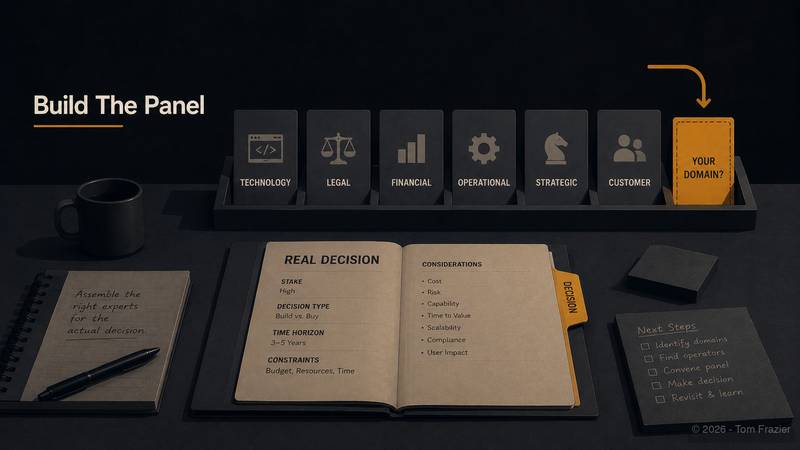
Identify which domains are relevant to it: technology, legal, financial, operational, strategic, customer. Assemble the panel for those domains and run the decision through it. Use Wispr Flow or another voice tool if you want to speak through it instead of type. Let the panel push back.
The pattern that fails isn't a lack of expertise. It's a room with only one kind of it.
You now have access to every kind of expert, assembled in minutes, for any decision you're facing. The only question is whether you build the panel before the decision or after it.
This is the first article in Phase 4 — Operations & Management. You can access the AI tool below.
Use the Business Expert Esemble GPT to build an on-demadn panel of experts. A free AI tool just for subscribers. ⤵️
This article is why I built the Business Expert Ensemble GPT. Access a panel of specialists across various fields, tailored to address your specific business needs.
Add collaborative problem solving to your leadership stack.
Common Questions About Business Expert Ensemble
I'm worried the advice might be too generic.
Business Expert Ensemble delivers customized guidance, ensuring relevance to your specific situation.
How can you cover such a wide range of topics?
Business Expert Ensemble has access to the entire corpus of OpenAI. The magic is focusing that into the spectrum of business areas relevant to your decision.
Is this tool suitable for complex business issues?
Business Expert Ensemble is adept at handling complex problems by leveraging the collective expertise of its panel. If there is an expert in the real world, it can help.
Can it keep up with the latest business trends?
Business Expert Ensemble uses the most up-to-date large language model from OpenAI informed on current trends, ensuring that the advice provided is up-to-date and relevant.
What if I need very specific industry knowledge?
Business Expert Ensemble specializes in creating panels with industry-specific knowledge tailored to your needs.
This post is for subscribers only
Sign up now to get access to the post.
Already a member? Sign in