

IP Guardian: How to Own What You Build Before Someone Else Does
Most founders engage with IP reactively. The question isn't how to protect everything... it's whether IP even applies to your business, and which stance gives you leverage without getting destroyed in court.

Phase 4 — Operations & Management
How to run a young company, protect your intellectual property, understand key finance aspects and how to pinpoint your ideal customer.
It is a Serial Entrepreneur's Playbook From Idea To Long-Term Success.
IP Guardian
Build a holistic approach to IP management, from initial assessment to the implementation of policies & practices for protection and compliance.
Most IP articles skip the first question. They assume IP matters to your business and move straight to what to file, what to register, and how to enforce. That assumption is wrong for a lot of companies — and dangerous for the ones where it's right but the terrain is misunderstood.
I'm a named inventor on a complex software patent. I've applied for others that were denied on conflict grounds. Same for design patents. I've filed trademarks — some cleared, some blocked by prior registrations. I have copyrighted writing and books cataloged in the U.S. Library of Congress. None of that produced a simple set of rules. It produced a framework for deciding when IP actually matters, which type is worth pursuing, and what you're risking when you decide to move.
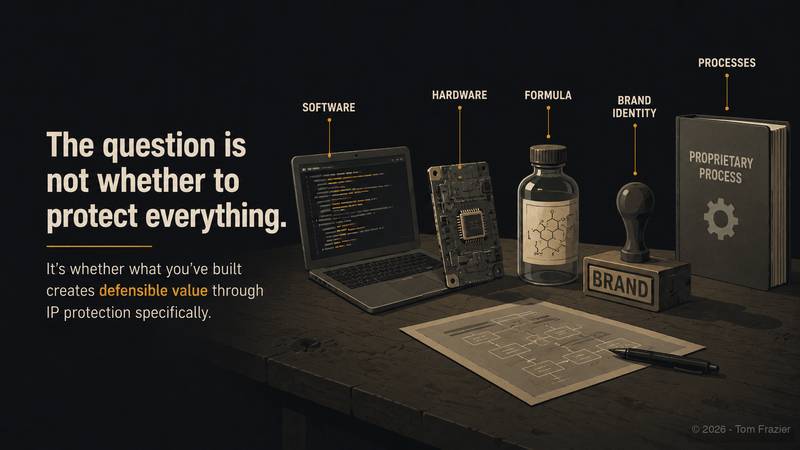
The more useful question isn't how to protect everything. It's whether and how IP belongs in your business strategy at all — and what you're actually risking when you decide to move.The more useful question isn't how to protect everything. It's whether and how IP belongs in your business strategy at all — and what you're actually risking when you decide to move.
First Question: Does IP Even Apply to Your Business?
Not every business has a meaningful IP conversation.
If you're building a coffee shop, your competitive advantage is location, service quality, and brand experience. If you're a reseller or running a dropshipping operation, you're selling other people's goods under other people's IP. Neither business has much reason to engage deeply with intellectual property law.
The calculus shifts the moment you're building something original: software, hardware, formulas, original content, brand identity, proprietary processes. The question is not whether to protect everything. The question is whether what you've built creates defensible value through IP protection specifically.
That distinction matters because IP is expensive, slow, and public. Filing a utility patent costs over $2,000 in USPTO fees alone for a standard entity, more like $15,000 to $25,000 once you include attorney fees and the multi-year prosecution process. (USPTO, 2025) Registration is not protection. It's a legal tool you may or may not need.
Start with a simpler question: what is your actual moat? If the answer is "our proprietary algorithm," IP may be worth pursuing. If the answer is "our team, our network, and our execution speed," spending six figures on patent prosecution may be the wrong use of capital.
The Four Types of IP You Need to Understand
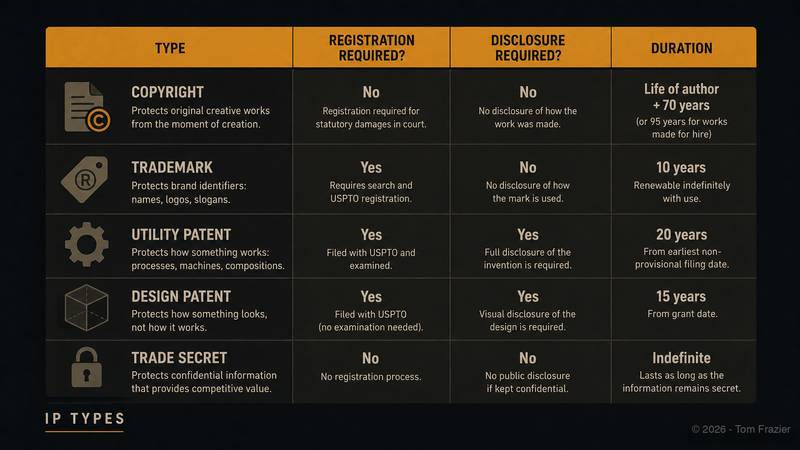
IP law covers four distinct categories. They protect different things, require different processes, and carry different costs. Most founders conflate them.
Copyright
Protects original creative works from the moment of creation. Code, articles, books, marketing materials, and visual designs are all copyrightable. You don't need to register for protection to exist, though registration is required to pursue statutory damages in court. Copyright is automatic and does not require disclosure of how the work was made.
Trademark
Protects brand identifiers: names, logos, slogans. A registered trademark gives you nationwide rights in the U.S. and a legal basis to stop others from using confusingly similar marks in the same category. Filing requires a search first; many rejections happen because someone else got there first. I've had trademarks clear my search only to have them blocked by prior registrations.
Utility patents
Protect how something works: a novel process, machine, manufacture, or composition of matter. I am the named inventor on a complex software patent. The filing creates a public record of the invention, including precisely how it works. That disclosure is not optional. In exchange for exclusivity, you hand your method to the world.
Design patents
Protect how something looks, not how it works. They are faster and cheaper to obtain than utility patents and have become strategically important in consumer hardware and UI design. I have a few design patents underway. Apple's battles over iPhone industrial design are the canonical example.
Trade secrets are a fifth category that requires no registration at all. They protect proprietary information that provides competitive value as long as it remains confidential: algorithms, customer lists, formulas, process know-how. Coca-Cola's formula has never been patented. The downside: no protection against independent discovery or reverse engineering.
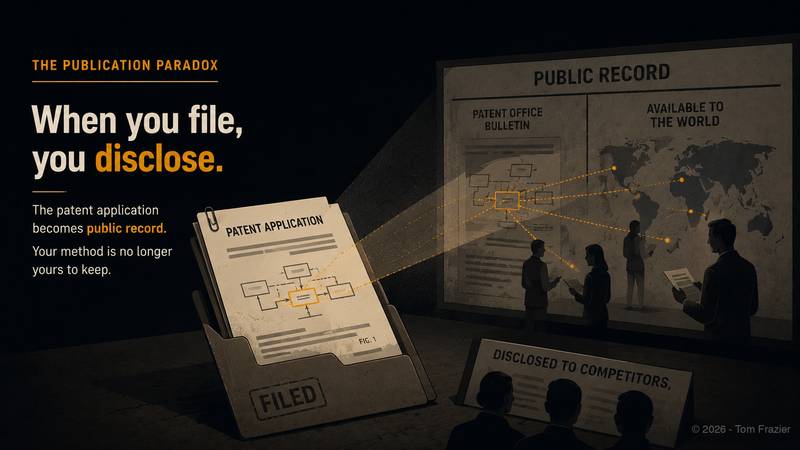
The Publication Paradox
Here is the counterintuitive argument most IP guides won't make: filing a patent can create competition more than it prevents it.
When you file, you disclose.
The patent application becomes public record. Competitors in other jurisdictions, operating in countries where your patent provides no protection, can read your method and replicate it legally. Competitors within the U.S. can design around your claims. Patent trolls, nonpracticing entities that accumulate IP for litigation purposes, can use your disclosure to build claims that circle what you've actually built.
I've applied for patents that were denied because someone else had already filed similar claims. Those denials saved me from spending more time and money on prosecution that would have ended the same way. They also confirmed the space was crowded.
The alternative — keeping an innovation as a trade secret — provides indefinite protection as long as the information doesn't leak. No disclosure. No expiration. No litigation surface for an adversary to attack.
The right choice depends on what you've built and who your realistic threat is. If your main competitor is a well-funded company with its own patent portfolio, going offensive without similar scale is a liability.
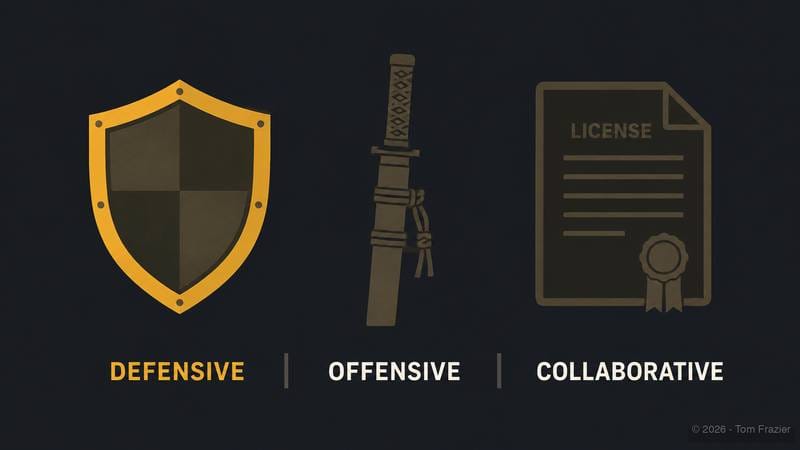
Three Stances: Defensive, Offensive, Collaborative
Once you've decided IP is worth engaging with, you need to pick a stance.
Defensive
Means building a shield. You file patents and register trademarks not to attack anyone, but to ensure you have legal standing to operate and a portfolio of claims to deploy if someone attacks you first. Nest filed patents on its smart thermostat before Honeywell sued in 2012. Those patents became bargaining chips in a case Nest survived. Defensive IP is about protecting your market share and your freedom to execute.
Offensive
Means using IP as a weapon. You file patents with the explicit intent to pursue competitors who enter your space, extract license fees, or slow their roadmap through litigation. This posture makes sense for large companies with deep legal budgets and portfolios broad enough to survive a counterclaim. For most startups, it is a dangerous stance.
Collaborative
Means licensing your IP to others in exchange for reciprocal benefits: revenue sharing, access to their IP portfolio, expanded distribution, or inclusion in an industry standard. IBM has used cross-licensing agreements this way for decades, trading portfolio access across competitors to avoid litigation and unlock market entry.
Bonus: Standard Essential Patents
Standard Essential Patents are a fourth category that sits outside the defensive/offensive/collaborative model. More accurately, they start collaborative and become something far more powerful.
A SEP is a patent covering technology that is essential to implement an industry standard: 5G, WiFi, Bluetooth, USB-C, video codecs like H.264. If you hold a SEP, everyone building a product that implements that standard needs a license from you. The leverage is structural.
The trade-off: when you contribute IP to a standards body like ETSI or the IEEE, you commit to licensing it on FRAND terms, meaning Fair, Reasonable, and Non-Discriminatory. You cannot refuse to license. You cannot charge one party dramatically more than another. What you can do is negotiate royalty rates, build licensing revenue at scale, and use your SEP portfolio as a seat at the table in every subsequent revision of that standard.
Qualcomm built its business on this model. Its 5G and LTE patents are embedded in nearly every wireless device manufactured — and every manufacturer pays for the privilege.
For most early-stage founders, SEPs are not an immediate concern. But if you are building in a space that runs on technical standards — wireless communications, networking protocols, audio/video compression, interface specifications — the possibility of contributing patented innovation to a standard is worth understanding before you file. What starts as a utility patent can, under the right conditions, become essential infrastructure that an entire industry is obligated to license.
That's a different kind of moat.
Most founders in early stages should default to defensive. Going offensive requires the kind of legal resources and portfolio depth that makes a counterclaim survivable. Most early-stage companies have neither.
The Counterclaim Problem
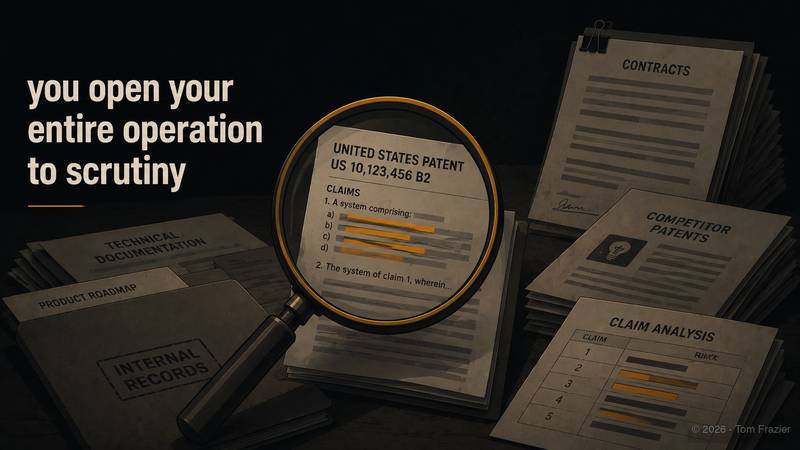
When you assert a patent against a company with its own IP portfolio, you open your entire operation to scrutiny.
The defender's attorneys will review everything you've built, everything you've shipped, every contract you've signed, and every piece of IP you hold. If they can argue you've infringed any of their claims, they will. The litigation expands. The costs compound. The timeline stretches.
Going on offense without scale is how small companies fund their competitors' legal teams.
This dynamic is well-documented. According to Holland & Knight's analysis of emerging technology IP, companies with concentrated portfolios increasingly face an environment where patents function as "litigation currency" rather than genuine innovation protection. The problem is particularly acute for startups, whose portfolios are rarely broad enough to survive an aggressive counterassault.
The lesson is not that you should avoid IP. It is that you need to understand the terrain before you move into it offensively.
IP Transactions: What IP Can Do Commercially
Beyond defense and offense, IP has commercial value many founders overlook. These transactions — sometimes called IPX — include:
Licensing
Granting another party the right to use your IP in exchange for royalties or fees. A software patent licensed to a non-competing company in an adjacent industry generates revenue with no operational overhead.
Cross-licensing
Exchanging access to each other's IP portfolios. This is how large tech companies negotiate peace: you can use mine, I can use yours, neither party litigates.
IP as a valuation asset
Acquirers often examine IP portfolios during due diligence. A well-structured set of patents, trademarks, and registered copyrights signals that the company has created defensible, transferable value. IP portfolios can be the deciding factor in acquisition pricing.
Revenue-sharing arrangements
In some collaborative agreements, licensing is structured around downstream revenue rather than fixed fees. This aligns the licensor's incentive with the licensee's success and is common in technology standards bodies.
The implication is that IP doesn't have to be a pure cost center. If you've built something genuinely novel, it may have value to parties who are not your direct competitors.
The Assessment Framework
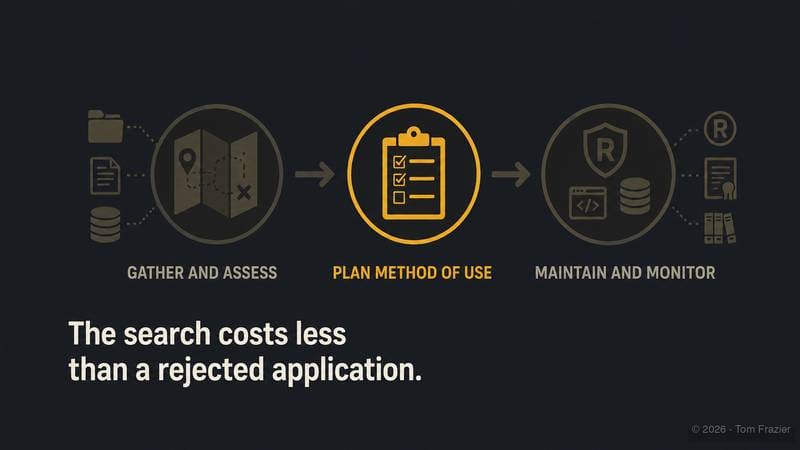
The practical work is threefold.
Gather and assess.
Map your business and identify what you've actually created that could qualify for protection: code, brand assets, novel processes, published content, unique visual designs. Run basic searches against existing registrations and patent databases to check for conflicts before you invest in an application. I've applied for trademarks without doing this first. The search costs less than a rejected application.
Plan your method of use.
Match each potential IP asset to a stance. Not every asset warrants the same approach. A brand name warrants trademark registration as a defensive measure. A novel algorithm may be better protected as a trade secret than as a disclosed patent. A unique hardware design may justify a design patent if knockoffs are a realistic competitive threat. The goal is alignment between the asset, the threat model, and the cost of protection.
Maintain and monitor.
IP protection erodes without active management.
Trademarks require renewal and enforcement; if you don't challenge infringers, you risk losing distinctiveness over time. Patents require maintenance fees paid to the USPTO on a fixed schedule. Trade secrets require consistent operational security. A leaked process loses protection immediately and permanently. The compliance layer here connects to how you should be thinking about regulatory risk across the business generally. The Compliance Playbook covers that broader risk framework.
As you scale, competitive intelligence on competitors' patent filings becomes part of your ongoing strategic work. Knowing what's being filed around you shapes both your product roadmap and your IP strategy. Competition Crusher covers how to build that intelligence function.
What This Actually Requires
Most founders engage with IP reactively: someone else files a claim, a trademark conflict surfaces during due diligence, a competitor copies a product design. That is the wrong sequence.
The right sequence is to assess early, pick your stance deliberately, and let the strategy drive the filings.
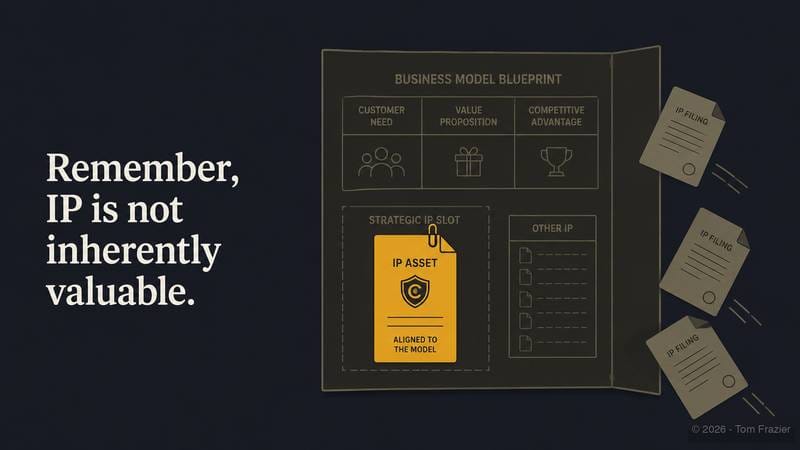
IP is not inherently valuable. IP that aligns with your business model, protects the thing that actually creates your competitive advantage, and is structured for the stance you intend to take is valuable. The rest is overhead.
You don't have to protect everything.
You have to protect the right things in the right way at the right time. Start with that question and work backward. The filing decisions get much clearer from there.
This is the second article in Phase 4 — Operations & Management. You can access the AI tool below.
Use the IP Guardian GPT to define and manage your IP portfolio. A free AI tool just for subscribers. ⤵️
This article is why I built the IP Guardian GPT. It will help you craft customized intellectual property strategies, focusing on maximizing IP value & mitigating risks
Secure Your Intellectual Property Innovations
Common Questions About IP Guardian
Isn't IP management too complex for small businesses?
It simplifies complex IP processes, making them accessible and manageable for businesses of all sizes.
How can I trust it to keep up with evolving IP laws?
It constantly updates its knowledge base with the latest IP laws and practices to provide current and reliable guidance.
Is it relevant for international IP issues?
While specializing in U.S. IP laws, it provides guidance that can be foundational for understanding and navigating international IP matters.
Can it help if I'm not sure what kind of IP protection I need?
It offers expert analysis to identify the specific types of IP protection suitable for your unique business needs.
Do I need legal expertise to work with it?
It presents IP information in an accessible manner, ensuring understanding regardless of your legal background.
This post is for subscribers only
Sign up now to get access to the post.
Already a member? Sign in
