


The Compliance Playbook: Comply Without Complexity
Compliance isn't where founders want to spend their energy but it's where many founders lose their companies. Here's how to build a compliance strategy before you need one, not after.

Phase 2 — Startup & Launch
How to start strong, find your voice, get press, stay compliant, and not blow the 180-day window most founders squander.
It is a Serial Entrepreneur's Playbook From Idea To Long-Term Success.
Business Rule Reckoning
Navigate the complex landscape of U.S. regulatory compliance, helping your business adheres to relevant federal and state regulations effectively.
A Note Before You Read
This article is educational content for founders and operators in the United States. It covers general frameworks, common requirements, and useful resources but is not legal, regulatory, or professional advice. Requirements vary significantly by business type, location, and circumstance. For anything consequential, get qualified legal or compliance counsel. This is the map; a professional can help you navigate your specific terrain.
A restaurant in Austin opened strong — good product, great location, early buzz. Nine months in, a routine inspection revealed they'd been operating without a Certificate of Occupancy for a commercial kitchen. Not a gray area. Not a paperwork delay. A full shutdown while they remediated, re-inspected, and re-applied. Three weeks of zero revenue. They lost two key employees who couldn't wait it out.
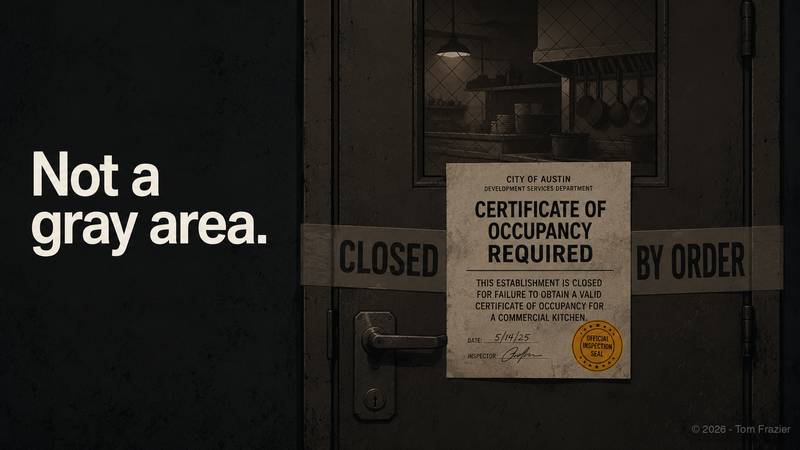
The owner knew compliance existed. He just assumed someone else had handled it.
That assumption kills more companies than bad products do. Compliance failures don't come with warning shots. They come as enforcement actions, injunctions, license revocations, or fines that arrive at exactly the wrong moment — when cash is tight and momentum is everything.
The right move isn't to hire a compliance officer on day one. It's to build a compliance map before you spend a dollar on marketing.
Start with Your Business Model
Compliance requirements aren't universal. They're business model specific. The regulatory footprint for a SaaS company looks nothing like the footprint for a local services business, and the licensing requirements for a franchise are entirely different from those of a marketplace platform.
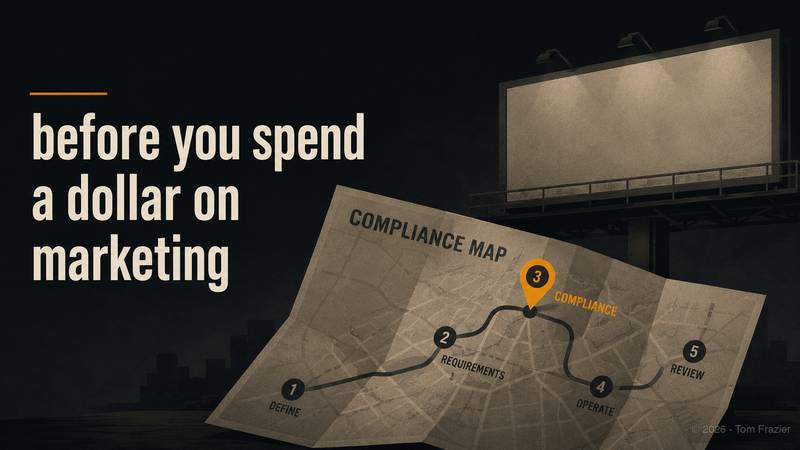
Before you can map your compliance obligations, you need to map your business model. Not loosely, specifically. The model you operate under determines which federal agencies have jurisdiction over you, which state-level regulators care about your operations, which certifications are required versus optional, and which insurance categories are non-negotiable.

Use it before you read the rest of this article. Identify your primary model. The methodology in that row is where you start.
No email address required.
Use the reference guide to identify your primary model. Most businesses map cleanly to one. Some straddle two. If you're a SaaS company with a freemium tier, you operate under both the SaaS and Freemium model frameworks — which compounds your compliance requirements in specific ways. Identify that before you go further.
The Compliance Stack
Compliance isn't a single checklist. It's four distinct layers, each with its own logic and its own failure mode.
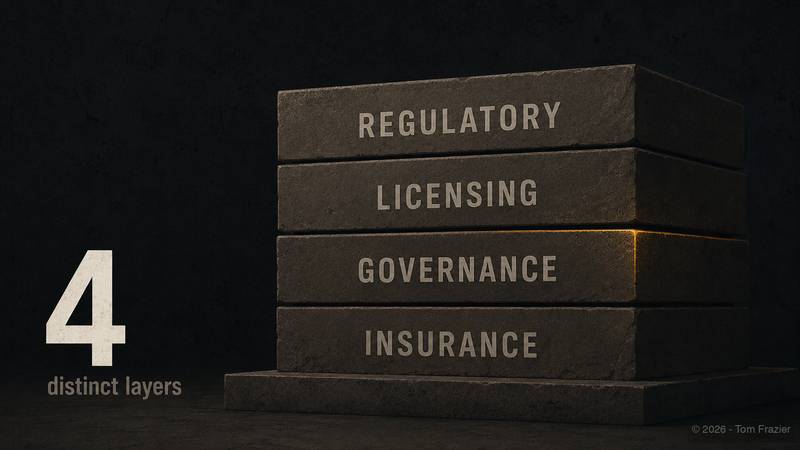
- Layer 1 — Regulatory
- Layer 2 — Certifications & Licensing
- Layer 3 — Industry Governance
- Layer 4 — Risk Transfer (Insurance & Permits)
Miss any one layer and the other three don't protect you. A company that's fully licensed but uninsured for the right categories is still exposed. A company with the right insurance but operating without the required industry body certification can be barred from contracting with the customers it's built its pipeline around. Work through all four.
Layer 1: Regulatory
U.S. regulatory compliance operates at two levels simultaneously — federal and state — and both have teeth.
At the federal level, the Code of Federal Regulations (CFR) is the master document. It contains the rules across all federal agencies and is searchable by topic and industry classification. The RegData platform from QuantGov gives you a quantitative view of regulatory burden by industry, which is useful for benchmarking against comparable businesses.
At the state level, requirements vary significantly. The FRASE Index (Federal Regulation and State Enterprise) maps the intersection of federal regulations with state-level economic activity. It is useful for understanding how federal rules apply to your specific location. State-level regulatory databases are maintained by each state's secretary of state office; most now have searchable online portals.
Minimum requirements
For most U.S. businesses include:
- Federal Employer Identification Number (EIN) via IRS.gov
- State tax registration (sales tax if you sell physical goods or taxable services; employer withholding if you have W-2 employees)
- Federal and state employment law compliance if you hire including Fair Labor Standards Act (FLSA), OSHA, and applicable state equivalents
- Data privacy compliance if you handle consumer data. CCPA applies if you touch California consumers; several states have now passed similar frameworks (IAPP State Privacy Legislation Tracker)
Recommended requirements
Most early-stage companies defer these until too late:
- ADA digital compliance for your website if you're selling to consumers (ADA.gov)
- FTC advertising and marketing disclosure rules if you run affiliate or influencer programs (FTC Disclosure Guidance)
- COPPA compliance if any of your users could be under 13
- Export control regulations (EAR/ITAR) if your software or service has any international dimension
Industry-specific overlays
Financial services businesses face SEC, FINRA, and state money transmitter licensing. Healthcare-adjacent companies face HIPAA. Food businesses face FDA and local health department jurisdiction on top of standard business licensing. If your business model sits in a regulated vertical, add those regulatory frameworks on top of the baseline above.
The SBA's Business Guide is a reasonable starting point for federal requirements. Your state's Secretary of State and Department of Revenue websites are the authoritative sources for state-level requirements.
Layer 2: Certifications & Licensing
Certifications and licenses are not the same thing. A license grants permission to operate. A certification attests to a standard of competence or quality. Both matter; conflating them creates gaps.
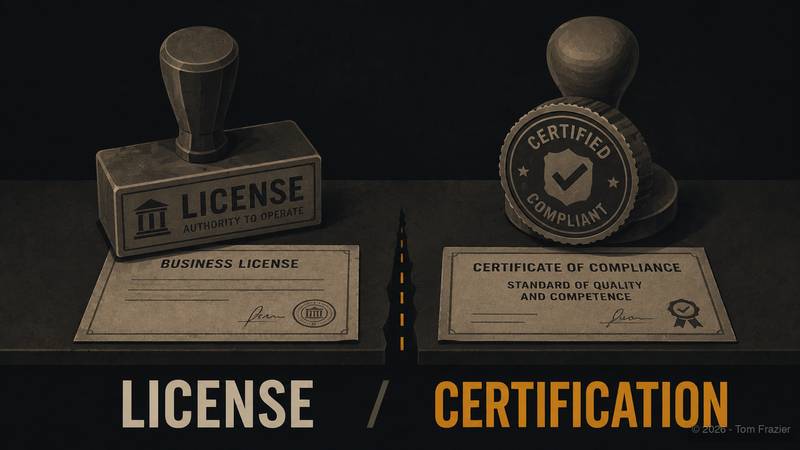
Licenses
Licenses are issued by government agencies and are typically mandatory. Operating without the required license isn't a risk — it's an active violation. The most common categories:
Business License
Nearly every jurisdiction requires a general business license or business registration. Check your city and county requirements in addition to state requirements — they stack, not substitute.
Professional Licenses
If your business involves a regulated profession — law, medicine, accounting, real estate, contracting, financial advising — individual practitioners must hold licenses issued by the relevant state board. The NCSL Professional Licensing Database tracks state-level occupational licensing requirements by profession.
Sector-specific Licenses
Food service requires health permits. Alcohol requires state liquor authority licensing. Firearms dealers require a Federal Firearms License (FFL). Cannabis businesses face a multi-layered state-by-state licensing structure. The SBA License & Permit Finder is a reasonable starting point by industry and state.
Certifications
Certifications are sometimes required by contract or customer category rather than law. Government contractors face specific certification requirements. The SAM.gov System for Award Management is the registration portal for federal contracting.
Industry-standard certifications
While not legally required, they can be commercially required if your target customers demand them. ISO 27001 for information security, SOC 2 for SaaS companies handling customer data, and PCI DSS for businesses processing card payments are the most common examples. Getting these after you've built your systems is significantly more expensive than designing for them from the start.
Layer 3: Industry Governance
Industry bodies set standards, enforce codes of conduct, and — in many sectors — create de facto licensing requirements that operate independently of government regulation. Ignoring them doesn't mean they don't apply to you. It means you find out they apply when a customer asks for proof of membership or compliance, and you have to say no.
Here are a few relevant bodies by business model:
Technology / SaaS
- CompTIA — technology industry certifications and advocacy
- Cloud Security Alliance (CSA) — cloud security standards; STAR certification is commonly required by enterprise customers
Financial Services
- FINRA — mandatory for broker-dealers; the self-regulatory body for U.S. securities markets
- CFA Institute — professional standards for investment management
Healthcare
Construction / Contracting
- Associated General Contractors (AGC) — industry standards and best practices
- National Electrical Contractors Association (NECA) — electrical contracting standards
Food & Beverage
- National Restaurant Association — compliance resources and advocacy; ServSafe certification widely required for food handlers
- FDA Food Safety Modernization Act (FSMA) resources
eCommerce / Retail
- National Retail Federation (NRF)
- PCI Security Standards Council — mandatory for businesses processing card payments
For any industry body relevant to your model: check whether membership is expected by customers in your target segment, whether any certifications require membership, and whether the body has a code of conduct that creates obligations for your business beyond government regulation.
Layer 4: Risk Transfer — Insurance & Permits
Insurance and permits are how you quantify and transfer risk you can't eliminate. Treating them as optional is how companies learn, expensively, that they aren't.
Insurance
Minimum insurance requirements for most U.S. businesses:
- General Liability (GL): Covers third-party bodily injury and property damage claims. $1M per occurrence / $2M aggregate is the standard minimum; most commercial leases and many contracts require proof of GL before you can operate.
- Workers' Compensation: Legally required in virtually every state if you have W-2 employees. Requirements vary by state and headcount. Check your state's workers' comp authority.
- Commercial Auto: Required if any vehicle is used for business purposes, including deliveries, client visits, or employee transportation. Personal auto policies exclude business use.
Recommended insurance based on business model:
- Professional Liability (Errors & Omissions / E&O): Essential for consulting, SaaS, financial services, legal, medical, and any business where a service failure creates financial or physical harm to a client. Not optional if you're selling professional services.
- Cyber Liability: Any business handling customer data should carry this. Breaches are expensive; lawsuits after breaches are more expensive. The average SMB data breach cost exceeded $3.3M in 2023 (IBM Cost of a Data Breach Report).
- Directors & Officers (D&O): Necessary once you take outside investment or form a board. Protects individual directors against personal liability.
- Product Liability: Required for any business manufacturing or selling physical products.
- Business Interruption: Covers lost income when a covered event forces you to stop operating. The Austin restaurant story above is a business interruption event — except compliance failures are typically excluded. Read policies carefully.
Compare quotes across carriers at The Hartford, Hiscox, or Simply Business. For industry-specific coverage, broker placement is almost always worth the cost.
Permits
Permits operate at the state and local level and are among the most commonly overlooked compliance requirements. They're not national, they're not searchable in a single database, and they vary dramatically by municipality.
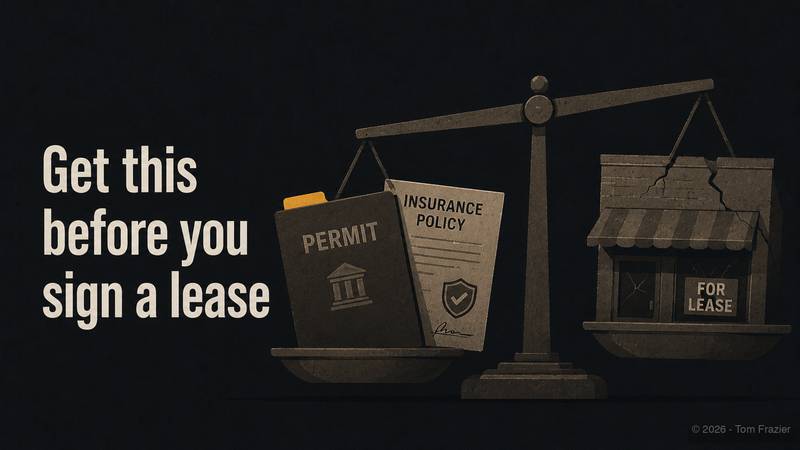
Minimum permits for most businesses with a physical footprint:
- Certificate of Occupancy (CO): Required for any commercial space. Confirms the building is approved for your type of use. Get this before you sign a lease, not after.
- Zoning Approval: Even in jurisdictions that don't require a formal permit, your intended use must conform to local zoning. Municode maintains a database of local codes and ordinances.
- Health and Safety Permits: Required for food service, childcare, and healthcare businesses.
- Sign Permits: Required in most municipalities before you install exterior signage.
- Home Occupation Permit: If you're operating from a home office, most jurisdictions require this. It's inexpensive and routinely skipped. It becomes relevant when you file taxes and deduct the home office.
Recommended permits by model:
- Fire Suppression / Alarm Inspection Permit: Required in many jurisdictions before commercial operations begin; often tied to the CO process but managed separately.
- Building Permits: Any renovation or buildout of a commercial space requires permits pulled before work begins, not after. Unpermitted work is a liability at sale, during inspection, and in insurance claims.
- Special Event Permits: If your business involves events, pop-ups, or temporary retail, check local permit requirements before you book the venue.
Your city or county's business development office is a great source you can find on usa.gov. Most now have online portals that let you filter by business type. Use them.
The Objection Worth Addressing
The most common response to this framework: "I'll deal with compliance when it becomes a real issue."
Here's the math that argument ignores. The cost of proactive compliance — understanding what you need, setting up the right structures, building a compliance calendar — runs from a few hundred to a few thousand dollars for most early-stage businesses. The cost of reactive compliance, once a violation has been issued, starts at fines and legal fees and scales rapidly to injunctions, license revocations, and operational shutdowns.
More important: compliance failures compound.
A business that fails a state licensing audit and loses its ability to operate in a given state doesn't just lose one revenue stream. It loses the credibility that comes with a clean compliance record which matters to investors, acquirers, enterprise customers, and partners.
Proactive compliance isn't overhead. It's the foundation that makes everything else you build defensible.
Your Compliance Calendar
Compliance is an operating cadence not a one-time checklist. Build it into your operational rhythm from the start.
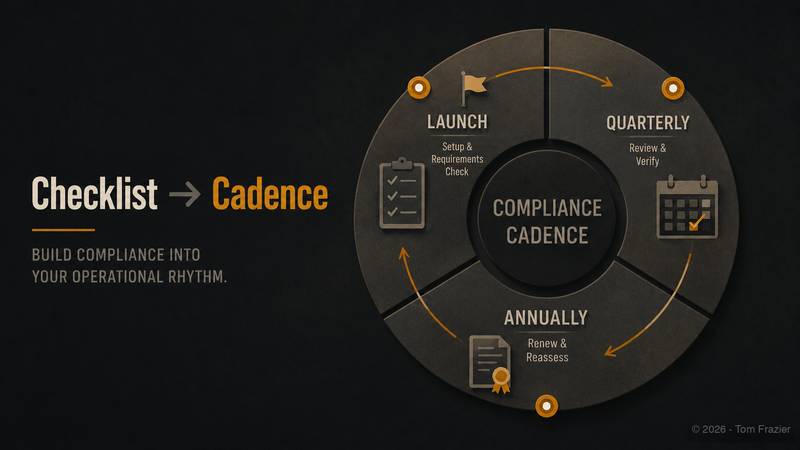
At launch
- Register your business entity (LLC, C-Corp, S-Corp) with your state
- Obtain your EIN from the IRS
- Register for state tax obligations
- Identify and apply for all required licenses and permits
- Bind minimum required insurance
- Map your industry body obligations
Quarterly
- Review any regulatory updates in your sector
- Verify that all licenses and permits are current
- Confirm insurance coverage still matches your operations (revenue, headcount, and products/services change; coverage should change with them)
Annually
- Renew all licenses and permits on required schedules
- Conduct an internal compliance audit against the four layers above
- Review contract templates for regulatory changes (especially data privacy, which is evolving fastest)
The SBA's Compliance Guide provides a baseline checklist. Industry-specific compliance calendars exist for most regulated verticals through their relevant trade associations.
In Summary
Compliance isn't where you build competitive advantage. It is, however, where you can lose everything you've built. The founders who treat it as a strategic discipline operate from a position that competitors who skip this step can never occupy.
Start with your model. Build the map. Run the calendar.
This is the fifth and final article in Phase 2 — Startup & Launch. You can access the AI tool below.
Comply Without Complexity. A free AI tool just for subscribers. ⤵️
This article is why I built the Business Rule Reckoning GPT. It helps founders navigate the complex landscape of U.S. regulatory compliance, helping your business adheres to relevant federal and state regulations effectively.
Accurately map your business to an established model, enabling a more streamlined approach to understanding and fulfilling specific industry requirements.
Common Questions About Business Rule Reckoning
What if my business's compliance needs are too complex?
Business Rule Reckoning aims to help with complex compliance landscapes explaining tailored solutions that may align with specific regulatory frameworks.
How do I know if my business model fits into standard categories?
Business Rule Reckoning can analyze many business models and accurately map them to established categories, providing clarity and focused strategic guidance.
I'm worried about the complexity of launching a business. Can Launch Lander simplify this process?
Launch Lander simplifies the business launch process by providing structured checklists and timelines. It offers a step-by-step approach, making complex tasks more manageable and helping to organize and prioritize efforts effectively.
Is it challenging to identify all the certifications and licenses I need?
Using Business Rule Reckoning can simplify the identification of necessary certifications and licenses, turning a potentially overwhelming task into a clear, actionable checklist.
Can a comprehensive compliance strategy be too complicated to implement?
Business Rule Reckoning strategies can be crafted to be comprehensive yet practical, ensuring they are not only thorough but also implementable and aligned with business operations.
This post is for subscribers only
Sign up now to get access to the post.
Already a member? Sign in