


Ideal Customer Conversation: What Your Best Customer Would Tell You If You Asked
42% of startups fail because they built for a customer who didn't exist. Most had an ICP. None talked to it. Here's why that conversation was hard and why AI just made the excuse obsolete.

Phase 4 — Operations & Management
How to run a young company, protect your intellectual property, understand key finance aspects and how to pinpoint your ideal customer.
It is a Serial Entrepreneur's Playbook From Idea To Long-Term Success.
Ideal Customer Conversation
Use AI to start asking your ideal customer profile questions to improve your product/service or anything else you'd want to know.
42% of startups fail because they built for a customer who didn't exist or wouldn't buy. Most of them had an ICP. They just never talked to it. The conversation that would have changed everything was one they kept deciding not to have.
AI just made that decision impossible to justify.
The Founder Who Knew Everything About Their Customer — Except Them
Here is the pattern. A founder has an idea. They write down who it's for. The slide says something like: "Our ideal customer is a 35–45 year old working parent, household income over $80K, values convenience, tech-comfortable."
They believe it. They build it. They launch it.
Then the market does what markets do.
Most founders skip ICP conversations not because they don't know they should have them. They skip them because they're afraid of what they'll hear. A founder who has never sold professionally (and most haven't) experiences customer rejection as a verdict on the idea, not as information. So they delay. They build instead of asking. They refine the product instead of testing the premise.
I've run what I call man-on-the-street conversations across dozens of companies. The goal was never to confirm I was right.
The goal was to find out what was wrong. To rule things out.
The value is in the invalidation, not the confirmation. Every assumption I killed in conversation was an assumption that wouldn't kill the company later.
Most founders never run that conversation. The fear is real. The cost of skipping it is higher.
What an ICP Really Is (vs. What Most Founders Build)
An ICP built from assumptions is a persona. It looks like research. It isn't.
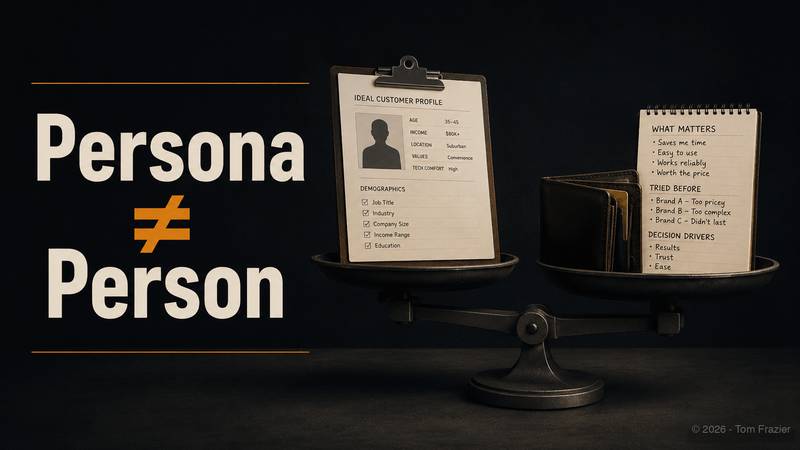
Demographics tell you who someone is on paper. Psychographics tell you how they actually decide: what they fear, what they've already tried, what would make them say yes today and no tomorrow. A demographic profile gets assembled in an afternoon without leaving your desk. A psychographic profile requires conversation with the actual human being you're trying to serve.
Companies that nail ICP execution are 67% more likely to exceed sales targets than those that don't. The gap between those two outcomes is not product quality. It's not pricing. It's whether someone talked to the customer before betting the company on who that customer was.
The right frame is this: your ICP is a hypothesis. Not a deliverable. Not a slide. A hypothesis that needs to be tested, broken, and rebuilt until the version you're holding reflects a real person who would actually open their wallet. Deliverables get filed. Hypotheses get tested. That distinction matters more than most founders realize until it's too late.
Why AI Is Structurally Aligned to This Problem
Large language models are trained on human language at a scale no individual researcher could replicate.
That means when you prompt an AI to behave like a 42-year-old soccer mom who coaches her daughter's team on weekends, works full-time in healthcare administration, and has tried and abandoned two meal-kit subscriptions... it draws on genuine patterns of how people in that situation think, speak, and decide.
It is not a perfect research panel. It does not replace talking to real humans at scale. But it is structurally aligned to human psychology in a way that produces directionally correct feedback. And directionally correct feedback in ten minutes is a different category of tool than the comfortable silence of never asking.
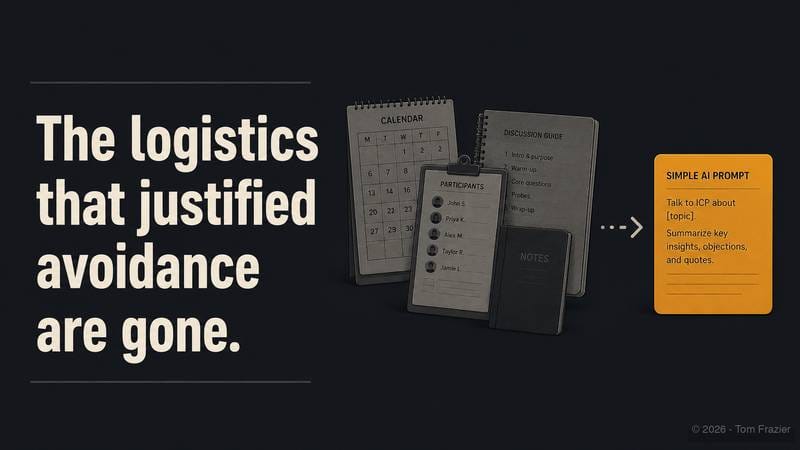
The logistics that justified avoidance are gone. What's left is the choice.
How to Run the Conversation
Three moves. Do them in order.
Define the ICP with specificity
Don't describe a demographic. Describe a person.
- Give them a context,
- a set of behaviors,
- a name,
- a specific problem they're actively working around, and
- a recent experience that shapes how they evaluate solutions.
The more specific the input, the more useful what comes back.
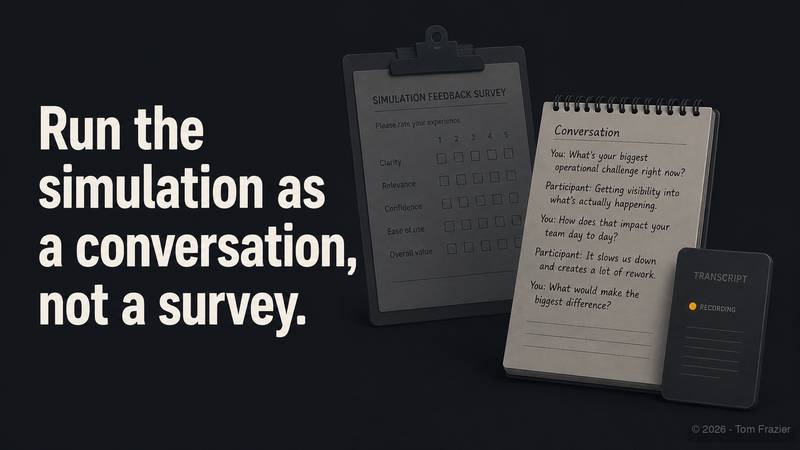
Run the simulation as a conversation, not a survey
Ask open questions.
- Ask what they've tried before.
- Ask what they'd need to see to say yes.
- Ask who else in their life would have an opinion.
- Then ask the hard one: "Is this something you'd actually pay for, and what would change your mind?"
A good AI-simulated ICP conversation feels like a real customer interview because you're treating it like one.
Interrogate the result
Two paths open when the simulated customer pushes back.
- Stop the interview and ask who a better ICP would be. Let the AI redirect you toward a customer profile that would respond more positively to the core offering.
- Ask how the idea itself would need to change to serve this customer. Both moves are productive. Both beat walking away without asking.
The point is not to get a green light from an AI. The point is to surface the assumptions worth stress-testing before the market finds them for you.
What You Do With What You Learn
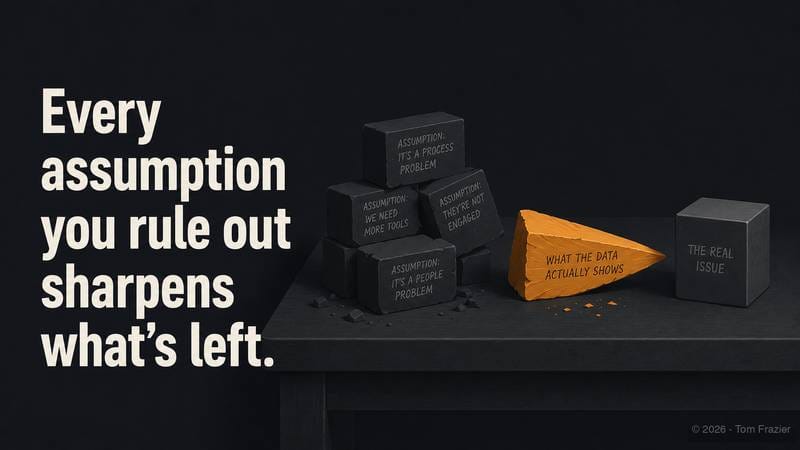
The most valuable output of an ICP conversation is not confirmation. It's elimination.
Every assumption you rule out sharpens what's left. The conversations I valued most across years of man-on-the-street interviews were the ones where I walked away having confirmed something didn't work. That's not failure. That's the job. You are not trying to prove your idea is good. You are trying to find out which version of your idea is real. And the faster you find the wrong versions, the more resources you have left to build the right one.
What you learn feeds directly into everything downstream. The brand you build should reflect what the real customer values, not what you assumed they'd value. The sales motion you adopt should match how the real customer actually decides, not a methodology designed for someone you imagined. Market segmentation, messaging, pricing, channel selection. Every downstream decision gets more accurate when the customer at the center of those decisions is real.
 Tom Frazier
80% of startups misidentify their ICP in early stages, according to a study of 100 early-stage companies. The failure is not analytical. It's conversational. They didn't get the data wrong. They didn't have the conversation at all.
The Conversation Costs Minutes Now
Your ICP is not a completed document. It's a living hypothesis. If it hasn't changed in six months, you probably haven't learned anything.
The conversation used to be hard to have. Logistically hard. Psychologically hard. You needed real humans, real scheduling, and enough resilience to sit across from someone who didn't care about your idea as much as you did. AI doesn't eliminate the need for real customer conversations at scale. But it removes the excuse for having none at all. The barrier was always psychological. Now the logistics are gone too.
What remains is the founder who still won't ask.
Talk to your money maker! Do it before you build the next feature. Do it before you brief the design team. Do it before you lock the pricing page.
What you build for the real customer looks different from what you build for the imagined one. The gap between those two things is where most startups spend their money. And most of them never find out the gap was there until the money is gone.
This is the third and final article in Phase 4 — Operations & Management. You can access the AI tool below.
Use the Ideal Customer Conversation GPT to define and manage your IP portfolio. A free AI tool just for subscribers. ⤵️
This article is why I built the Ideal Customer Conversation GPT. It will help you ask customer profile questions to improve your product/service.
Master Customer Insights
Common Questions About Ideal Customer Conversation
How can Ideal Customer Conversation ensure the accuracy of customer profiles?
Ideal Customer Conversation utilizes advanced data analysis techniques and industry insights to create precise and reliable Ideal Customer Profiles.
Can Ideal Customer Conversation adapt strategies for different industries?
Yes, Ideal Customer Conversation is equipped to tailor strategies and insights to a variety of industries, understanding specific market dynamics and customer behaviors.
How does Ideal Customer Conversation keep up with changing market trends?
Ideal Customer Conversation continuously updates its knowledge base with current market data and trends, ensuring that all strategies and insights are relevant and up-to-date.
Is Ideal Customer Conversation capable of handling large volumes of customer data?
Absolutely, Ideal Customer Conversation is designed to efficiently process and analyze large datasets, providing comprehensive insights for businesses of all sizes.
How does Ideal Customer Conversation contribute to improving marketing ROI?
By delivering targeted customer profiles and market segmentation, Ideal Customer Conversation helps businesses focus their marketing efforts, potentially improving ROI.
This post is for subscribers only
Sign up now to get access to the post.
Already a member? Sign in