


Agents Solved Execution. Nobody Told Your Company.
Execution was the bottleneck for the entire history of organized business. Agents solved it. The constraint moved to leadership judgment, and almost no organization has restructured to reflect that.

Agentic systems are the shift most organizations are not built to hold.
Execution has been the bottleneck for the entire history of organized business. You needed people to do the work. If the organization is growing that means more work; therefore, more people. The org chart was designed as a picture of authority.
The org chart was a resource allocation tool for human execution capacity. That is no longer true.
A line got crossed somewhere in the last year or two. Execution, the actual doing of knowledge work, went cheap and scalable and is currently decoupling from headcount. The constraint now sits with leadership judgment.
What Agents Actually Handle Now
The specific list matters here. In abstract, this argument is easy to ignore so here are a few specific things.
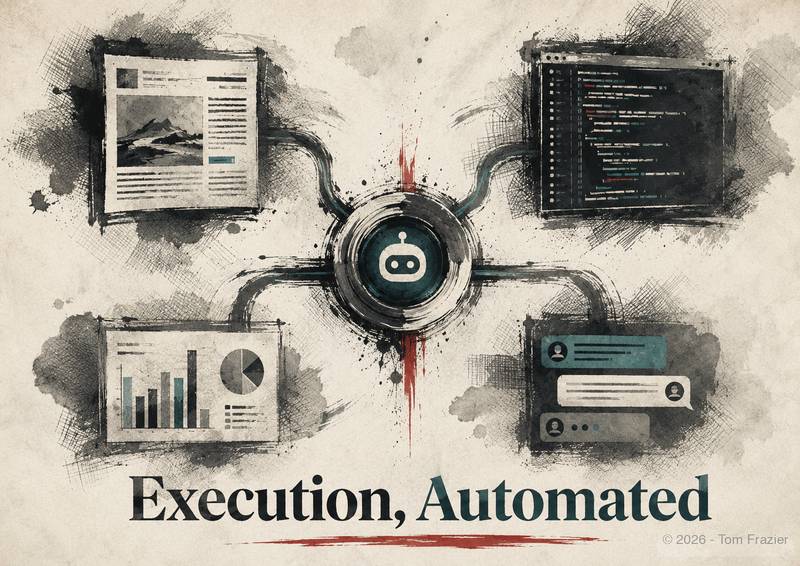
- Agents can write and edit production content beyond just rough drafts that need a human to do the real work afterward. They are now capable of publication-ready output calibrated to a defined voice and a defined standard.
- They generate code in nearly any language, including the multi-step development work that used to require a senior engineer.
- They run data analysis, build models, produce visualizations, and synthesize research faster than any human team ever has.
- Customer communication across email, chat, and support queues: handled, at volume in any human language.
- They can execute multi-step business processes end to end, procurement and scheduling and reporting and compliance documentation, without a human coordinating each handoff.
 Tom Frazier
The money trail confirms this too. The AI agents market was $7.7 billion in 2025 and is projected to reach $105.6 billion by 2034, a compound annual rate of 39.5%. That adoption curve is not a forecast of potential. It is a measurement of adoption already underway.
Bain's 2026 operating model research does a great job of summarizing it:
AI breaks the link between headcount and output, which forces a rethink of how work gets structured, how roles get defined, and where value actually comes from.
Almost nobody is asking the next question. If that link is broken, what is the company supposed to look like now?
The New Equation of Agent Execution
Capacity scaled with headcount for most of the industrial era. Hire more people when you need to do more work. The relationship was never perfectly linear, but it held well enough that headcount became the main lever anyone reached for.
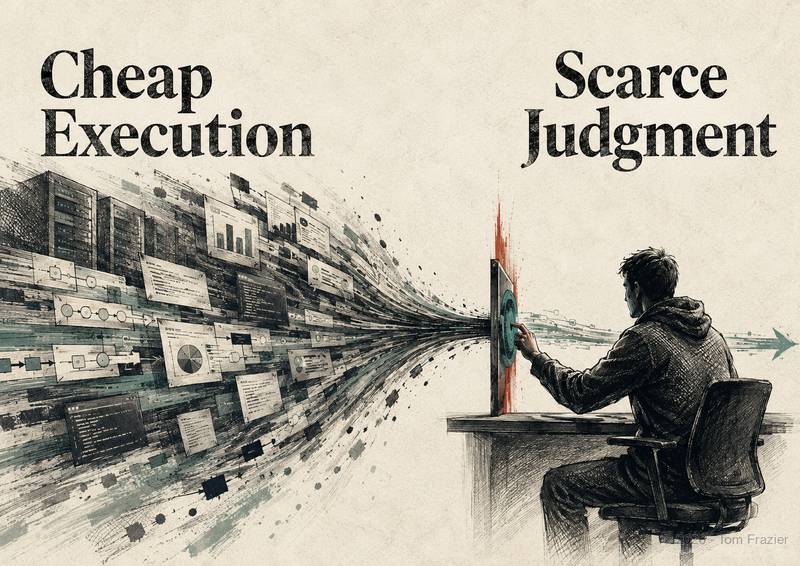
That model is now forever broken for nearly every company. Execution capacity, meaning the ability to produce content, write code, analyze data, answer customers, and run workflows, is now a function of infrastructure spend rather than headcount. The cost curve is falling. The capability curve is rising.
 Tom Frazier
 Tom Frazier
So the equation is now completely flipped. Execution capacity is cheap and getting cheaper. Judgment is scarce and does not scale... yet. A handful of companies are in the process of working this out and are rebuilding around it. Most have not because the management layers, the coordination functions, the headcount-based capacity models, decades of organizational infrastructure, all of it, was built to solve a problem that is now largely solved.
The Problem Most Organizations Are Still Solving
Look at what companies are optimizing for. It tells you exactly where they are.
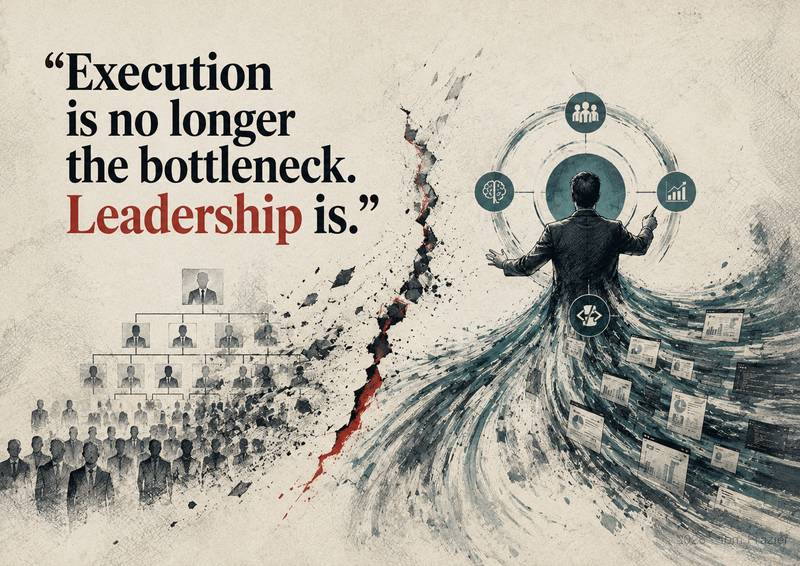
Most AI adoption inside large companies is aimed at efficiency: cutting the time a human spends on a task, speeding up a workflow that already exists, reducing the cost of a function that used to need more bodies. That is real value but is also too small given the proliferation of where AI should operate within an organization.
 Tom Frazier
Why? Because efficiency gains get competed away. Every company in an industry buys the same category of tool and captures roughly the same improvement, which turns the improvement into table stakes rather than advantage. So, relative position doesn't really change.
What moves it is structural redesign: an organization where the solved execution layer is matched by leadership infrastructure capable of pointing it somewhere. And that has a compounding effect instead of evaporating. Judgment applied to cheap execution buys you more shots at applying judgment. Nobody has really built that leadership loop just yet.
Where This Argument Is Weakest
The strongest objection is not that agents are overhyped. It is that tasks considered “solved” by AI is more than the evidence supports.
Anyone who has run agents in production is familiar with the common failure patterns. They lose the thread on long-horizon tasks. They are also confident when they are wrong. They handle the ninety percent case beautifully but ruin it with the last ten percent which carries real risk. So, a human still reads the output, and if a human still reads the output then execution was never really decoupled from headcount. It just moved from producing to checking. GM Insights, the same firm forecasting the market to $105.6 billion, lists limited contextual understanding and accuracy as a live constraint on the industry it is bullish on.
That objection is correct about today but wrong about the overall direction. Checking is not the same class of work as producing. Producing scaled with headcount linearly; checking scales with how well the checker's judgment has been encoded into what the agent was given up front. So the review bottleneck is real, and it is a leadership infrastructure problem.
I don't know the timeline. I know the order of operations.
This Is Not a Job Loss Argument
Most coverage of this shift is about displacement: which jobs agents replace, which workers are exposed, which industries contract. Whatever that framing is worth as labor economics, it is a distraction from the design question that actually decides which companies come out the other side. The reskilling conversation is easier to have. However, the conversation about what the agents are allowed (and authorized) to do isn't being had enough.
The question is not whether agents will replace people. Some will.
The consequential question is whether a company is built to direct agents: whether enough context, values, and constraint reach the agent for its output to compound the organization's actual intent instead of drifting away from it.
An agent is not autonomous in the way the word suggests. It is a very capable execution system running inside whatever context it was handed. Give it context that is rich, precise, and matched to how the company actually decides things, and it extends the company. Give it context that is thin or generic or missing, and it executes beautifully in a direction no founder would have picked nor accurate. That is a leadership distribution problem, the same one I've written about a few times
Four recent pieces I have written come at the same point from different sides.
- In The Calendar Ceiling Problem, the constraint was mathematical. Operators cannot be present for enough decisions.
 Tom Frazier
- In The Org Chart Is 170 Years Old, the constraint was structural. The hierarchy was built to distribute instructions, never judgment.
 Tom Frazier
- In Why Companies Keep Overhiring and Overcutting, the constraint was economic. Companies substitute headcount for leadership capacity and pay for it in cycles.
 Tom Frazier
- In The Fortune 500 Is Dying Faster Than You Think, the constraint was existential. Companies that cannot close the gap between intelligence and response die.
 Tom Frazier
While execution is mostly solved, the required judgment does not have sufficient depth.
Which leaves the question I keep turning over. If judgment is the constraint, and judgment currently lives inside a handful of heads and calendars, then the next thing anyone builds is the thing that gets judgment out of those heads and into the system. Not more managers. Something else... maybe an Agent Relations Department, perhaps a reboot of a central wiki, who knows. While I don't know yet what the finished version looks like I do know that whoever builds it first stops competing on the execution scaling we all benefit from.


