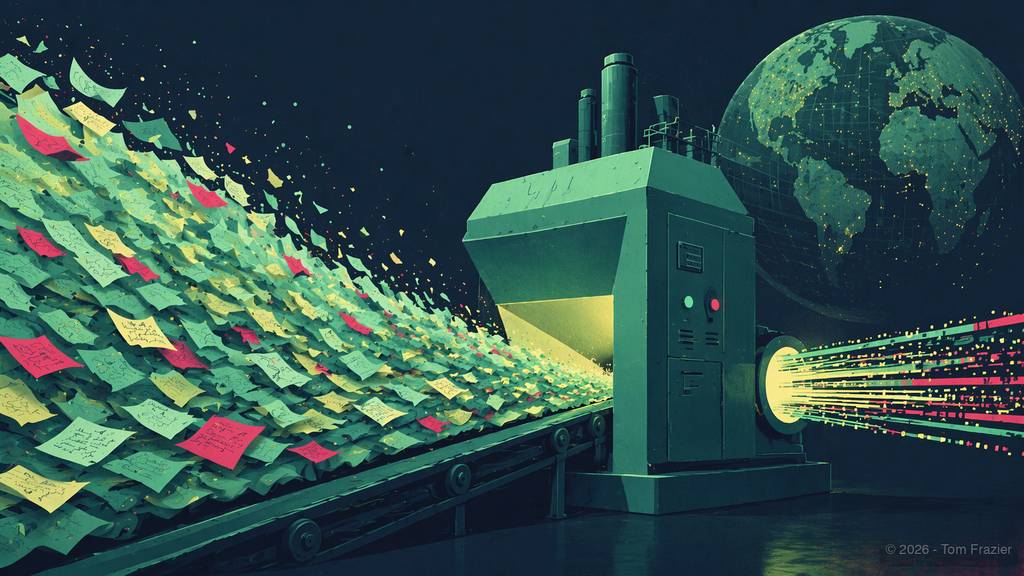


Why Companies Keep Overhiring and Overcutting
Companies don't overhire because they're irrational. Headcount becomes a proxy for leadership capacity when leadership itself doesn't scale. Layoffs are the correction. The deeper problem is structural, and it keeps coming back.

There is a pattern that plays out in almost every company that scales past a few hundred people. It goes like this: growth creates leadership gaps, leadership gaps create coordination problems, coordination problems get solved by adding managers, more managers create cost and complexity, competitive pressure arrives, mass layoffs follow.
Then it starts again.
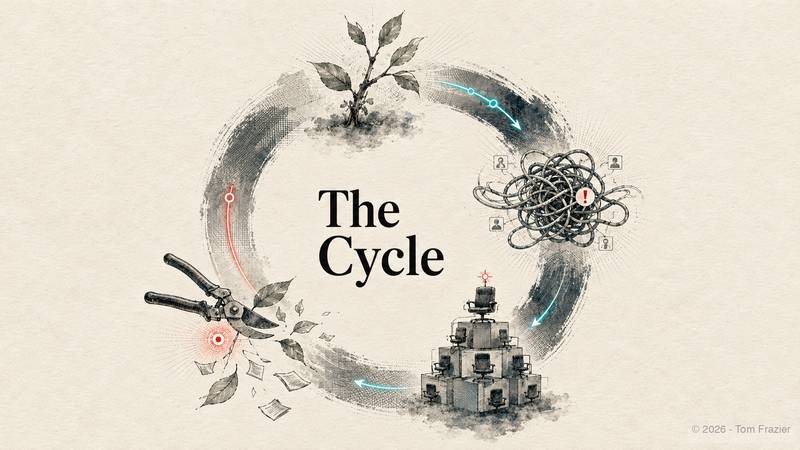
This is not a strategy failure. It is not a talent failure.
It is the organizational immune response to leadership scarcity: a system repeatedly attempting to solve a structural problem with a tool that cannot solve it.
The Cycle, Explicitly
Stage one
A company grows. Revenue is up, headcount expands, new functions are added. The founding team that could once hold the entire organizational context in their heads can no longer reach everyone. Decisions start getting made without the context that leadership would have provided. Execution drifts from intent.
Stage Two
Coordination problems emerge. Teams are working at cross-purposes. Priorities conflict. Projects stall because the right people weren't consulted. Customer experience becomes inconsistent. The organization is large enough that the people running it can no longer see it clearly.
Stage Three
The solution is more management. Hire a VP to own the problem. Add a layer of directors to sit between the executives and the individual contributors. Create a program management office to drive cross-functional alignment. Each of these moves addresses a real symptom. None of them addresses the underlying constraint. The leadership judgment the organization needs is still concentrated at the top, still rationed by calendar hours, still degrading as it travels through hierarchical layers.
Stage Four
The management layer becomes cost and complexity. A larger management structure requires more coordination to coordinate itself. Decisions take longer. Political dynamics between management layers add friction. The organization that added management to move faster is now moving slower and spending more.
Stage Five
Competitive pressure arrives: a downturn, a market shift, a new entrant. The cost structure is suddenly exposed. The answer is a restructuring. Thousands of jobs eliminated. The management layers added in stages two and three are the first to go.
Stage Six
The cycle begins again. The next growth phase will surface the same coordination problems the management layers were hired to solve. The same response will follow.
Amazon Is Running the Cycle in Real Time
The abstract version of this cycle is easy to dismiss. The concrete version is harder to ignore.
Amazon's corporate headcount grew from approximately 117,000 to 350,000 between 2017 and 2022. The growth was driven partly by pandemic e-commerce demand and partly by the organizational logic described above: rapid expansion created coordination problems, coordination problems were solved with managers, managers required managers to manage them. CEO Andy Jassy described the resulting structure directly: layers of management that hindered timely decision-making.
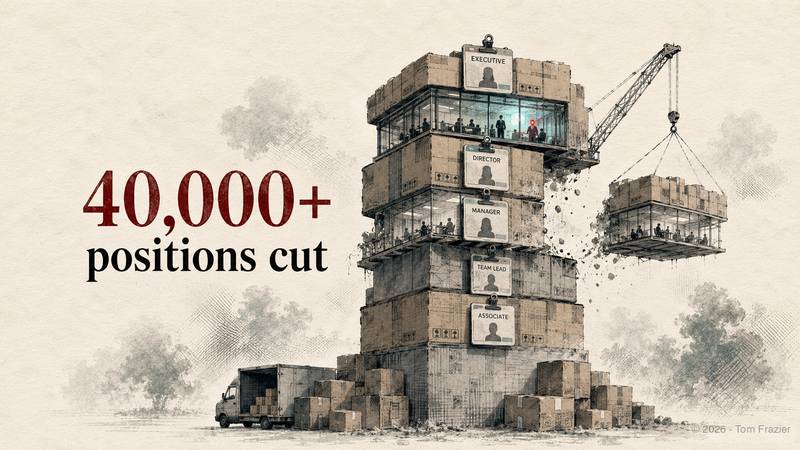
When consumer habits normalized post-pandemic, Amazon ran two major rounds of corporate cuts: approximately 27,000 positions eliminated in late 2022 through early 2023, followed by another 14,000 announced in late 2025. Together, more than 40,000 corporate positions eliminated: the largest workforce reductions in the company's history. Jassy cited both overcapacity and management bloat as the causes.
Amazon is not a poorly run company. It is one of the most operationally sophisticated organizations in the world. The cycle happened anyway, because the cycle is structural.
Operational excellence cannot override organizational physics.
Microsoft's Lost Decade
The Microsoft case is older but more thoroughly documented, which makes it instructive in ways that current events are not.
When Steve Ballmer became CEO in 2000, Microsoft employed roughly 39,000 people. By the time he announced his retirement in 2013, that number had grown to approximately 99,000, a 154% increase while revenue roughly tripled but market capitalization remained effectively flat. The Vanity Fair account of the Ballmer era documented the internal mechanism: stack ranking forced employees to compete against colleagues rather than collaborate. Divisions became siloed empires. The organizational complexity created by 13 years of headcount growth made the company structurally incapable of moving at the speed the market required.
Microsoft researchers and engineers developed early versions of technologies that would later define entire industries: touchscreen computing, streaming, mobile software. The organization could not translate those capabilities into products fast enough to matter. This was not a technology failure. It was a leadership distribution failure.
The judgment required to identify, prioritize, and drive those opportunities could not travel through 99,000 people and multiple management layers fast enough to outpace smaller, flatter competitors.
 Tom Frazier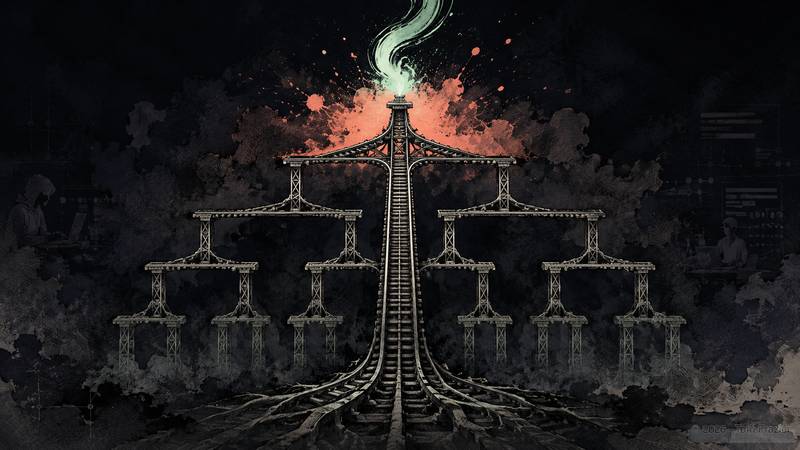
Satya Nadella's restructuring after 2014 was not primarily a strategy pivot. The strategy was already visible inside the organization: cloud, productivity software, developer tools. The restructuring was a reduction in the organizational distance between executive judgment and execution.
What the Cycle Actually Costs
The direct costs of large layoffs are the ones that appear in restructuring charges: severance, outplacement, real estate consolidation. These are large numbers. They are not the largest numbers.
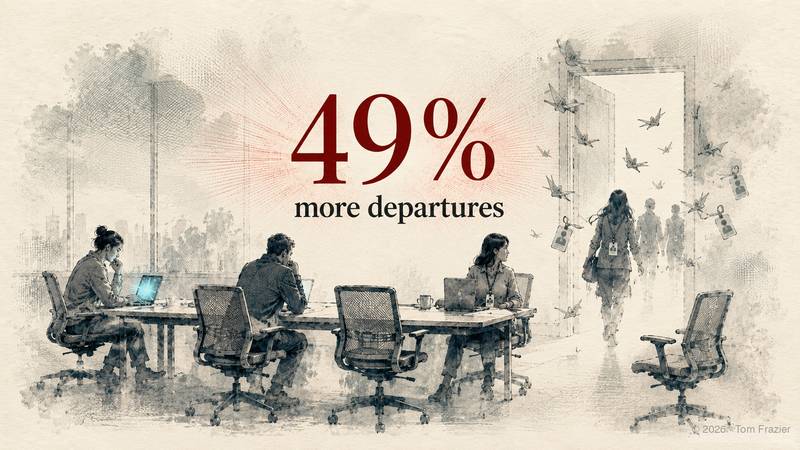
Research from management scholars Charlie Trevor and Anthony Nyberg found that a 10% workforce reduction results in a 49% increase in voluntary departures among remaining employees. The people who leave voluntarily after a layoff are disproportionately the highest performers, the ones with options. ActivTrak tracked worker activity across thousands of employers and found that after layoffs, individual productivity fell by nearly an hour a day, about 18 hours a month. For a company with 100 employees, that is more than $50,000 a month in lost output, on top of the severance itself.
Gallup's State of the Workplace data shows employee engagement drops an average of 20% among survivors of layoffs. HBR research tracking organizations through layoff cycles found engagement takes 12 to 18 months to rebound. During that window, the organization executes at reduced capacity while carrying the same fixed cost structure. The cycle does not save money.
 Tom Frazier
It defers cost, disguises it, and adds new layers of it that never appear in the restructuring charge.
Why Headcount Becomes a Proxy
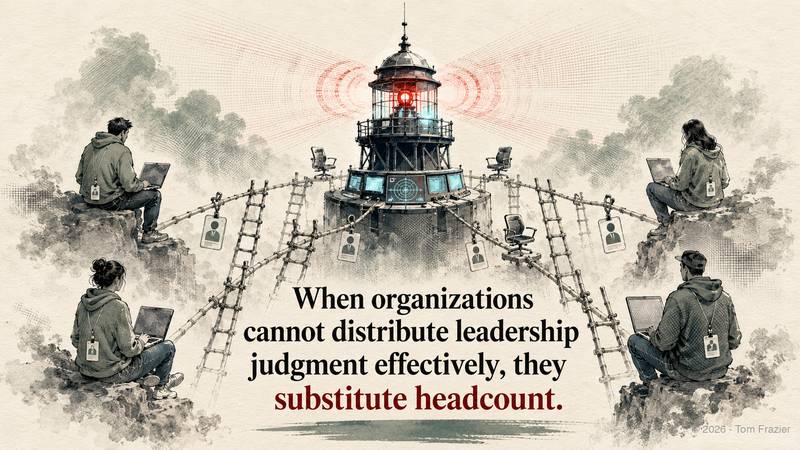
The deepest structural problem is not that companies overhire. It is why they overhire.
When organizations cannot distribute leadership judgment effectively, they substitute headcount.
The reasoning is implicit but consistent: if we can't get our best people's judgment to the edges of the organization, we can hire more people at the edges who will develop their own. If we can't make fast decisions with a small team, we can hire enough people to cover the ground even with slow ones. Headcount becomes a proxy for organizational capability precisely because leadership bandwidth cannot scale.
Tom Frazier
When the proxy fails, when competitive pressure exposes the cost of carrying capacity that isn't producing proportional output, it gets cut. The capability it was substituting for was never built. The next growth cycle will require the same substitution.
The companies that escape the cycle are not the ones that hire better or lay off smarter. They are the ones that solve the underlying constraint: leadership judgment that can reach the edges of the organization without requiring an army of middle managers to carry it.
Tom Frazier