


Your Agents Moving Faster Than Your Judgment Is A Problem
Agent capability doubles roughly every seven months. Leadership judgment still moves at the speed of your calendar. That gap is widening, and companies that don't build judgment into the system will watch their agents drift at machine speed.

Nearly a trillion dollars of US stock market value disappeared in about 36 minutes on May 6, 2010. Much of it came back within the half hour. Nothing about the underlying companies had changed. Algorithmic trading systems were executing faster than any human could oversee them. One large automated sell order set off a cascade: programs saw the selling, sold in response, and handed the problem to the next program, compounding the error at machine speed. What finally broke the spiral wasn't a person. It was an automated five-second trading pause on the Chicago Mercantile Exchange. The lesson is blunt. When execution outruns judgment, errors don't just happen. They compound.
Most companies deploying agents right now are building the organizational equivalent.
Defining the Gap
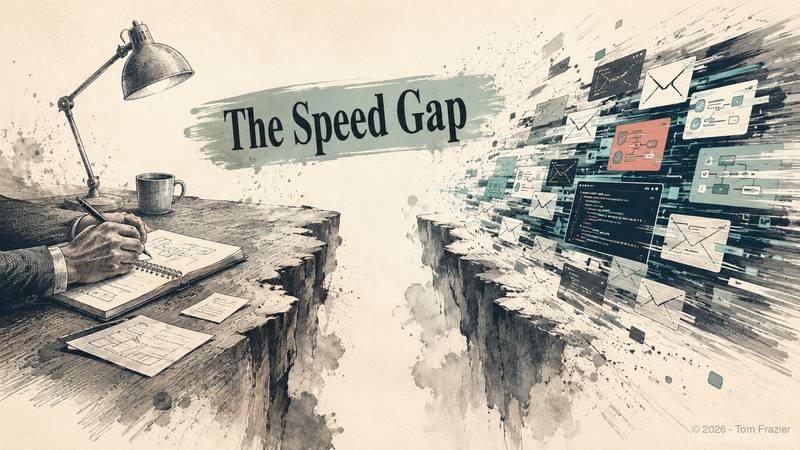
The previous piece in this series made the case that agents have largely solved the execution bottleneck. Producing content, writing code, managing data, handling customer communication, running workflows: all of it is now fast, scalable, and decoupled from headcount.
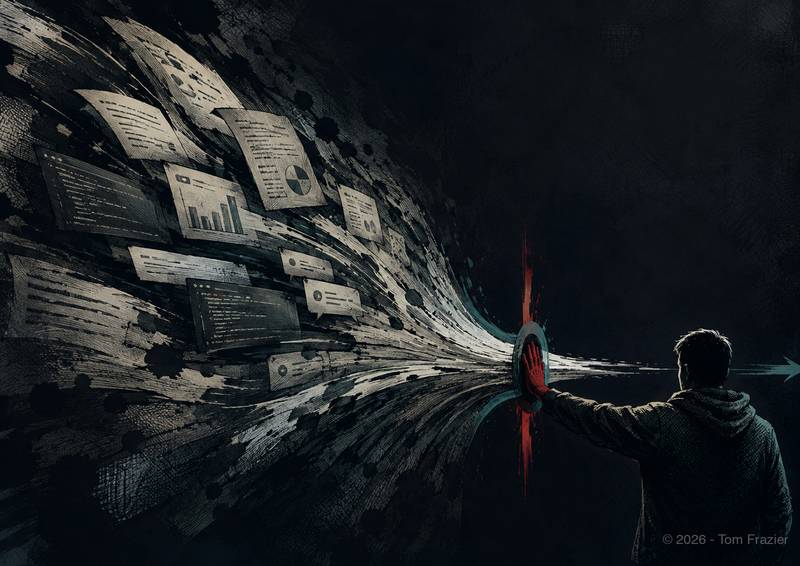
What I didn't fully name is the space between agent execution and leadership judgment. That is an organizational speed gap.
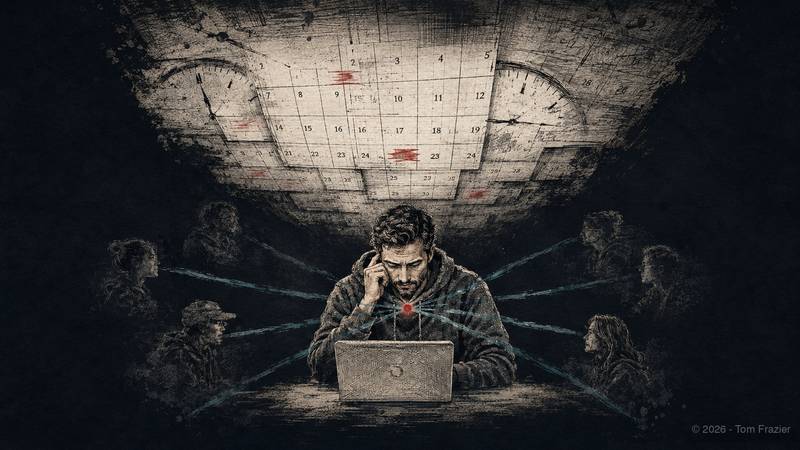
Leadership judgment travels at human speed. It moves through conversations, observation, feedback loops, meetings, and the slow build-up of organizational context. It needs presence, attention, and calibration, and all three are rationed by the same limit I shared in The Calendar Ceiling Problem.
Agent execution travels at machine speed. It doesn't wait for a decision to be made at the top of a hierarchy and passed down. It runs on whatever context it was handed, as fast as its infrastructure allows, around the clock.
Organizations have always had difficulty between judgment and execution: the distance between what the executive team decided and what the edges of the company actually did. The difference now with agents is the magnitude of that gap. Most companies have sped up execution dramatically by deploying agents while doing nothing to speed up how fast judgment reaches the systems doing the work.
What the Gap Looks Like Inside Organizations
The symptoms of this often get misread. People call them quality problems, talent problems and most commonly communication failures.
I believe they are none of those. They're alignment failures.
Signal One
Decisions that surprise the executive team are one signal. An agent-run process produces output the people in charge would have handled differently: a customer email that doesn't reflect what the brand actually stands for, a code deployment that creates downstream architecture problems, a research synthesis that misses the one insight that mattered. Trace it back and the root cause is almost always thin leadership context at the point of execution. The agent did what it was directed to do. The direction was too thin and lacked the experience of the leader.
Signal Two
Quality that varies by team is another. When agent output is consistently strong in one function and patchy in another, the variable isn't the model. It's how much judgment is packed into the context the agent is working from. Functions where someone invested in rich, specific guidance get better output. Hand an agent a generic brief and walk away, and you get generic results.
Signal Three
The third signal is customer experience that contradicts internal confidence. Companies that put agents at the customer interface keep discovering that their own satisfaction with the output doesn't match how customers respond. The internal team grades against context it has. The customer gets the output without it. When judgment is thin in the system, that gap stays invisible until customers make it visible.
The survey data says the same thing from the outside. IDC research published by SAP, drawn from more than 620 IT leaders across 15 countries, found that 81% of organizations have a detailed AI strategy, but only 12 to 16% have reached meaningful execution at the enterprise level. The three gaps holding the rest back:
- fragmented toolchains disconnected from where work happens,
- AI that lacks real-time business context, and
- governance that hasn't matured.
All three describe one condition: execution capacity deployed without the leadership infrastructure to direct it.
That condition has a root cause I keep coming back to: companies treat intelligence as a tool when it is much more. I've argued it belongs as the Fourth Pillar of the business, which makes the full set people, process, technology, intelligence. Bolt it on as a tool and you get exactly this gap. The CFO's version of that argument is in The Fourth Pillar, and the founder's version is the spine of my book, The Idea Chose You.
 Tom Frazier
The Flash Crash Analogy
The 2010 Flash Crash is a great organizational analogy. The mechanism is nearly identical.
The Dow Jones Industrial Average dropped nearly 1,000 points, about 9%, in minutes, then clawed back most of the plunge within the next half hour. The joint SEC and CFTC investigation found that a single automated sell order for 75,000 futures contracts, run by an algorithm set to target a percentage of trading volume without regard to price or time, triggered a cascade of automated responses across the market. Each system executed correctly inside its own parameters. No individual system malfunctioned. What was missing was coordinated oversight running at the speed the systems ran.
The story got messier five years later. Prosecutors charged a trader working from his parents' house near Heathrow with spoofing that same futures market and in 2016 he pleaded guilty to spoofing and wire fraud. People still argue about how much of the crash was his. A bad actor was in the market, and the market's machines amplified everything at a speed no human was positioned to catch.
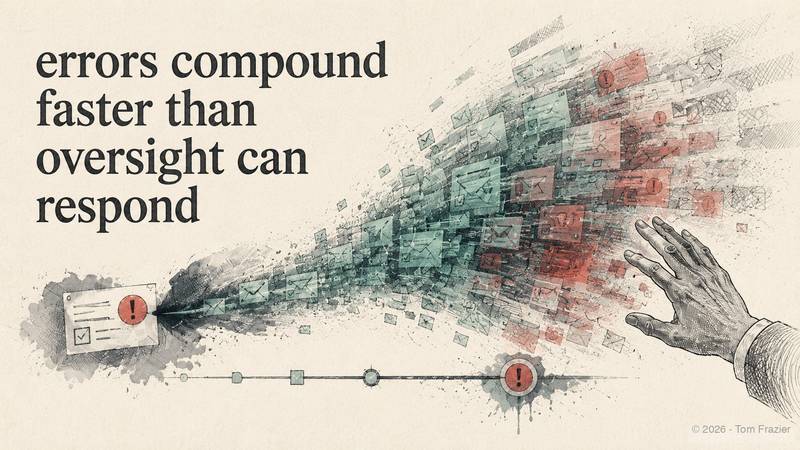
Inside a company, that kind of failure isn't one giant failure. It's a structural condition where errors compound faster than oversight can respond. An agent drafting customer emails without enough brand context sends one bad email. Recoverable. Ten thousand bad emails before a human reviews the output is a different category of problem. An agent routing support tickets without good escalation judgment mishandles one case. Also recoverable. Systematically mishandling a whole class of cases for three weeks before the pattern surfaces in churn data? That's a Flash Crash.
Research on preference drift in agents points at the same mechanism. Agents running without ongoing alignment checks develop what researchers call preference drift: behavior that shifts gradually with task structure and working conditions, moving away from the original alignment with nobody reprogramming anything. That drift tracks the conditions the agent works under. It is hard to catch, because it builds across hundreds or thousands of interactions without a detectable anomaly at any single step, right up until the output has drifted well away from what the people in charge would have chosen.
The Gap Size Will Grow Unchecked
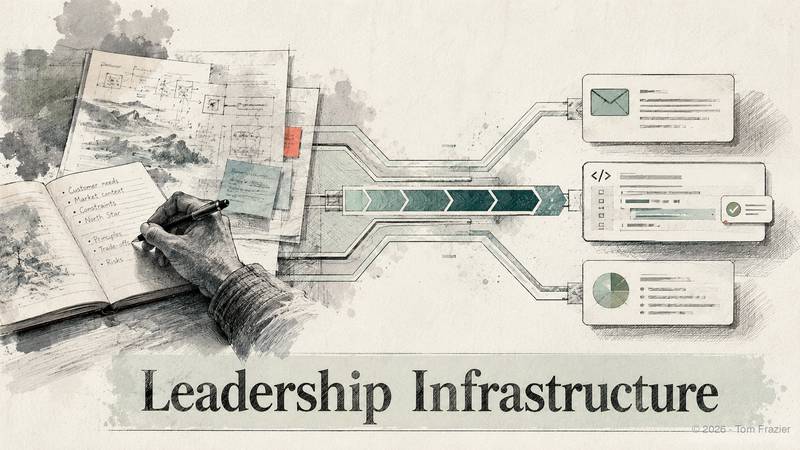
Agent capability is compounding but leadership seemingly has no infrastructure. METR's measurements show the length of tasks frontier agents can complete on their own has doubled roughly every seven months for six years running. The execution layer gets faster, broader, and more autonomous every cycle. The leadership layer still runs on the structure this series traced back to Daniel McCallum's 1855 railroad diagram in The Org Chart Is 170 Years Old & It Shows. That's a hierarchy built to move instructions down through layers of management, never to distribute judgment at machine speed.
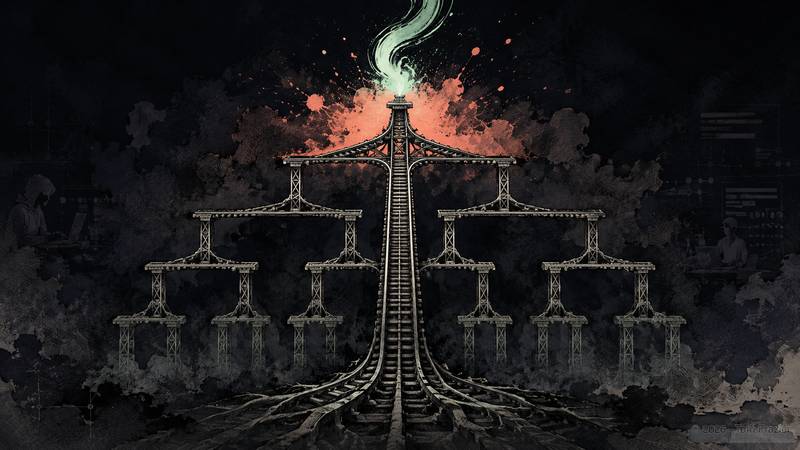
As the distance between agent execution and human oversight grows, so does the cost of weak leadership infrastructure at the point of execution.
It's the same acceleration compressing corporate lifespans, which I documented in The Fortune 500 Is Dying Faster Than You Think. Companies aren't failing because agents are uncontrollable. They're failing because nobody built the leadership infrastructure to direct agents well, and the distance between what agents can do and what leadership can watch is widening faster than most organizations are moving.
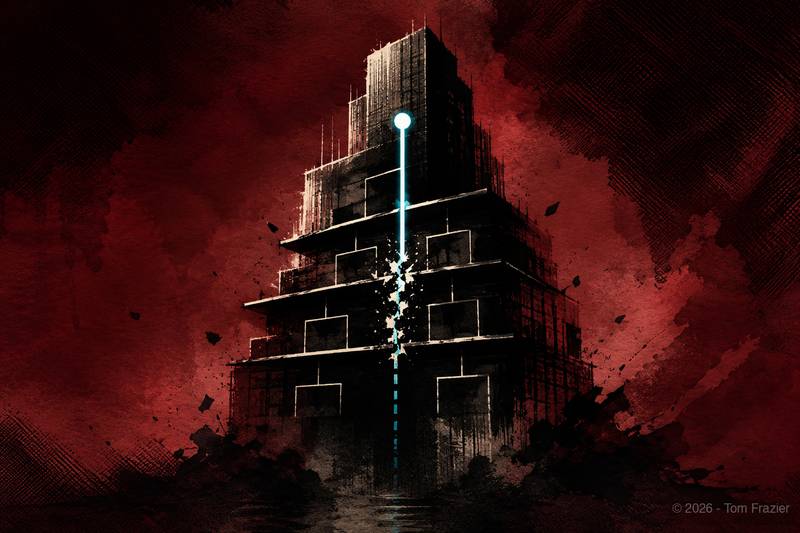
The answer is not to slow execution. Throttling execution to match human oversight bandwidth isn't a competitive option. The answer is to build a leadership infrastructure that runs closer to the speed of execution: context rich enough, specific enough, and aligned enough that agents can act inside it without a human stepping in at every turn.

So if judgment has to be written down before it can travel at machine speed, somebody has to do the writing, and it can't start with the technology. It has to come out of the heads of the people whose judgment the company already runs on. At most companies right now, that job doesn't exist. Nobody owns it. Nobody is measured on it. The agents are already running and we collectively need to solve this to unlock the next great organizational design.


