

The Org Chart Is 170 Years Old & It Shows
The org chart was invented in 1855 to solve a task coordination problem on a railroad. It was never designed to distribute leadership judgment. That was never the goal — and most companies are still paying the price for that original design decision.

Fun fact, the organizational chart was invented in 1855. Daniel McCallum, general superintendent of the New York and Erie Railroad, needed a way to manage thousands of workers across hundreds of miles of track. He drew a tree — a branching diagram of roles, reporting lines, and departmental divisions, compiled with civil engineer George Holt Henshaw.
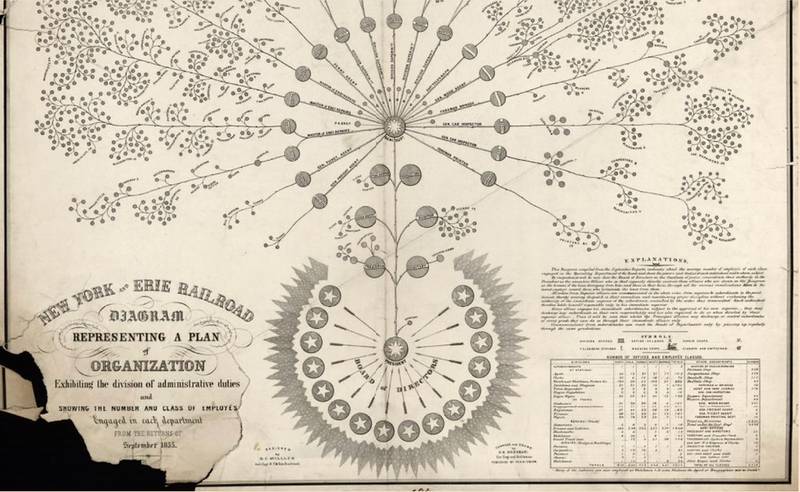
That tree, with slight variations, is still how most companies are structured today.
This is not a design choice. It is an inheritance. And the thing that was inherited was built to solve a fundamentally different problem than the one most organizations now face.
What McCallum Was Actually Solving
The railroad problem in 1855 was a task coordination problem. McCallum needed to know who reported to whom, which department owned which section of track, how many workers were in each division, and how instructions could flow reliably from the top of the organization to the workers executing them. The org chart answered all of those questions.
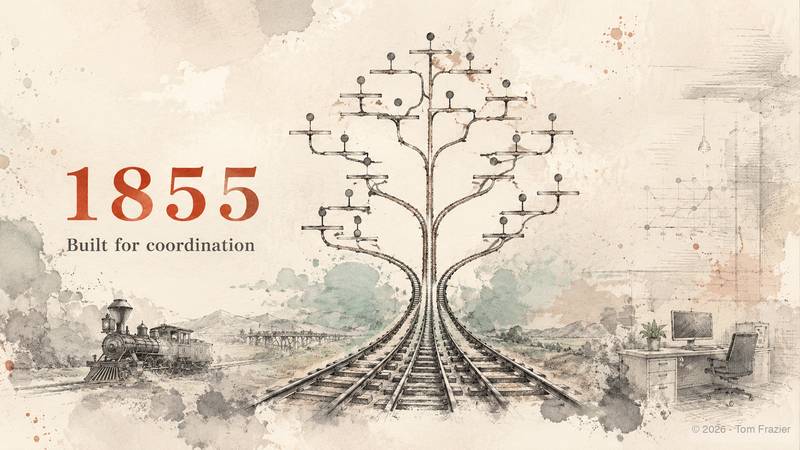
That org chart was never designed to distribute leadership judgment.
The workers laying track and operating trains didn’t need access to executive perspective. They needed clear instructions and someone to enforce them. McCallum’s goal: task execution at scale across geography. The org chart was the right tool for exactly that job.
Middle management emerged as the translation layer. Executives set strategy; middle managers converted that strategy into process; frontline workers executed the process. The system worked because the work was slow, physical, and predictable. A supervisor could observe, correct, and reinforce behavior in real time because the pace of work allowed for it. Judgment traveled slowly through the hierarchy — and that was fine, because execution traveled slowly too.
That alignment between leadership speed and execution speed is what the organizational chart was built to maintain. Most industries lost that alignment decades ago.
The Abstraction Tax
Every management layer between executive judgment and execution degrades the signal.
Strategy at the top of an organization is nuanced, contextual, and full of tacit knowledge — the kind of understanding that comes from being close to customers, competitors, capital, and the board simultaneously. It carries values, priorities, and risk tolerance that are often never fully articulated because the leader holding them has internalized them through experience.
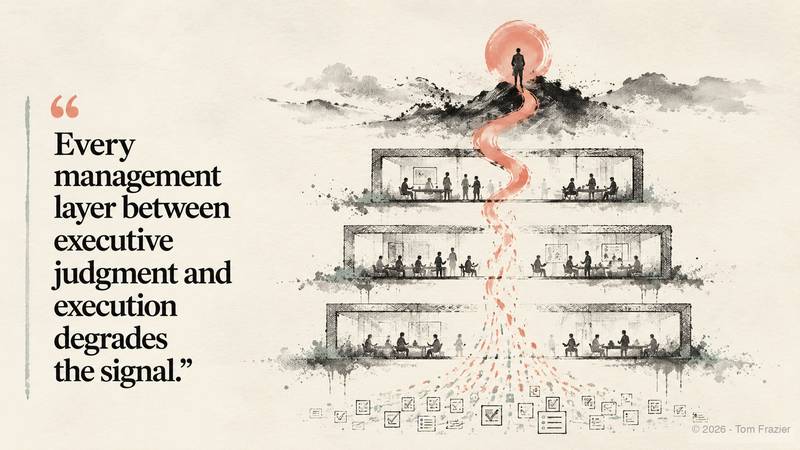
By the time that strategy reaches a middle manager three layers down, it has been processed through two interpretive filters. Each layer understood what it understood, passed on what it chose to pass on, and applied its own judgment about what the people below it needed to know. The nuance compresses.
As strategy gets executed, the context strips away. It becomes process, and process becomes task. The judgment is gone.
This isn't a failure of management skill. It is the structural cost of hierarchical signal transmission. Physics doesn't care about org design intentions.
The result is an organization that executes efficiently on a plan that is increasingly disconnected from the actual thinking at the top — and a leadership team that regularly encounters decisions made below them that they would have made differently if they had been present.
The Experiments That Tried to Fix It
Organizations have noticed this problem for decades. The attempted solutions tell you something — not because they worked, but because of precisely how they failed.
Zappos
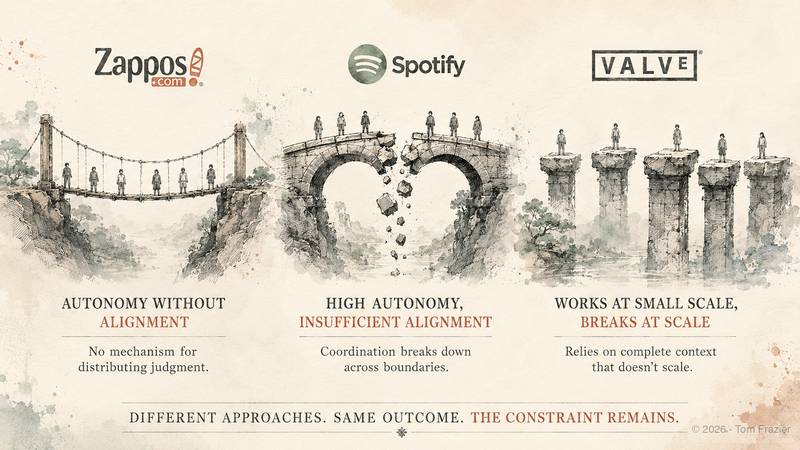
Adopted Holacracy in 2013 under Tony Hsieh: no titles, no traditional management hierarchy, radical autonomy distributed to self-organizing circles. Within two years, 18% of employees took a severance buyout rather than adapt to the new system. By 2016–2017, Zappos was already adapting the model back toward traditional structures. Hsieh’s death in 2020 removed the last committed driver. Holacracy eliminated hierarchy without providing a replacement mechanism for distributing judgment. Autonomy without alignment doesn’t solve leadership scarcity. It just makes the scarcity less visible until the misalignment surfaces.
Spotify
Introduced its Squad model — small autonomous product teams organized into Tribes, Chapters, and Guilds — and the business press treated it as a template for the future of organizational design. Then a former Spotify employee published a widely-read post documenting that Spotify itself had largely moved away from the model while other companies were adopting it wholesale. The core failure: squads had high autonomy but insufficient alignment. Different squads chose different technical approaches, coordination across tribe boundaries proved harder than in traditional structures, and the model displaced output accountability without replacing it with anything more effective.
Valve
Built a company with no fixed hierarchy and employee-driven project selection. For a small, highly curated team of senior engineers, it produced exceptional results. It also produced a company that stayed small by design — because the model breaks down when you can no longer rely on every person having complete organizational context.
The pattern across every experiment: each one solved a real problem with traditional hierarchy while creating a new problem that traditional hierarchy had implicitly solved.
They reorganized the structure around the leadership scarcity problem without reducing the scarcity itself.
The Constraint They Were All Avoiding
Every alternative org model shares the same implicit assumption: if we restructure the hierarchy, leadership judgment will distribute more effectively.
It won't — not through structural changes alone. The constraint is not the shape of the org chart. It is the bandwidth of the leaders at the top. McCallum's tree doesn't cause leadership scarcity. It just makes the scarcity visible.
 Tom Frazier
A flatter organization reduces the number of distortion layers between executive judgment and execution. That is genuinely valuable. But a flat organization with five hundred people still has one CEO with the same number of hours as before. The distance between executive judgment and the edge of the organization is shorter — but the judgment is still stuck at the top, and the hours are still fixed.
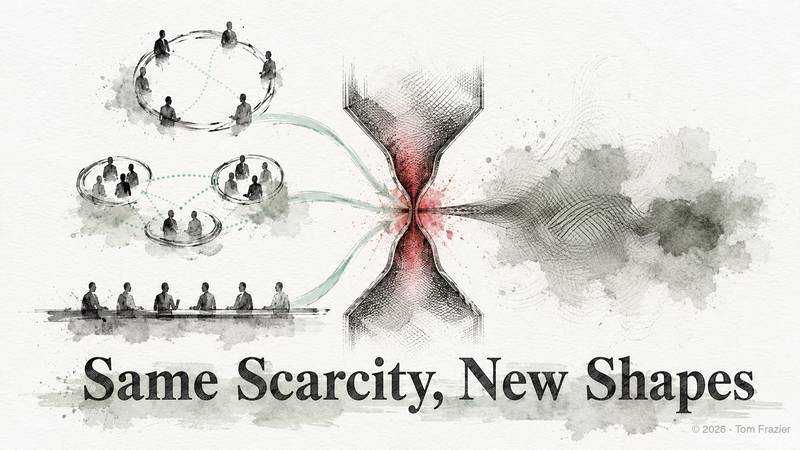
The organizations that benefit most from flat structure are the ones where leadership judgment has already been effectively internalized by the people closest to execution. That internalization doesn't happen through org design. It happens through sustained, high-bandwidth access to the leaders who hold it — exactly the thing the calendar ceiling makes structurally scarce.
Org redesign is a workaround. It reduces the distance that leadership judgment has to travel. It does not increase the supply of that judgment, and it does not solve the problem of distributing it to the places in the organization that need it most.
Why This Matters Now
For most of the industrial era, the gap between what hierarchical org design could do and what organizations actually needed was manageable. Execution was slow enough that leadership judgment could catch up. Competitive change was slow enough that misalignment at the edges of the organization rarely caused catastrophic damage before it could be corrected.
Both of those conditions are gone.
Tom Frazier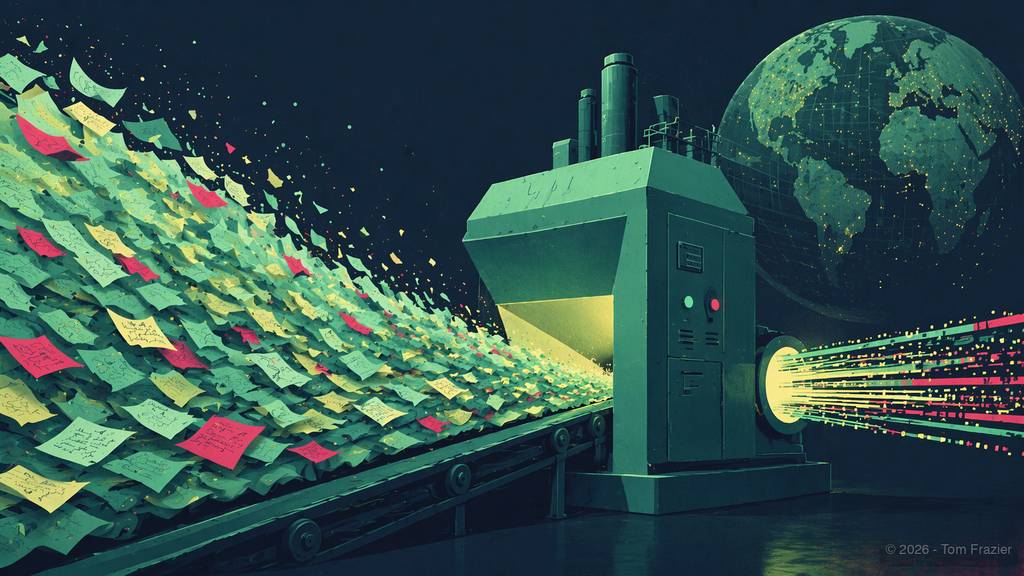
Execution speed has increased by orders of magnitude — and with AI agents now handling content generation, code, data analysis, customer communication, and workflow automation at scale, it is about to increase further. The gap between how fast organizations can execute and how fast leadership judgment can travel through a 170-year-old hierarchical structure is widening, not closing.
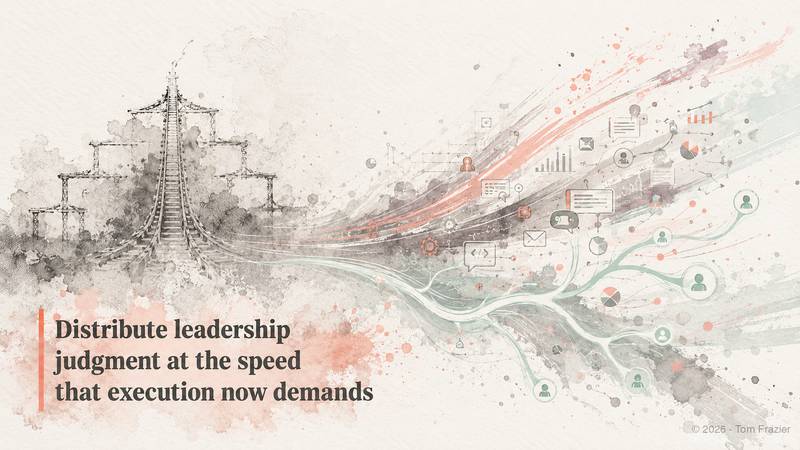
The org chart was the right answer to a problem that no longer exists.
The problem that exists now is different: not how to coordinate task execution across geography, but how to distribute leadership judgment at the speed that execution now demands.
McCallum's tree has no answer for that. It was never asked the question.
What comes next isn’t a flatter version of the same structure. It isn’t another model that redistributes the scarcity rather than reducing it. The organizations that close this gap won’t do it by changing the shape of the hierarchy. They’ll do it by finding a way to put leadership judgment in more places at once — without cloning the CEO and burning out the exec team.
That’s the problem worth solving.
