

The Fortune 500 Is Dying Faster Than You Think
The companies that fell didn't fail to see the threat coming. Kodak invented digital photography. Nokia's middle managers understood the iPhone threat clearly. Sears' CEO was an early e-commerce advocate. They failed because leadership judgment could not travel through the organization fast enough.
In 1958, the average S&P 500 company expected to be on the list for 61 years. Today, that number is under 18.
At the current rate of churn, more than half of the companies on the S&P 500 right now will be replaced within the next decade.
That trend gets cited frequently as a technology disruption story — the pace of innovation accelerating, incumbents outpaced by faster-moving startups, industries restructured by software. The data supports a different explanation. The companies that fall are not primarily out-innovated. They are out-aligned. Their leadership cannot travel through the organization fast enough to respond to what the organization can already see.

Use it before you read the rest of this article. Identify your primary model. The methodology in that row is where you start.
No email address required.
The Intelligence Was There
Kodak is the case most people reach for when they want to illustrate the cost of missing a technology shift; a shift that I saw first-hand living in Rochester, NY while attending RIT. The standard version of the story is that Kodak didn't see digital photography coming. The accurate version is almost the opposite.
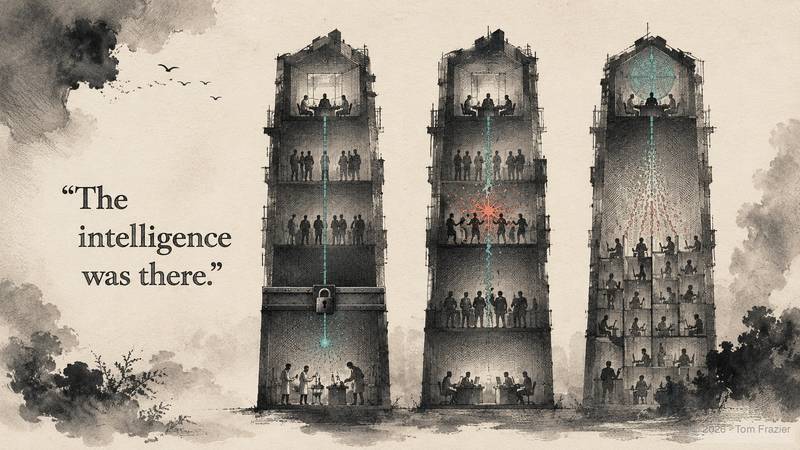
In 1975, Kodak engineer Steve Sasson developed the world's first functional digital camera. The prototype was crude — a 0.01-megapixel image that took 23 seconds to capture — but the technology was real, and it was built inside Kodak's own labs. When Sasson presented it to management, the response was to bury it. Leadership understood what it was. They concluded that commercializing it would cannibalize film revenues, and film revenues were the business. The intelligence existed.
The judgment required to act on it did not travel from the lab to the people who could authorize the pivot.
Nokia's failure followed a structurally identical path. INSEAD researchers conducted 76 interviews with Nokia's top and middle managers, engineers, and external experts after the company's collapse. Their finding was direct: Nokia saw the iPhone threat clearly. Middle managers understood what was happening. The failure was not awareness — it was the gap between what middle management knew and what reached the executive team. A culture of fear created by aggressive senior leadership meant that accurate, negative information about Nokia's competitive position did not travel up the hierarchy accurately. Top management was making decisions on optimistic signals from a frightened middle management that was telling them what they wanted to hear.
Sears is the third example, and it is the most instructive because it fails the 'they didn't see it coming' defense entirely. Sears' CEO Eddie Lampert was an early and vocal advocate of e-commerce. He pushed the company online before most of its customers were ready to shop that way. The intelligence was present at the top. The organizational structure — split into 30 competing divisions, each with its own executives and P&L — made it impossible for that strategic clarity to translate into coherent execution. Each division optimized for its own survival. The leadership judgment that existed at the center could not travel through a structure deliberately designed to keep divisions independent.
The Pattern Across All Three
These are not technology failures. They are not strategy failures. They share a single structural characteristic:
the intelligence required to respond to an existential threat existed inside the organization
and the leadership judgment required to act on that intelligence could not travel fast enough or accurately enough through the organizational structure to drive a response.
 Tom Frazier
In Kodak's case, the intelligence sat in the R&D lab and never reached executive decision-makers with the support required to act on it. In Nokia's case, it existed at the middle management layer and was distorted before it reached the top. In Sears' case, it existed at the top and couldn't reach the execution layer because the organizational structure between them had been deliberately fragmented.
The direction of the failure varies. The underlying mechanism is identical: the distance between where judgment lives and where it needs to go was too large, and the organizational structure provided no reliable way to close it.
Why the Clock Is Speeding Up
Innosight's corporate longevity research tracks S&P 500 tenure across decades.
The 33-year average in 1964 had narrowed to 24 years by 2016 and is forecast to reach 12 years by 2027.
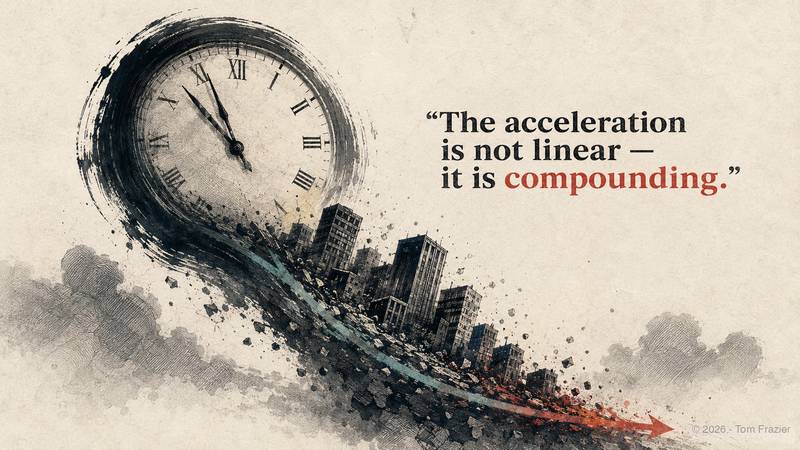
The acceleration is not linear — it is compounding.
The standard explanation for the acceleration is technology: faster innovation cycles, lower barriers to entry for startups, platform businesses that scale faster than incumbents can respond. That explanation is partially correct and mostly incomplete.
The companies that have replaced the departing Fortune 500 members share structural traits that have nothing to do with technology advantage. Amazon, Google, and Netflix did not simply have better technology than their predecessors — in most cases, their predecessors had access to comparable technology first. What they had was shorter organizational distance between executive judgment and execution. Fewer layers between strategic clarity and operational response. Leadership alignment that could travel faster than the organizational structures of the companies they displaced.
McKinsey's research on organizational agility found that companies with flatter hierarchies and clearer decision rights consistently outperform more hierarchical peers in fast-changing environments — not because flatness is intrinsically superior, but because it reduces the distance leadership judgment has to travel. The advantage is not structural. It is speed of alignment. Those who now adopt AI as a completely independent business pillar alongside people, process and technology will adapt faster than their peers who do not.
Tom Frazier
The Next Wave Will Be Faster
The acceleration in corporate mortality is not a stable new normal.
It is a trend line that continues to steepen. The reason is execution speed.
For most of the industrial era, the gap between when a leadership failure became visible at the organizational edges and when it caused terminal damage was measured in years. Misalignment between executive judgment and operational reality could compound slowly enough that organizations had time to correct before the damage became irreversible. That correction window is shrinking.
Tom Frazier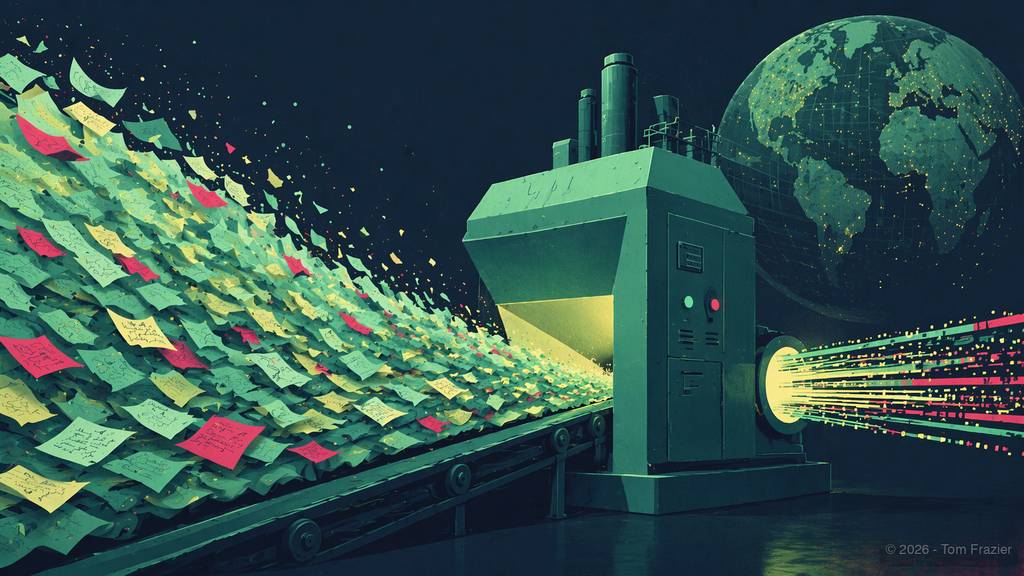
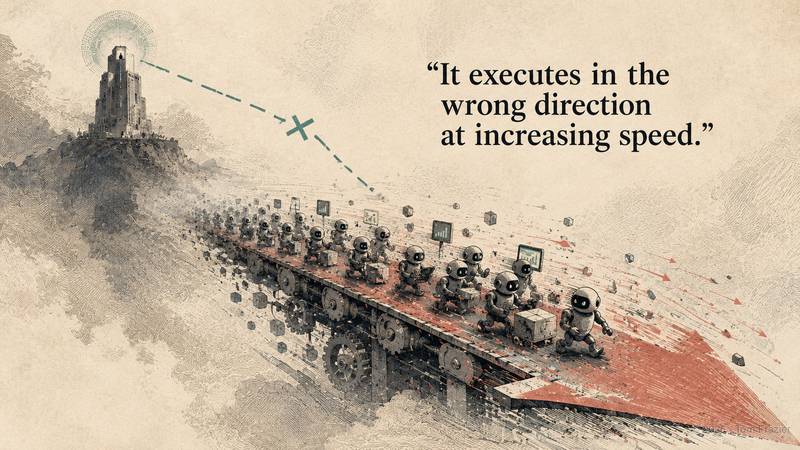
AI agents have begun operating at the execution layer of organizations — writing content, generating code, handling customer interactions, synthesizing research, managing workflows. As that capability expands, the speed at which a misaligned organization can cause damage to itself accelerates proportionally.
An organization whose leadership judgment is disconnected from its operational reality does not just drift slowly in the wrong direction. It executes in the wrong direction at increasing speed.
The companies currently on the S&P 500 that will not be on it in ten years are, in most cases, not facing a technology problem they cannot solve. They are facing the same problem Kodak faced, the same problem Nokia faced, the same problem Sears faced: leadership judgment that cannot travel through the organization fast enough to drive the response the organization already knows it needs.
The leadership constraint has always been structural.
What has changed is that the cost of leaving it unaddressed is now accelerating toward catastrophic faster than it ever has before.


