

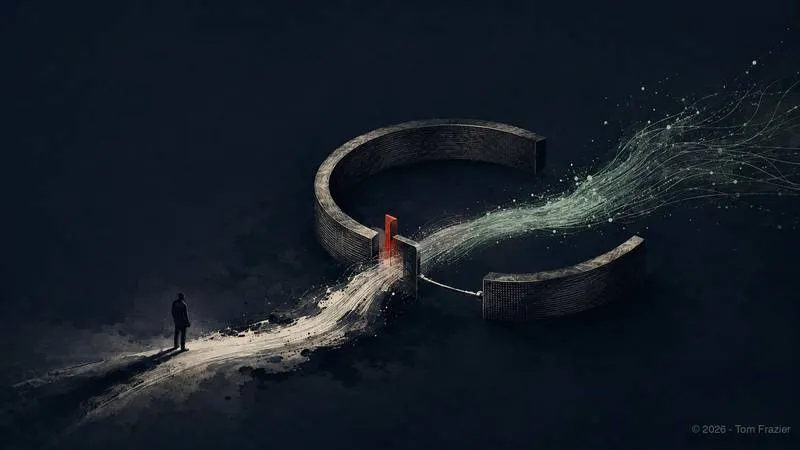
The Nearly Headless Harness
Everyone's picking sides in the AI harness debate: Cowork versus OpenClaw, head versus headless. The real skill isn't choosing a side. It's building the skill layer that lets both run.
Everyone building an AI stack right now is hunting for the one harness that wins. Claude Cowork or ChatGPT Work on one side, a headless loop like OpenClaw or Hermes on the other, and everyone's got a strong opinion about which one is the future. You don't need to pick "a" winner...
A task that needs a human in the loop today doesn't need one forever. The whole game is getting it out of the loop, on purpose, once sufficient truthiness has been established. Most of the industry is still arguing about which harness deserves your loyalty.
The better question is which harness deserves this job right now, and what has to be true before that answer changes.
The Industry Is Fighting the Wrong War
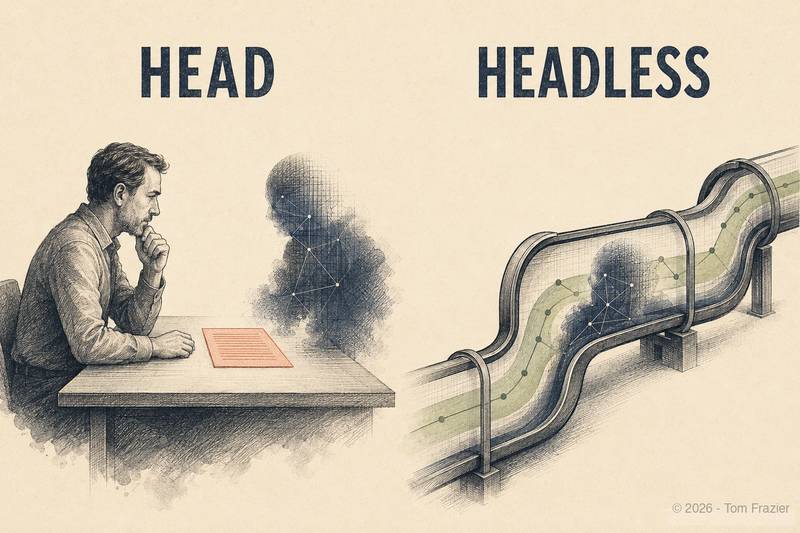
Head and headless aren't rival philosophies. They're two different relationships between a human and a model.
A head harness keeps you in the room. Claude Cowork and OpenAI's ChatGPT Work both work this way: the agent gathers context, does the reasoning, and then waits. It hands back a draft, a sheet, a plan, and you decide what happens next. A headless harness doesn't wait. OpenClaw and Hermes run as gateways, not conversations. You give them a channel and a job, and they keep working it without checking in.
Vercel settled this argument for anyone still having it, and they did it by accident. Their AI SDK now lets you swap the harness running underneath your app the same way you've always been able to swap the model. One line of config. No rewrite. Claude Code, Codex, Deep Agents, OpenCode, and others are all interchangeable adapters in the same framework. Nobody building that infrastructure thinks one harness is going to win. They built for a world where you're running four of them by lunchtime.
Head Work Is Expensive. Make It Rare.
A head harness is the most expensive thing you can run, and I don't mean the API bill.
It costs your attention. Every time an agent hands work back to you and waits, you're the bottleneck, by design. That's not a flaw. Judgment is the entire point of keeping a human in the loop. But judgment doesn't scale, and pretending it does is how a promising AI rollout turns into another meeting you have to attend.
So the goal isn't more head work. It's less, on purpose, and the "less" is earned rather than assumed. A head harness should be reserved for the first time you do something: the version of a task where you genuinely don't know yet what good looks like. Once you do know, keeping a human checking every output isn't rigor. It's a habit you should try to break.
Skills Are the Bridge
I used to be a headless purist. I built a whole digital-twin organization inside OpenClaw and let it run, on the theory that if the agent was good enough, my job was just to get out of the way. Weeks of wreckage taught me otherwise. I was furious the first time it burned real money on a decision I'd never have made, and the fix I reached for wasn't "add more human oversight." It was a bridge I didn't have a name for yet.
 Tom Frazier
That bridge is just a skill
Not the general sense of the word: the specific one. A documented, reusable piece of capability. I define it once, under supervision. Both my head tools and my headless loops can call it afterward. When I catch myself making the same judgment call three times, I write it down as a skill instead of doing it a fourth time. The skill inherits my judgment. It doesn't inherit my attention.
This is the actual shape of a stack that gets more capable over time. The head's job was never to keep doing the work forever. It's to keep building and improving the skills that let the headless side do more of it, correctly, without asking.
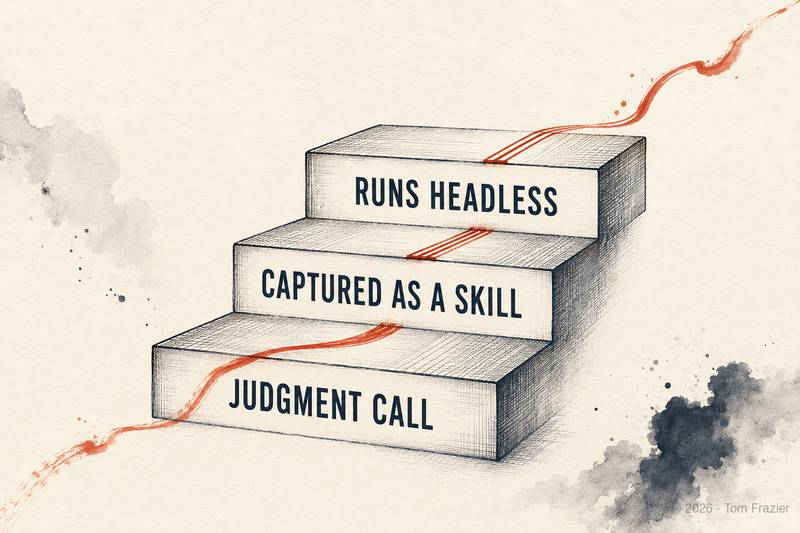
The Migration, Not the Split
Call it the Skill Ladder. A task starts on the bottom rung, under head supervision, because nobody's proven yet that it can run without you. It climbs one rung when the judgment call gets written down as a skill. It climbs the last rung when that skill has run headless enough times that auditing it, not doing it, is the only work left.
Most people, much less organizations, never build the ladder. They pick a side instead. Headless zealots automate first and discover the gaps the hard way. Head loyalists never let go of anything, and wonder why their AI spend keeps climbing while their leverage doesn't.
The ladder is what separates a stack that compounds from one that just accumulates tools.
Here's what that looks like across three example jobs.
- An inbox agent reading and filing email is a skill that graduated months ago. It runs fully headless.
- A writing partner, the kind of work this piece is an example of, hasn't graduated and won't. It's judgment-heavy every single time, so it stays on the bottom rung by design.
- Planning a code project sits in the middle. Headless agents find the bugs and open the PRs, while a head harness still owns the sequencing decisions, because that part hasn't repeated enough times yet to trust.
The mix isn't static. It's supposed to keep shifting toward the top.
"But Won't One Platform Just Win?"
Maybe. Say Anthropic or OpenAI or whoever builds the model everyone standardizes on in five years. That doesn't collapse the split. It just moves who owns the skill layer. I'd believe otherwise the day one platform starts shipping the governance layer as a default instead of an add-on. Nobody has yet.
Twenty researchers spent two weeks trying to break autonomous agents running on OpenClaw, and every failure they documented traced back to the same root cause, and it wasn't the technology. It was governance. Nobody had defined what the agent was allowed to decide on its own versus what needed a human to sign off. That problem doesn't disappear if there's only one harness left standing. If anything it gets worse, because a single dominant platform means a single point of failure for judgment nobody wrote down.
 Tom Frazier
Consolidation is a bet on which company builds the best skill infrastructure. It's not an argument against having one.
What Staying Fully Head (or Fully Headless) Costs You
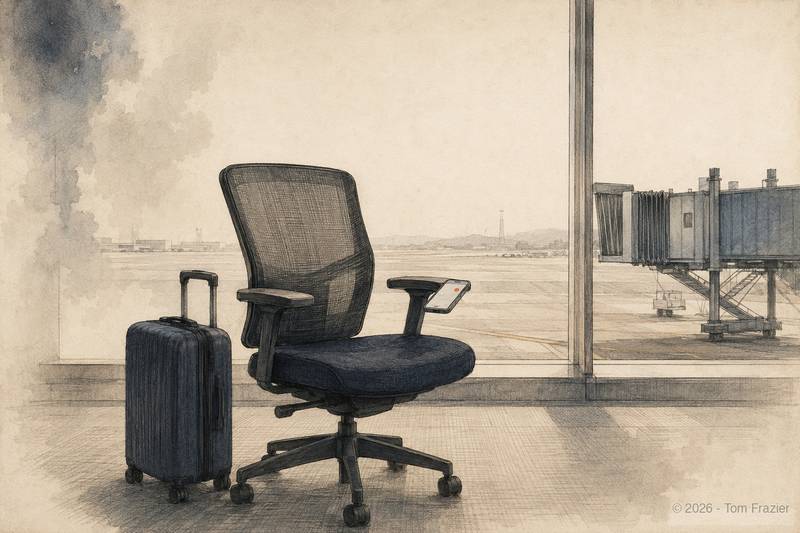
Neither failure is really about the technology. Both are about skipping the ladder.
Don't Lose Your Head
The head function was never going to disappear, and the operators still hoping it will are optimizing for a job that isn't there anymore. What shrinks is how much of it you're doing yourself, task by task, forever. What doesn't shrink is the work of deciding what deserves to graduate next, and catching it when a skill drifts from what you actually meant.
I don't know which lab wins the model race. I know the order of operations: build the skill, prove it, let it graduate, then go build the next one. That's not a smaller job than running everything by hand. It's a different one, and it looks a lot less like managing agents and a lot more like being the orchestrator the work was always waiting for.
 Tom Frazier
Builders who get the ladder right get something rare: work that compounds instead of just repeating. That's worth wanting. That's actually worth wanting.
Nearly headless. Never fully. That's not a compromise. It's the only version of this that scales past you.


