

Dre & Druckenmiller Just Crossed AI's Ambassador Threshold
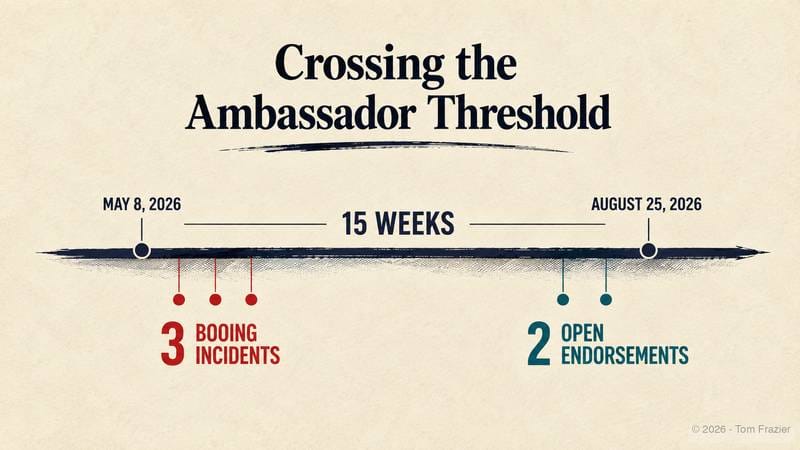
In May, students booed AI off the commencement stage. In August, Dr. Dre and Stanley Druckenmiller each admitted using it and refused to defend the choice. Fifteen weeks apart. The question of whether AI is acceptable closed somewhere in between.
Two men who have nothing else in common said the same thing two days apart. One of them makes records. The other moves bond markets. Neither was asked to defend artificial intelligence and neither bothered to. They said they use it, in the flat tone you would use about a calculator or a drum machine.
Nobody defended AI because they didn't need to.
Fifteen weeks is forever in AI
On May 8, a commencement speaker at the University of Central Florida told a hall of graduating humanities students that the rise of artificial intelligence was the next industrial revolution. She got booed. Students at Middle Tennessee State booed a record executive the following day, and a week later Eric Schmidt was booed at the University of Arizona and kept talking over it, telling the crowd he could hear them and that there was fear in the room.
A mere fifteen weeks after that, Dr. Dre sat down with the New York Times and said he uses AI when he produces.
He put the objectors in the same category as the people who once objected to drum machines.
His framing was blunt. The only ones who see it as a threat, he said, are the ones who have trouble creating.
Two days later, Stanley Druckenmiller published an op-ed in the Wall Street Journal, got flagged by a detection tool, and was asked to answer for it. "Of course I used AI," he told NOTUS.
Druckenmiller writes everything with it now, he said, for the same reason he reaches for a calculator when he does arithmetic.
The Journal's editorial page editor backed him within a day.
Neither man coordinated with the other. Between them they cover the two ends of the status ladder in American life, the studio and the trading floor, and they landed on the same posture in the same week without conferring.
The Ambassador Threshold
Acceptance was never going to come from institutions. Nobody was waiting on a regulator or a research consensus to declare AI socially permissible, and if they had been, the wait would still be on.
It comes from inside communities instead. Here is the mechanic, and I have just given it a name.
A technology becomes acceptable inside a community the moment someone whose status that community cannot dismiss uses it openly and declines to justify it.
The casualness is the real power here. Argue for it and you have invited the counterargument; defend it and you have conceded there was something worth defending. Treating it as unremarkable does neither.
Watch how both men behaved under challenge. Druckenmiller never mounted a case for AI-assisted writing; he said he doesn't know why it's relevant, his name is on the piece, the message is his. Dre never built an argument for AI in music. He filed the objection under drum machine skepticism and moved on. Each treated the question as already answered, which is the most effective way to answer it.
Two people did what a decade of position papers could not.
Music and finance share no members, which means the threshold has now been crossed at both ends of a ladder most people are somewhere in the middle of.
I have been sitting on this since GPT-3
My conviction here is old enough to have been embarrassing when I formed it.
Years before GPT-4, back when the models were bad and saying this out loud made you sound credulous, I was using one to build a system for making children's books. The problem had nothing to do with publishing. Material that teaches kids about fear and disappointment and how to sit with a hard feeling is abundant in English and thin to nonexistent in most other languages. Spanish is passable. Welsh, Gaelic and Hebrew are not, and families trying to keep a heritage language alive were being asked to choose between the language and the material.
 Tom Frazier
The AI did not write those books. I want that exact, because it is the argument in miniature. The model let me build the system that produced them, which is a different job than authorship and a more useful one.
Dre drew the same distinction, incidentally, when he described using AI to see what it would do with something he had already made. Neither of us handed over the work. We handed over the part that was never the point.
I keep a full disclosure of how I use these tools, including the Claude skill I built for running an argument past five separate advisors before I publish, which is free and which you should take. It also explains why I prefer LLM to AI. Then I used the word AI a dozen times here anyway, because that is the word Dre used, the word Druckenmiller used, and the word the students booed.

The actual Claude skill I run every argument through before I publish it. Five advisors, independent analysis, anonymous peer review, one verdict.
The objection that deserves an answer
Two wealthy men are not a referendum. The people who booed were the ones with something at stake and likely voicing larger concerns. A producer and an investor carry no exposure to the labor market their endorsement helps reshape, and that mistaking elite acceptance for social acceptance is how you declare a question settled when the powerful simply stopped listening.
I'd say that is correct about the asymmetry but wrong about what was being said.
Listen to what the graduates actually said. One UCF graduate told a local station that her class had no trouble accepting that AI exists; what they could not accept was what it was doing to the jobs they had spent four years training for. The numbers back her. In March, unemployment for graduates aged 22 to 27 ran 5.6% against 4.2% for all workers. That is a bill arriving.
The booing separates two conflated questions. 1 - Is this acceptable, and 2 - who pays for it. The first closed question is now over. The second is still real and it will get louder. Treating them as one fight is the error that I see.
Your evidence expired
Here is where this lands on you, if you are running something and you have not moved on this yet.
You tried using AI for something that mattered but the result was mediocre so you filed the entire category under "no or not yet." That view has also gone stale because the shelf life of AI capability is incredibly short.
I have argued a more polished version of this before: most pilots measure an axis that does not compound, then correctly report finding nothing. Underneath sits a more basic problem.
You may be extrapolating from a fixed point on a steep curve so your extrapolation can be wrong with a few months.
Take video. Generating it has always been slower than watching it, which is why AI video stayed a novelty. As of late August, a five second clip renders in under three seconds on fal's post-trained build of MiniMax's open weights.
Ignore that number, which will be wrong by the time you finish reading. Watch the trend.
When content gets produced faster than it gets consumed, a format stops being a file and becomes a stream that can bend while you are inside it. Storytelling becomes negotiable. The same curve runs through visual production, lyric writing, beat synthesis, financial modeling. Different slopes, same shape.
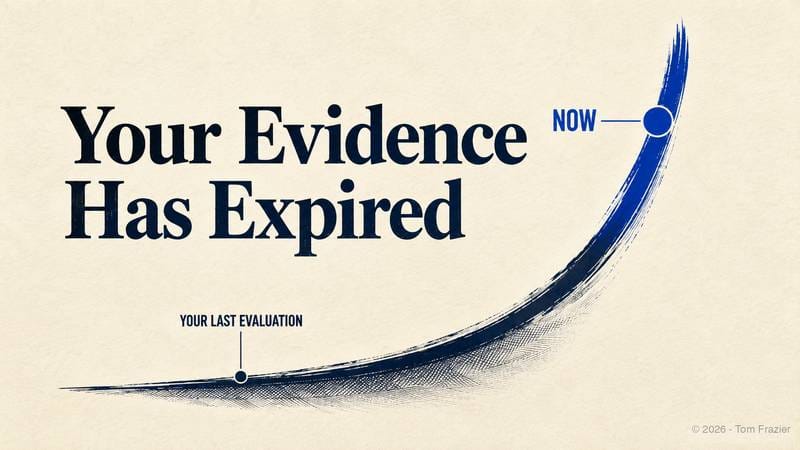
The delay in action can be expensive
Twelve months late is not twelve months of work to make up.
The people who started early are not ahead on hours. They are standing on scope they already granted, on evidence that only accumulates, and on judgment about where these tools break that cannot be bought or briefed. Execution itself is already being answered by agents. This is the capability underneath, and it compounds whether or not you participate.
Dre & Druckenmiller delivered the social cover you were waiting for.
Somewhere a kid is going to fix a story
A girl watches a show that does not exist yet. Twenty minutes in she doesn't like where it went, so she says so out loud, and the story bends while she is still watching. The next one is better, because the system learned something from the correction. She will not call it AI.
This is the future of television.
That is your daughter, or your niece, or the kid two doors down. Between here and there sits a stack of decisions being made right now by people who did or did not update their evidence in time.
I'll leave you with this:
They are waiting for who goes first.


