


Bitcoin's Pivot Was Inevitable
The greatest technology pivots share one pattern: the real use case was always bigger than the problem the builder was solving. Satoshi built Bitcoin to escape bad monetary policy. The pivot is that Bitcoin may be what fixes it for nations.

Amazon built AWS to fix its own website. Twitter was a side project inside a dying podcast company. The greatest technology pivots in history share one pattern: the real use case was always bigger than the problem the builder was trying to solve.
Bitcoin was built to let individuals opt out of a monetary system that kept bailing out banks at their expense. On January 3, 2009, Satoshi Nakamoto inscribed a newspaper headline into the first block ever mined: "Chancellor on brink of second bailout for banks." The intent was personal-scale rebellion.
The Bitcoin pivot is sovereign-scale infrastructure.
And it was always going to be.
The Pivot Pattern
Technology pivots get misread as failures that got lucky. They're not. The best ones are evolutionary: the core architecture stays exactly the same, and the world discovers that the problem the builder was solving was a small version of a much larger one.
Around 2000, Amazon started building internal infrastructure to survive its own growth. Engineering teams were drowning in scaling problems: how do you keep a retail website up on Black Friday when traffic spikes by an order of magnitude overnight? The solution was modular, reusable compute infrastructure. By 2003, at an executive offsite, Amazon's own account of how AWS began describes the moment the team realized that what they'd built to solve Amazon's problem could solve every developer's problem. In 2006, AWS launched S3 and EC2. Amazon didn't change what it had built. It discovered who else needed it.
Twitter, now X, is the same story at a different scale. Jack Dorsey conceived of a short SMS-based status update tool inside Odeo, a podcasting startup that was failing after Apple moved into podcasting and made the company's core product irrelevant. The first tweet, "just setting up my twttr," went out in March 2006. The tool was designed to let friends broadcast brief updates to small groups.
Twitter became the real-time nervous system of global information.
Not because it changed. Because the world found a larger problem that fit the same architecture.
Neither AWS nor Twitter changed what they were. They found what they were for.
What Satoshi Was Actually Building Against
Bitcoin's original use case is not ambiguous. Satoshi left a record.
The whitepaper appeared on October 31, 2008, two weeks after the US government passed the Emergency Economic Stabilization Act, a $2 trillion bank bailout package. The timing was not coincidental. Then, on January 3, 2009, when Satoshi mined the first Bitcoin block, he encoded a permanent message into it: the front-page headline from The Times of London that day.
Chancellor on brink of second bailout for banks.
That headline is still there. It will always be there. It sits in the first block of a chain that now secures trillions of dollars of value, and it says plainly: this was built in response to governments printing money to save institutions that ordinary people had no vote in saving.
The architecture followed the diagnosis. Fixed supply: 21 million Bitcoin, no exceptions, no authority that can change it. No central bank. No single point of control. Peer-to-peer settlement, meaning two parties can transact directly without asking permission from a financial intermediary that serves interests other than theirs. Every design choice in the Bitcoin protocol was a solution to one specific problem: monetary systems controlled by actors whose incentives run against the people using the currency.
Satoshi built opt-out infrastructure for individuals. That was the brief.
The Architecture Never Changed
Here is what makes Bitcoin different from most technology pivots. When Amazon pivoted to AWS, it productized what it had built. When Twitter emerged from Odeo, it shed the podcasting wrapper and started fresh. Both involved deliberate repositioning: decisions made by people in rooms.
Bitcoin's pivot involved no such decision. Nobody repositioned it. No board approved a new strategy. The protocol is more-or-less identical today to what it was when the genesis block was mined. Fixed supply: same. Mathematical settlement: same. Absence of central authority: same. What changed was not Bitcoin. What changed was the scale of the problem looking for that architecture.

For over a decade years, the dominant use case was consumer. Individuals holding Bitcoin as a hedge against inflation in their own national currency. Operators treating it as a store of value outside the traditional financial system. The original Satoshi brief basically. But underneath that consumer adoption, something else was building. Nation-states were beginning to understand that the trust problem Bitcoin was designed to solve is not actually a consumer problem.
It is a sovereign problem.
Why Nation-State Is the Right Scale
The sovereign trust problem
At its base layer, Bitcoin does one thing: it settles value between two parties who cannot trust each other's monetary systems, on terms neither party controls. No counterparty risk from a central bank. No political conditions on the transaction. No risk that one side debases the settlement currency between the time a deal is struck and the time it clears.
That problem exists between consumers. But the cost of solving it at consumer scale is modest. The cost of the alternative is bearable: a slightly worse exchange rate, a slightly higher wire fee.
At the sovereign scale, the same problem is catastrophic. Two nations that distrust each other's monetary systems have historically needed a third party: a dominant reserve currency backed by a nation both sides are willing to trust. For the last century, that has been the dollar. The dollar's dominance was always a function of political trust, not mathematical neutrality. And political trust is not stable.
Why Bitcoin and not some other cryptocurrency
Two reasons.
The first is structural. Bitcoin's proof-of-work mechanism means anyone, anywhere, can become a validator of the network. No permission required. No minimum stake. No centralized gatekeeper deciding who participates. As Bitcoin's block rewards halve over successive cycles, miners will increasingly earn their returns through transaction fees rather than new issuance. That model fits sovereign settlement precisely because the economics of nation-state transactions run to high value in low volume. Every other major cryptocurrency has moved or is moving toward proof-of-stake, which requires validators to lock up large amounts of the asset itself to participate. Ethereum's minimum is 32 ETH. In practice, that means centralized interests dominate validation: custodians, exchanges, institutional stakers who hold the power to influence the network. The decentralization is cosmetic. A 51% attack on Bitcoin's mining network is, at this point, economically implausible. The same cannot be said of most alternatives.
The second reason is adoption and scale. Every other cryptocurrency is either unable to scale to the transaction demands of sovereign settlement, too small in adoption to function as a credible neutral layer, or in the worst cases, not genuinely decentralized at all.
Bitcoin is the only network that has operated continuously, without a controlling authority, at global scale, for over sixteen years.
Bitcoin is not a CBDC
One more distinction worth making. A Central Bank Digital Currency is a fundamentally different idea. A CBDC is a digitized version of a single nation's currency: it carries the same inflationary risk, the same political control, the same trust dependencies as the fiat currency it represents. It is, in effect, the existing monetary system in digital form. Bitcoin is the opposite: stateless, fixed in supply, controlled by no government. The two can coexist: a nation might use a CBDC for domestic transactions while settling international trade in Bitcoin. But they are not substitutes. One digitizes the problem. The other solves it.
I've written elsewhere about the Satoshi Settlement thesis: the structural case that dollar reserve dominance is ending, that the multipolar alternative fails without a neutral intermediary, and that Bitcoin is the only settlement layer available that belongs to no government and can be weaponized by none. The architecture Satoshi built to free individuals from monetary policy they didn't control turns out to be the same architecture nations need to settle trade without ceding monetary sovereignty to a rival.
 Tom Frazier
Same problem. Different scale. Same solution.
The Destiny Argument
If that architecture becomes the basis of sovereign settlement, something else follows. The inflationary monetary policy Bitcoin was built to escape at the individual level gets structurally constrained at the system level. A nation that must settle international trade in Bitcoin cannot simply print its way out of an imbalance. It must hold Bitcoin to transact. It must earn it or acquire it. The discipline individuals sought by opting into a fixed-supply asset becomes, gradually, the discipline the monetary system imposes on governments.
Satoshi didn't design that outcome. He designed an architecture honest enough to produce it.
The Proof Is Already In
The US Strategic Bitcoin Reserve is not the destination. It is the first credible evidence that the pivot has happened. On March 6, 2025, the largest economy on earth classified Bitcoin as a reserve asset: the same category as gold, the same category as oil. It issued a no-sell mandate on its holdings. Not a payment experiment. Not a legal tender test. A strategic reserve.
 Tom Frazier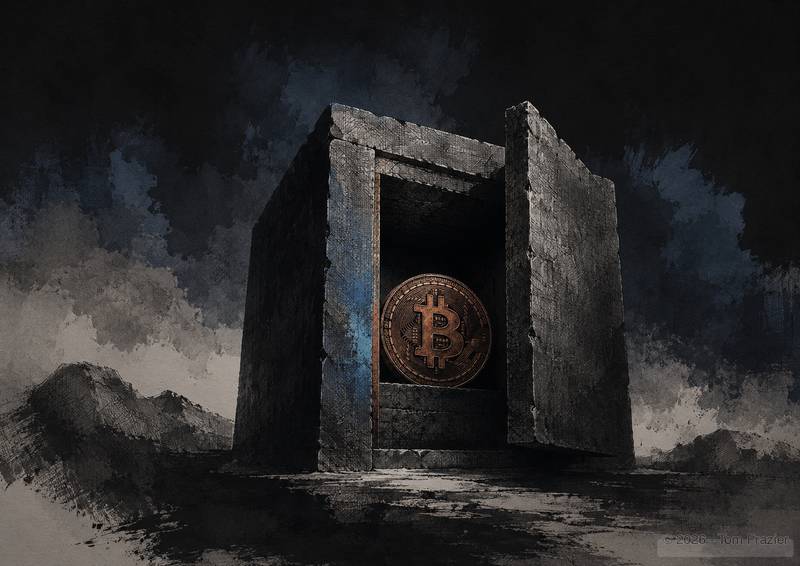
The architecture Satoshi built in 2008 to let individuals opt out of a monetary system that bailed out banks is now held by the government that wrote that original bailout check. That's not contradiction. That's a technology finding its highest use case, exactly as the best technologies do.
It was always going to be this.
What the Best Builders Actually Do
Every great technology gets its use case wrong the first time. Not because the builder lacked vision, but because the problem the world actually needed solved was larger than the one visible at the time. Amazon's engineers were trying to survive Black Friday. Twitter's founders were trying to save a struggling startup. Satoshi was trying to give individuals an exit from a broken monetary system.
All three built something true. True enough to survive contact with a problem none of them originally imagined. True enough to scale from the problem in front of them to the problem the world turned out to have.
The second-order consequence of that last one is still unfolding. If Bitcoin becomes the settlement layer for nations, the inflation Satoshi built it to escape doesn't just get avoided by individuals who opt in. It gets constrained for everyone, at the system level, by the architecture itself.
The builders who matter aren't the ones who got it right from the start. They're the ones who built something honest enough to find out what it was really for.


