

Preparing for Press: How to Become Noteworthy and Not a Footnote
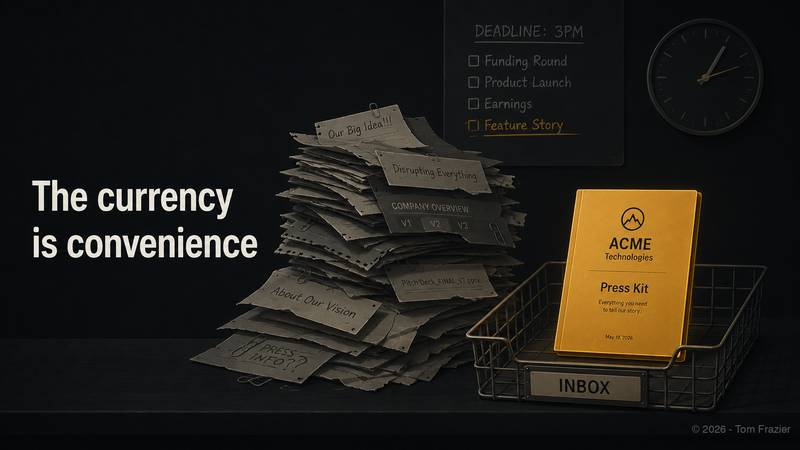
Most founders who don't get press coverage don't fail because their story is weak. They fail because they made the journalist's job hard. Press coverage is a transaction and the currency is convenience. Here's how the media machine actually works, and how to use it to your advantage.

Phase 2 — Startup & Launch
How to start strong, find your voice, get press, stay compliant, and not blow the 180-day window most founders squander.
It is a Serial Entrepreneur's Playbook From Idea To Long-Term Success.
Press Prep
It evaluates your business's readiness for public relations, gives personalized assistance in developing a full suite of logos and social media elements, and crafts comprehensive press kits.
I've pitched journalists. I've also sat across from founders pitching me. After enough time on both sides of that table, the pattern becomes impossible to miss:
Most founders who don't get coverage don't fail because their story is weak. They fail because they made the journalist's job hard.
Press coverage is not a reward for having a good company. It's a transaction — and the currency is convenience. Journalists are working against deadlines, managing multiple stories, and fielding dozens of pitches a week. The founder who gets the call-back is almost never the one with the most impressive company. It's the one who made it frictionless to say yes.
Here's how that actually works.
The Earned vs. Paid Distinction (and Why It Matters More Than Most Founders Think)
Before you build a PR strategy, you need to know which game you're playing.
Owned media — channels and assets you control: your website, blog, newsletter, podcast, resource library, social profiles, customer emails, founder essays, reports, webinars, and gated tools. It doesn’t borrow trust the way earned media does, and it doesn’t scale instantly like paid media, but it compounds because you own the audience relationship, the message, the archive, and the conversion path.
Coverage you didn't pay for — an interview, a feature, a quote in an article, a podcast appearance. It carries implicit third-party validation. Readers know it wasn't purchased, which is why it moves the needle on trust, brand authority, and investor perception in ways that paid placement never fully replicates.
Advertising — sponsored posts, press release distribution services that guarantee placement, native content partnerships. It scales predictably because it's a transaction. You get what you pay for, and readers mostly know it.
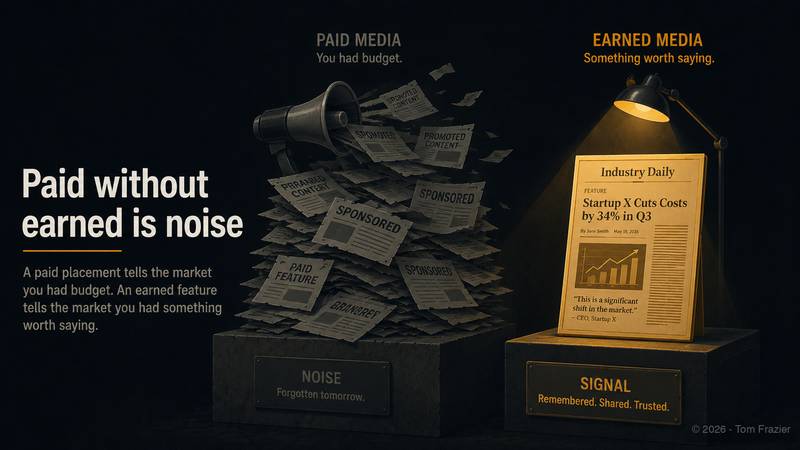
The mistake early-stage founders make is treating paid placement as a substitute for earned coverage. It isn't. A sponsored feature in a trade publication tells the market you had budget. An earned feature tells the market you had something worth saying. Those are different signals.
The practical rule: use paid media to sustain visibility once you have a story. Use earned media to build the credibility that makes that story stick.
Paid without earned is noise. Earned without paid support often fades before it compounds.
Most early-stage companies should focus almost entirely on owned and earned media. The budget is limited, the credibility upside is higher, and the discipline of pitching without paying forces you to sharpen your story in ways that make every subsequent piece of communication better.
What Journalists Are Actually Looking For
Journalists are not looking for impressive companies. They're looking for stories their audience cares about, attached to sources who make them easy to write.
What makes a story? Something timely, specific, and consequential. A funding announcement matters. A new product launch can matter. A data point that illuminates a trend matters. Your general excellence as a company does not.
The founders who consistently get coverage share a few habits:
They tie their news to something external
If there's a regulatory shift, a market movement, or a technology development generating coverage, the smart move is to connect your story to it — not wait until you have "enough news" to stand alone. Journalists are already writing about the macro. Make it easy for them to include you.
They lead with the specific
The pitch that says "we're transforming the logistics industry" gets deleted. The pitch that says "we reduced last-mile delivery costs by 34% for three mid-market retailers in Q3" gets read. Specifics signal credibility. Generalities signal nothing.
They have assets ready
This is where most founders lose the coverage they've already earned. A journalist responds. They want a quote, a photo, a data point, a quick call. If you're scrambling to pull together a headshot or drafting your company bio from scratch at that moment, you've introduced friction at exactly the wrong time. The pitch that converts is backed by a press kit that removes every possible reason to say "let me come back to this."
The Anatomy of a Press Kit
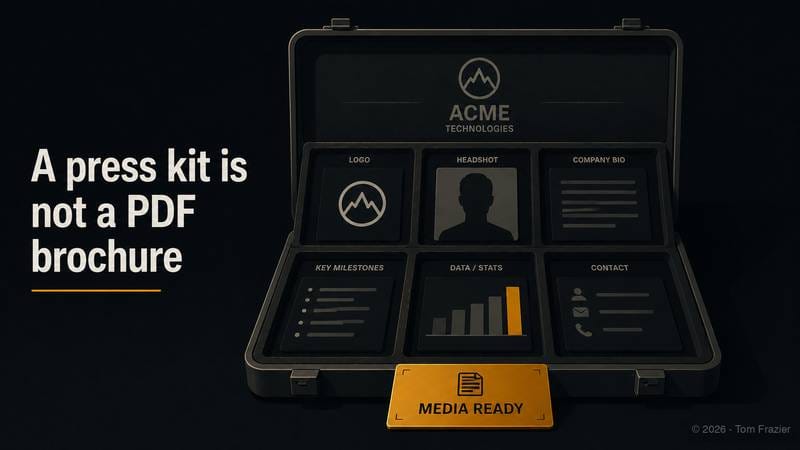
A press kit is not a PDF brochure. It's an operational document — a self-contained packet that gives a journalist everything they need to write about you without asking you a single question they shouldn't have to ask.
The founders who get consistent coverage have this ready before they need it. The ones who don't are always building it reactively.
Here's what belongs in it.
1. Brand Story
Lead with your market position, not your origin story. Journalists don't care about why you started the company. They care about what you do, for whom, and why it matters.
Structure it with three clear statements:
- Our product is for people who believe ___
- We focus on people who want ___
- We promise that engaging with us will help you get ___
Follow that with one tight paragraph — not a page — that describes the company in plain language. No jargon, no superlatives, no claims that can't be verified. The paragraph should answer: what does this company do, who does it serve, and what makes it different?
This is the section most founders write last and should write first. If you can't answer those three statements clearly, your media strategy has a messaging problem that no pitch can fix.
2. Brand Assets
Journalists and editors need visual assets in the formats they actually use. If you make them hunt for your logo or send them a JPEG that turns into a smear at any reasonable size, you've introduced friction.
A complete brand asset package includes five logo versions:
- Horizontal — the standard lockup, used in most editorial contexts
- Vertical — stacked version for layouts where width is constrained
- Horizontal Knockout — reversed on dark backgrounds; essential for podcast cards and dark-mode formats
- Vertical Knockout — same, vertically oriented
- Profile/Circle — cropped for social profiles, author bios, and circular media placements
Each should be provided in at minimum SVG (vector/scalable), PNG on transparent background at 2x resolution, and wherever possible, EPS for print applications.
The founders who get this right also include a one-line usage note: what colors are acceptable backgrounds, whether the mark can be used on its own, minimum sizing constraints. Editors at professional publications will appreciate it. Small outlets will just be glad they have what they need.
3. Social Media Presence
List every platform where your company has an active presence — not every platform where you've ever created an account. An abandoned Twitter account listed in your press kit is worse than not listing Twitter at all.
Your social share asset belongs here: a single graphic formatted for standard share sizes (1200×630 for most editorial and social contexts) that encapsulates your value proposition visually. This is not a product screenshot. It's not a logo on a background. It's the image that appears when someone shares a link to your company, and it should tell a story in two seconds without any supporting text.
Include direct URLs — not "find us on LinkedIn," but the actual profile link. A journalist pulling together a piece under deadline doesn't have time to search.
4. Products and Services
This section is not a product brochure. It's a value proposition statement and a hero asset: one clean image that depicts your primary offering in a media-ready context.
The value proposition statement should be three to four sentences. What does the product do, who is it for, and what does the customer get that they couldn't get before? No feature lists. No technical specifications unless your audience is technical. The metric that changes after someone uses your product is almost always more compelling than any description of how it works.
The hero image should show the product in use — not floating on a white background, not in a product mockup framing that looks generated. Show the product doing what it does. If you're a software company, show a real screen with real data, not a stock photo of someone typing.
5. Management Profiles
A journalist writing about your company will often want to quote a named executive, link to a profile, or verify basic credentials. If that information isn't in your press kit, they'll try to find it themselves — and they'll get it wrong, or they'll move on.
Each key management profile should include:
- Headshot — professional, high-resolution, recent. Not your LinkedIn photo from 2019.
- Title and primary function — one line, not a paragraph
- Work history — two to three sentences, most recent and relevant first, no resume density
- Personal social links — LinkedIn at minimum; Twitter/X if active professionally
Keep bios tight. A journalist who needs a quote wants to verify who they're quoting, not read a career retrospective. The profile is a credential check, not a biography.
6. Key Milestones
This is the section that distinguishes a real company from an aspirational one, and it's the section that changes most often — which means you need to update it.
Milestones include both achieved and upcoming, and they serve different purposes:
- Achieved milestones establish momentum and credibility. Funding rounds, customer counts, revenue thresholds, awards, partnerships, notable deployments, product launches. Include dates. Approximate is fine; vague is not. "Closed seed round, [Month Year]" beats "raised early-stage capital."
- Upcoming milestones give journalists a reason to follow up. Series A in process, product launch scheduled, market expansion announced. These create future coverage hooks and signal that the company is in motion.
- What to exclude: milestones that don't mean anything to someone outside your company. Reaching 100 team members matters. Launching your fourth internal process improvement initiative does not.
7. Contact Information
This sounds obvious. Founders get it wrong constantly.
The contact listed in your press kit should be reachable, responsive, and empowered to schedule time with the CEO or founder within 24 hours. If that's you, say so. If that's a PR coordinator, make sure they know what they're authorized to commit to.
Include your company website, a media inquiry email address, and ideally a phone number for urgent contacts. A journalist on deadline who can't reach you in an hour will move to a source they can reach.
How to Write a Press Release That Gets Read
Most press releases are unread because they're written for the company, not for the journalist. They open with the CEO's name, bury the news in paragraph three, and close with a boilerplate that reads like it was copied from a 2007 IR template.
The press release structure that actually works is simple:
- Headline: The news, in one sentence. Not "Company X Announces Launch of Revolutionary Platform." Something like: "Logistics Startup Cuts Mid-Market Delivery Costs 34%, Closes $4M Seed."
- First paragraph: Who, what, when, where. All of it, in four sentences or fewer. A journalist should be able to write the article's opening paragraph from your first paragraph alone.
- Second paragraph: One substantive quote from the CEO. Not "We're thrilled to announce." Something that gives the reader something to think about. This is your only real editorial space — use it.
- Third paragraph: Context. Why does this matter? What's happening in the market that makes this news relevant?
- Boilerplate: Three sentences on the company, written in the third person. This is the text that gets copied into "About" sections. Write it like it will be published verbatim, because sometimes it is.
- Contact information: Press inquiry email, phone, website. This belongs at the bottom of every release, not just the ones you remember to add it to.
Total length: 400 words maximum. If it's longer than that, you're explaining instead of reporting.
Building a PR Strategy That Scales
The press kit is infrastructure. It doesn't replace a strategy.
A media strategy that scales has three layers:
- Tier 1: Your owned channels. Your blog, LinkedIn, newsletter, podcast. You control the message, the timing, and the format. This is where your point of view gets established before journalists ever find you. Founders who are already on the record with specific, defensible positions are dramatically easier to pitch because the journalist can verify the angle before they pick up the phone.
- Tier 2: Earned placements. Interview outreach, HARO and Qwoted responses, podcast guest appearances, contributed op-eds. These build credibility over time and create a citation trail that compounds. Every earned piece becomes a credential for the next one.
- Tier 3: Amplification. Once you have earned coverage, paid distribution — social promotion, newsletter sponsorships — can extend its reach. This is where paid media earns its place: not generating credibility, but extending the reach of credibility you've already built.
The rhythm matters as much as the activity. Intermittent press pushes around funding or launches are tactically useful but strategically weak. Consistent, quiet presence in publications your target audience actually reads builds the kind of market authority that makes the next round easier to close and the next partnership easier to earn.
The founders who get consistent, serious press coverage share one characteristic:
They made media readiness a standing discipline, not a crisis response. The press kit was ready before the journalist asked.
The quote was already on record before the story broke. The brand assets were available in the right formats before the podcast went live.
That's not luck. That's operational discipline applied to a function most founders leave entirely to chance.
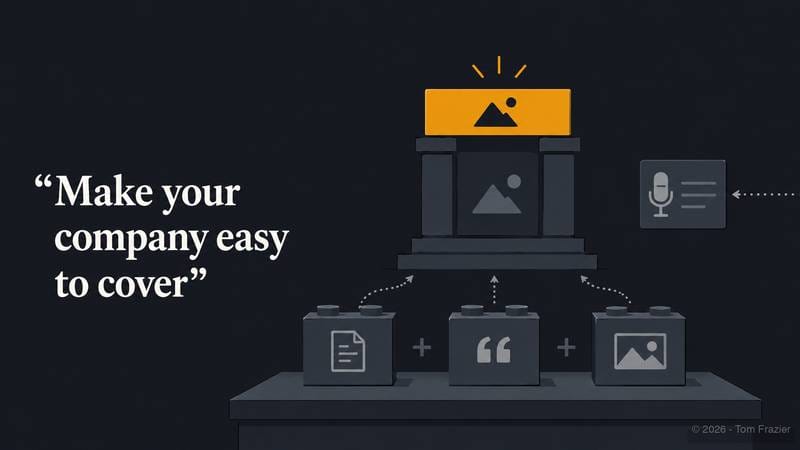
Make your company easy to cover. The rest follows.
This is the fourth article in Phase 2 — Startup & Launch. You can access the AI tool below.
Be Newsworthy Not A Footnote. A free AI tool just for subscribers. ⤵️
This article is why I built the Press Prep GPT. It offers tailored advice for launching, promoting, and scaling businesses of all types. It covers your press management preparedness, Brand asset creation & management and press kit development.
Get a comprehensive and professional press kit for your business, enhancing your media outreach and public relations efforts.
Common Questions About Press Prep
How can Press Prep help if our business is new to PR and lacks experience?
Press Prep guides businesses through the initial stages of PR, offering expertise and tools to build a strong foundation in public relations, even for those new to the field.
Does Press Prep cater to businesses outside the traditional PR mold?
Absolutely. Press Prep adapts strategies to suit a diverse range of businesses, ensuring personalized solutions that resonate with each unique brand and industry.
How does Press Prep handle a business with limited brand assets or unclear branding?
Press Prep specializes in developing and refining brand assets, providing creative direction and practical solutions to establish and clarify your business's brand identity.
Can Press Prep manage our PR needs if we have a small team and limited resources?
Press Prep is just a tool but is equipped to efficiently manage PR tasks, optimizing resources and providing scalable solutions that fit the capabilities of smaller teams and budgets.
Is the Press Prep approach adaptable to rapidly changing market conditions and trends?
Press Prep is a GPT so it stays abreast of market shifts and trends, ensuring that your PR strategies remain relevant, agile, and effective in a dynamic business environment.
This post is for subscribers only
Sign up now to get access to the post.
Already a member? Sign in

