


Launch Strong: How to Make Your First 180 Days Count
A launch is not an event. It is a 180-day operating period with three distinct phases each demanding different focus, different metrics, and different decisions. Founders who collapse all three into a single launch day spend the next six months wondering why nothing stuck.

Phase 2 — Startup & Launch
How to start strong, find your voice, get press, stay compliant, and not blow the 180-day window most founders squander.
It is a Serial Entrepreneur's Playbook From Idea To Long-Term Success.
Launch Lander
It covers all stages from pre-launch to post-launch and develops strategies including market research, branding, promotional tactics, and operational planning unique your business
This is a long article so get comfortable, take notes and come back for reference.
Most founders treat launch like a finish line. They spend months building, then one day flip a switch and wait for the market to respond. When it doesn't — or when early traction sputters into silence — they conclude they have a product problem. They usually don't. They have a process problem.
The window between "we're launching" and "we have traction" is where companies are won or lost, and it has nothing to do with the quality of your product.
It has everything to do with whether you've done the unglamorous, sequential work before, during, and after the moment you go public. I've launched companies in several different countries. The pattern of failure is nearly identical every time: founders conflate a launch plan (a to-do list for a single day) with a launch strategy (a 180-day operational commitment). They're not the same thing.
A launch plan tells your team what to post on day one. A launch strategy tells you what signals to watch, what to stop doing, and how to turn early users into durable traction. This article is built around the latter — a practical field guide organized across three distinct phases: the 90 days before you go live, the moment of launch itself, and the 90 days that follow. Every section tells you what to do and — just as important — what to stop wasting time on.
The Timeline
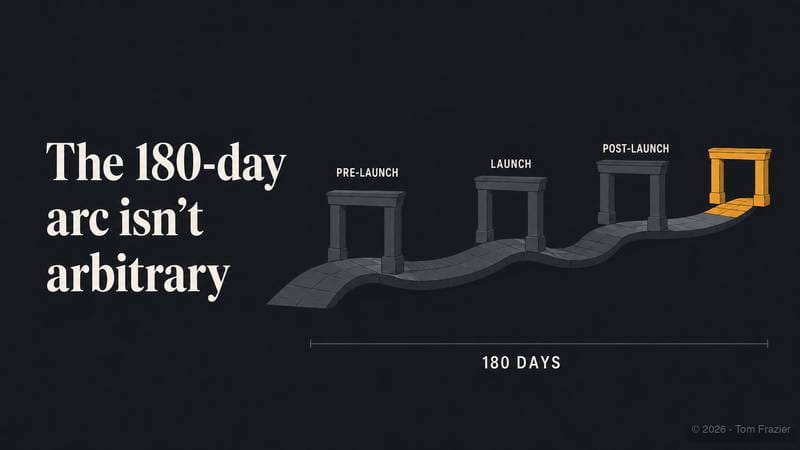
Before the checklists, a rough map. The 180-day arc isn't arbitrary — it reflects the natural cadence of early market development. Compress it and you ship before you're ready. Stretch it and you lose the momentum window that makes early adopters actually feel early.
| Timeframe | Phase | Primary Focus |
|---|---|---|
| Day −180 to −91 | Deep Pre-Launch | Market intelligence, brand foundations, infrastructure |
| Day −90 to −31 | Active Pre-Launch | Asset production, launch-list development, partner outreach |
| Day −30 to −1 | Final Pre-Launch Sprint | Soft launch testing, media seeding, readiness audit |
| Day 0 | Launch | Coordinated activation across all channels |
| Day +1 to +30 | Early Signal | Feedback capture, retention diagnostics, rapid iteration |
| Day +31 to +90 | Consolidation | Doubling down on what's working, cutting what isn't |
The line most founders blur is the one between Deep Pre-Launch and Active Pre-Launch. Research isn't an ongoing activity — it has a defined endpoint. If you're still doing primary market research at Day −30, you're late.
Phase One: Pre-Launch (Day −180 to Day −1)
What Market Research Actually Means
The founders who get this right aren't reading industry reports or fielding survey responses. They're having uncomfortable conversations and looking at behavioral data that already exists.
Real market research has three components:
- competitive displacement analysis,
- channel signal reading, and
- buyer conversation.
Competitive displacement analysis means mapping not just who your competitors are, but which customers have left them and why. These are your first calls. A churned customer from a competitor is a research goldmine — they've already articulated the gap your product needs to fill.
Channel signal reading means going where your buyers already congregate — specific subreddits, LinkedIn groups, Slack communities, industry forums — and cataloging the language they use to describe their problems. Not your language. Theirs. The vocabulary gap between how you describe your product and how buyers describe their problem is usually the single biggest obstacle to early messaging.
Buyer conversations mean sitting with potential customers before you have a product to pitch. The discipline here is asking about their current behavior, not their hypothetical preferences.
"What do you use today?" produces better signal than "Would you use this?"
Behavioral data over stated preference, every time.
The most common pre-launch research mistake is treating market validation as a one-time event instead of a progressive narrowing of uncertainty. You're not trying to prove the market exists. You're trying to understand the specific problem, in the specific segment, at the specific price point, that gives you a viable entry. Those are four different questions, and most founders answer only the first one.
Pre-Launch Market Research Checklist
- Map the top 3–5 competitors and identify their public churn signals (negative reviews on G2, Trustpilot, or app stores; social complaints; community forum complaints)
- Conduct 15–20 buyer conversations focused on current behavior and workarounds — not on your product
- Identify the 3–5 online communities where your target buyer is most active and spend 30 days listening before posting anything
- Document the exact language buyers use to describe the problem you solve — use these phrases verbatim in your messaging
- Identify the top 3 reasons current alternatives fall short; these become your differentiation pillars
- Define your initial ICP (Ideal Customer Profile) with specifics: company size, role, industry, specific trigger event that creates urgency to buy
- Price-test your model through direct buyer conversation before locking it — ask what they currently spend on the problem, not what they'd pay for your solution
Brand Development
Brand work in pre-launch isn't a creative exercise — it's a strategic one. The decisions you make here set constraints on everything downstream: messaging, channel selection, partner conversations, and pricing positioning. Get it wrong and you spend the next 12 months fighting the market's misreading of you.
 Tom Frazier
The foundational work is defining your brand architecture before you produce any assets. That means: your mission (what you're changing in the world), your vision (the future state your company is building toward), your values (the non-negotiable operating principles), your brand essence (one word or phrase that captures what you stand for), and your brand promise (the specific commitment you make to every customer, every time). These aren't marketing deliverables. They're decision filters. Every asset, message, and channel choice should be tested against them.
A brand that can't be articulated in a room of five founders without disagreement isn't ready to go to market.
From that foundation, the execution work flows:
Pre-Launch Brand Development Checklist
- Define the five-element brand architecture: mission, vision, values, essence, promise — in writing, approved by all co-founders
- Write your positioning statement using this template: For [target customer] who [has this problem], [brand] is the [category] that [delivers this specific benefit], unlike [alternative] which [falls short in this specific way]
- Develop your brand voice and tone guide — at minimum: 3 adjectives that describe how you sound, 3 adjectives that describe how you don't, and 5–10 example phrases that are "on brand" vs. "off brand"
- Name, domain, and handle audit — secure your primary brand name across the domains and social handles you intend to own, including obvious misspellings
- Develop a brand style guide covering: primary and secondary color palette (with hex codes), typography system (heading and body fonts), logo system (primary, secondary, favicon), and image/photography direction
- Define your category positioning — are you creating a new category, repositioning in an existing one, or displacing an incumbent? Each requires a different narrative strategy (I cover this in-depth in a separate article).
Tom Frazier Tom Frazier
 Tom Frazier
Asset Generation
Asset generation is the most execution-intensive phase of pre-launch, and most teams sequence it wrong. They build the website before they've locked messaging. They produce content before they know which channels they'll prioritize. They design for a brand identity they haven't fully defined.
Pre-Launch Asset Generation Checklist
Website
- Build to the minimum viable credibility threshold — not a full marketing site, but enough to convert a warm referral and survive a journalist's first look. That means: hero section with a clear value proposition and CTA, product/service explanation that a newcomer can parse in 90 seconds, social proof (even if early — logos, founder credentials, waitlist count), and a working lead capture mechanism
- Implement analytics from day one: GA4 and a heatmapping tool (Hotjar or Microsoft Clarity) — you need behavioral data from your first visitors, not just traffic counts
- Set up conversion tracking before you go live — not after
Content
- Write 3–5 cornerstone articles or pieces before launch — not for traffic, but to establish a content anchor that gives media and partners something to reference
- Develop a 90-day content calendar covering the post-launch period — frequency you can actually sustain beats ambitious plans you'll abandon
- Produce your launch announcement content in full before launch day: press release, founder letter or blog post, social copy variants for each platform
Collateral
- One-pager or pitch deck for partner and investor conversations (not a product demo — a business narrative)
- Email sequence for new subscribers or sign-ups: minimum a welcome email + 2 follow-on messages that deliver value before asking for anything
- Case study or proof point document — even pre-revenue, document a pilot customer's experience, a beta result, or a before/after use case that illustrates the value
Media Kit
- Founder headshot (professional, not a LinkedIn crop)
- Company logo in multiple formats (PNG transparent, SVG, dark/light versions)
- 50-word, 150-word, and 300-word company descriptions ready to paste
- Key stats and traction points updated and ready (even pre-launch metrics like waitlist size, pilot results, or development milestones)
Launch-List Development
Your launch list is not your marketing list. It's a curated group of people who will actively help your launch succeed — through early purchases, referrals, social amplification, or warm introductions to others. Size matters less than composition and activation likelihood.
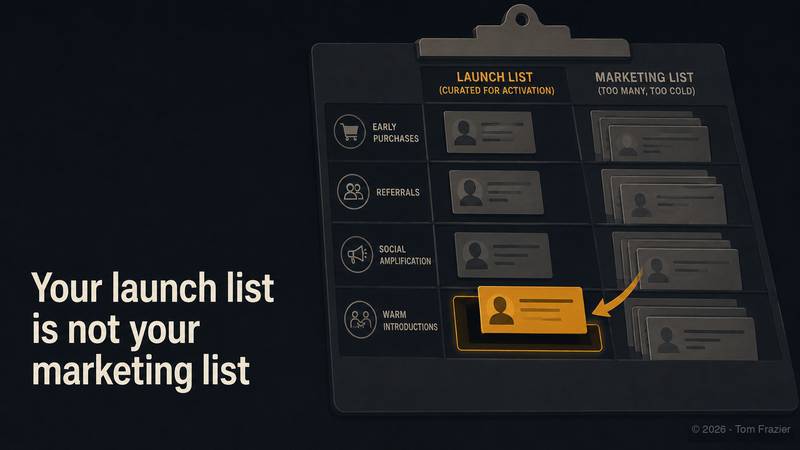
The best launch lists are built from four segments:
- direct relationships (people who know and trust you personally),
- industry adjacent contacts (people in adjacent roles or industries who can open doors),
- potential early adopters (people who fit your ICP and have expressed prior interest), and
- amplifiers (journalists, newsletter writers, community managers, and influencers who reach your target buyer).
The mistake is treating the launch list as a notification list rather than an activation network. The people on it should receive a personal, non-automated communication before launch day — something that makes them feel like insiders, not like subscribers. That distinction is the difference between people who forward your launch to their networks and people who don't open the email.
Pre-Launch Launch-List Checklist
- Build a segmented list with a minimum of 4 columns: name, relationship type (personal/industry/ICP/amplifier), contact method (email/LinkedIn/phone), and activation ask (purchase/share/introduce)
- Set a target: 200 contacts minimum, with at least 50 in the amplifier category
- Personalize outreach for the top 50 contacts — these are the people who can move the needle most directly and deserve individual attention
- Pre-write the personal pre-launch email — the one that goes only to people who know you and asks for a specific favor, not a generic newsletter blast
- Identify 10–15 journalists or newsletter writers who cover your category and begin building relationships through genuine engagement at least 60 days before launch
Infrastructure and Operational Readiness
Going live before your operational infrastructure is ready is a specific kind of expensive. Your first customers will define your brand perception in ways your marketing never will. If the signup flow breaks, the onboarding email never arrives, or a support request disappears into a shared inbox, you're spending social capital you haven't earned yet.
The readiness audit is ruthless: can the business actually function at 2x, 5x, and 10x your expected Day 1 volume, without you personally in every workflow?
Pre-Launch Infrastructure & Operational Readiness Checklist
Core Systems
- CRM configured and populated with your launch list before Day 0 — not a spreadsheet, an actual system you'll use
- Customer support workflow defined: who handles inbound, what's the SLA, what escalation path exists — even if it's a one-person operation
- Payment processing fully tested end-to-end — not just technically functional, but tested with real payment methods in production mode
- Email service provider configured with proper domain authentication (SPF, DKIM, DMARC) — critical for deliverability; fix this before you build a list, not after
- Analytics stack verified: confirm every key conversion event is firing correctly before launch
Operational Procedures
- Onboarding flow documented and tested by someone unfamiliar with the product — they will find what your team missed
- Internal escalation process defined for launch-day issues: who decides what gets fixed now vs. later, and who has the authority to pause a campaign if something breaks
- Launch-day communication plan for the internal team: who's monitoring which channel, at what intervals, and what the go/no-go criteria are if a critical issue appears
- Legal and compliance layer confirmed: terms of service, privacy policy, and any category-specific requirements (financial services, healthcare, data handling) live before you take a paying customer
Load and Stress Testing
- If you're running a software product, stress test against 10x expected launch-day traffic — not your average week's traffic, your launch day traffic, which will be the highest single-day volume you'll see for months
- Test your payment processor under concurrent transaction load
- Confirm your hosting and infrastructure autoscaling is configured correctly — a traffic spike that crashes your site on launch day is unrecoverable in the short term
Phase Two: Launch (Day 0)
Launch day is not the day you find out if your strategy works. It's the day you execute a plan you've already built. The founders who treat launch day as a strategic decision point are the ones who freeze, post-pone, or scramble.
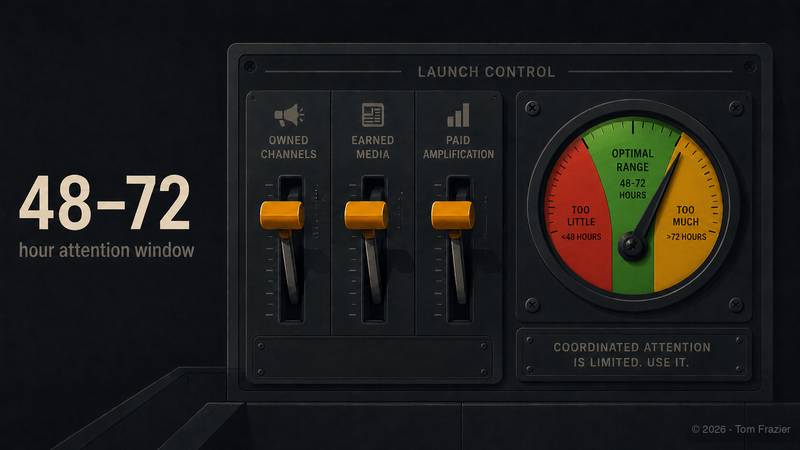
The objective on Day 0 is full coordinated activation: owned channels go live simultaneously, earned media coverage publishes as planned (or as close to it as you can control), paid amplification turns on, and your launch list receives their pre-written, personalized outreach. The window of coordinated attention lasts 48–72 hours. Everything on this checklist is designed to maximize that window.
In-Market Awareness: Paid, Owned, and Earned
- Owned channels are your floor — the minimum that happens regardless of what earned or paid media does. Your website goes live, your launch blog post publishes, your email list receives the announcement, and your social accounts post coordinated content. The mistake is treating owned channels as the backup plan. They're the backbone. Everything else amplifies them.
- Earned media is the highest-leverage and most unpredictable element. The work to earn it happens in the 60 days before launch — not the week before. By Day 0, you should have at minimum: one journalist or newsletter writer who has agreed to cover the launch, one or two industry voices who have agreed to mention or share it, and a press release that's been distributed through a service like PR Newswire or BusinessWire for syndication. Target specific beats, not generic business outlets. A story in a niche industry publication read by your exact ICP is worth ten mentions in a general business outlet.
- Paid amplification is a multiplier, not a substitute for organic traction. Don't run paid on Day 0 against cold audiences. On launch day, paid media belongs on two targets: retargeting your existing warm audience (people who visited your site during soft launch or pre-launch period) and amplifying your organic launch content to lookalike audiences built from your launch list. Spend that first $1,000–$2,000 on signal amplification, not discovery.
Launch Day In-Market Awareness Checklist
- Publish the launch blog post or founder letter on your owned domain — not just on LinkedIn or Medium
- Send the launch email to your full list at a tested optimal send time for your audience (Tuesday–Thursday, 9–11am in your primary timezone, as a default starting point)
- Post coordinated social content across all active platforms — adapt format and length per platform, not copy-paste
- Activate the retargeting audience in paid media
- Send personal outreach to the top 50 contacts on your launch list — not a blast, a direct message with a specific ask
- Submit to relevant directories, communities, and aggregators: Product Hunt, relevant subreddits, industry Slack communities, niche directories in your category
- Send the press release to your media distribution service
- Monitor inbound closely for the first 8 hours — respond to every comment, every email, every social engagement personally if volume allows
Partner Introductions and Announcements
Launch is the highest-legitimacy moment you'll have in the early life of your company. Use it to anchor partner relationships you've been building in pre-launch. A partner who agrees to introduce you to their audience or co-announce during your launch window provides social proof that no amount of paid media can replicate.
The right partners are adjacent, not competitive: businesses that serve your target customer in a complementary way and have an established audience relationship with them. Their endorsement at launch signals to your ICP that you belong in the ecosystem.
Launch Partner Checklist
- Identify 3–5 strategic partners to co-announce with or receive endorsements from — these conversations should be live by Day −60 at the latest
- Agree on the specific form of the partnership announcement: their newsletter mention, a joint social post, a co-branded piece of content, or a formal press release citing the partnership
- Provide partners with ready-to-use assets — text, images, links — that require minimal effort to deploy; the easier you make it, the more likely it happens
- Follow up with all partner contacts within 24 hours of launch to confirm deployment and thank them specifically
Launch Event Ideas
An in-person or virtual event concentrated around launch creates a forcing function for media, partners, and potential customers to engage simultaneously. The best launch events serve one of three strategic functions: demonstration (show the product doing something remarkable), education (teach the target audience something valuable, with your product as the natural next step), or community (bring the right people into the same room and let the conversation happen organically).
Three themes worth considering:
- Live Demo + Q&A Webinar — A 45-minute structured demonstration of the product solving a real customer problem, followed by 30 minutes of unscripted Q&A. The key is choosing a demo scenario that is instantly recognizable to your ICP. Abstract demos fail. Demos that make the audience think "that's exactly my problem" convert. Stream it live, record it, and repurpose the recording as your primary piece of mid-funnel content for the next 90 days.
- Founder's Roundtable — A private, invitation-only conversation with 10–20 potential customers or industry voices, structured around the problem your product solves — not around your product. Record it (with permission) and distill it into a piece of original research or a published insight report. The event becomes a credibility asset. The content becomes a distribution asset. The attendees become advocates.
- Category Challenge or Audit — A structured public event where you demonstrate the gap in the market your product addresses — often by auditing the existing alternatives publicly. This works particularly well for products that displace a legacy process or incumbent tool. It's inherently newsworthy, it positions you as the informed authority in the category, and it gives media something concrete to cover beyond "company launches product."
Promotional Strategy
Promotions at launch should accomplish one thing: lower the activation barrier for the first cohort of customers. They're not a pricing strategy. They don't set a long-term price expectation. They're a mechanism for getting your first 50–100 customers across the finish line so you have real users in the system generating real data.
The most effective launch promotions are time-bounded and exclusive — not discounts that persist indefinitely, which train the market to wait. A 30-day founding member offer with a genuine deadline creates urgency without permanently anchoring your pricing low.
Make the promotional offer simple enough to communicate in one sentence. Complexity kills conversion.
"First 100 customers get locked in at our founding price of $X forever" is simple.
A tiered promotional structure with five different offer combinations is not.
Phase Three: Post-Launch (Day +1 to Day +90)
The 90 days after launch are when most founders make the same mistake in reverse: they stop executing. The campaign is over. The launch event happened. Now they wait for the market to do its thing. That's not how traction works. Traction is manufactured through relentless attention to signal — what's working, what's breaking, and where the product is failing to deliver on its promise.
The primary objective in post-launch isn't growth. It's retention. A company that acquires 100 customers and keeps 80 is in a fundamentally different position than one that acquires 500 and keeps 40.
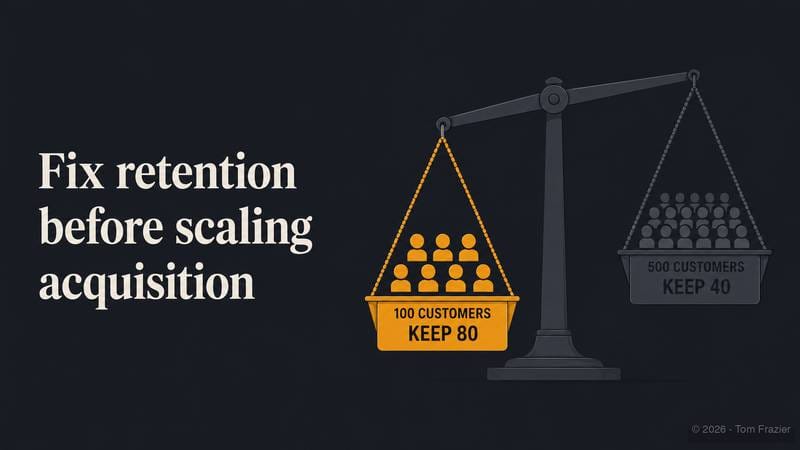
Fix retention before scaling acquisition.
Capturing Early Customer Feedback
The most valuable feedback in the first 30 days post-launch comes from three sources: customers who converted and stayed, customers who converted and churned, and prospects who evaluated and didn't buy. Most founders talk only to the first group.
Tip 1: The 48-Hour Check-In Call
Book a 20-minute call with every paying customer within 48 hours of their purchase. Not a support call — a structured conversation. Three questions: What made you decide to buy today? What was the first thing you tried to do with the product? What, if anything, didn't work the way you expected? The answers to the third question are more valuable than any survey you'll ever send.
Tip 2: The Churn Autopsy Interview
Every customer who cancels or goes inactive in the first 30 days gets a personal email — not an automated win-back sequence — asking for a 10-minute conversation. The response rate is surprisingly high if the email is genuine and comes from a founder. The goal isn't to win them back. It's to understand the specific failure point. A pattern that appears in 3 or more churn interviews is a product or process problem that needs to be fixed immediately.
Tip 3: The Non-Buyer Debrief
Identify 10–15 people who evaluated your product during launch and didn't buy. Reach out directly — LinkedIn, email, or phone. Acknowledge they looked and didn't commit, and ask for 15 minutes to understand why. The objections that prevented conversion from a warm prospect are almost always more actionable than the suggestions you'll get from satisfied customers.
Early-Adopter Incentives
Early-adopter incentives serve a different function than promotional discounts. Discounts lower price. Early-adopter incentives buy loyalty and create advocates. The distinction matters because the behavior you want from your first customers isn't just purchase — it's referral, testimonial, and case study participation.
The most effective early-adopter incentives:
- Founding member pricing — A price lock at current rates for the lifetime of the product, communicated as a permanent benefit. This is the most powerful retention lever in subscription businesses. The founding member feels vested in your success; leaving means giving up their pricing advantage.
- Roadmap influence — Formal access to the product roadmap with a genuine vote or input mechanism. This works particularly well in B2B. Buyers who feel like co-builders stay longer and advocate harder than buyers who feel like customers.
- Priority support tier — First-in-queue access to the team. Simple, credible, and high-perceived-value at near-zero cost when you're small enough that support volume isn't yet a burden.
- Referral equity — A referral credit or revenue share for early customers who introduce paying customers. Don't overcomplicate the economics. If a referred customer is worth $X to you, sharing $X/5 with the referrer is a rational customer acquisition cost.
What not to offer: extended free trials.
Free trial extensions attract users who aren't committed enough to pay. They inflate your active user metrics while generating no revenue and consuming support resources. If the product hasn't convinced someone to pay after a standard trial period, more trial time rarely changes the outcome.
Monitoring the User Journey: Moments of Truth and Proof of Value
The user journey isn't a marketing diagram. It's a sequence of specific moments where your customer either continues forward or stops. The founders who win in the post-launch period are the ones who've mapped these moments precisely and have instrumentation to see when customers fall out of the sequence.
The three customer 'Moments of Truth' to monitor:
First Moment of Truth — Activation.
Did the customer get to the core value of your product? In most SaaS products, this is a specific action that indicates the product has "clicked" — a dashboard populated with real data, a first workflow completed, a first output generated. Define this moment precisely for your product, then measure the percentage of new customers who reach it within the first 48 hours. If that number is below 60%, your onboarding has a problem, not your product.
Second Moment of Truth — Habit Formation.
Did the customer return? The return-to-product rate in days 3, 7, and 14 post-signup is the most predictive early indicator of long-term retention. A customer who logs in on day 3 is significantly more likely to still be a customer on day 90 than one who doesn't. Track this cohort behavior from the first week of post-launch, not when you have thousands of customers.
Third Moment of Truth — Value Articulation.
Can the customer describe the value they've gotten? Ask directly, in conversation, 21–30 days post-signup. If a customer can't articulate the specific value they've received, they haven't experienced it clearly enough — and they're a churn risk regardless of what your engagement data says.
The three business moments of 'Proof of Value':
The Case Study Threshold.
The first customer who can articulate a before/after result in specific, measurable terms becomes your primary proof of value asset. Pursue this conversation aggressively in the first 60 days. One real case study with specific numbers outperforms 50 testimonials.
The Referral Signal.
The first unsolicited referral from a customer tells you something more important than any NPS score: someone thought your product was good enough to put their own reputation behind it. Track when this happens, who sent it, and what they said to the person they referred. That's your best conversion message, already written.
The Expansion Signal.
The first customer who upgrades, purchases a second seat, or increases usage without being prompted is your proof that the product delivers enough value to justify paying more. This is your green light to invest in acquisition. A company without any expansion signals shouldn't be scaling its customer acquisition spend.
The Counter-Argument Worth Addressing
The most credible objection to a framework this structured is that early-stage companies can't afford it — that the time spent on pre-launch research, checklist management, and post-launch analysis is time better spent shipping and iterating.
That's a reasonable position for a consumer app with a low-friction conversion model and the ability to run rapid A/B tests across millions of users. It's the wrong position for a B2B company, a company with a complex sales cycle, or any business where early customer relationships are difficult to replace once lost.
The cost of a broken launch isn't a bad launch week. It's the 6–12 months of momentum loss, team morale erosion, and investor credibility damage that follows. I've seen well-funded companies take 18 months to recover from launch failures that the 180-day framework would have prevented. The framework doesn't cost time — it concentrates it in the right places, before the damage is done.
What Execution Actually Looks Like
The founders who move through the 180-day arc successfully share one operational habit: they treat the launch period as a distinct operational mode with its own priority stack. During this window, the team is not building new features. It's not taking investor meetings. It's not attending conferences. It's executing the launch strategy and capturing the signal that makes the next 18 months of decisions better.
That discipline requires saying no to things that feel urgent. It requires recognizing that the launch window is finite and non-repeatable. You will never again have a reason to concentrate this much attention on market entry — the early adopter is a specific kind of buyer who operates in a specific window, and once that window closes, you're selling to a different psychology with different expectations.
Build the machine before you need it. Test it before it matters. Then run it hard when the market is watching.
This is the second article in Phase 2 — Startup & Launch. You can move ahead to making a successful app or access the AI tool below.
Startup Strong Within 180 Days. A free AI tool just for subscribers. ⤵️
This article is why I built the Launch Lander GPT. It offers tailored advice for launching, promoting, and scaling businesses of all types. It covers all stages from pre-launch to post-launch and develops strategies including market research, branding, promotional tactics, and operational planning unique your business.
Get comprehensive launch plans for a wide range of businesses, ensuring a well-structured and strategic approach to starting your venture.
Common Questions About Launch Lander
What if understand the unique aspects of my business idea?
Launch Lander is designed to handle a wide range of business types, from local stores to digital ventures. It asks specific questions to tailor its approach and utilizes a vast repository of business knowledge to provide relevant advice.
Can this help if I'm unsure about my business launch plan?
Launch Lander guides you through the creation of comprehensive launch plans. It breaks down the process into manageable steps, ensuring thoroughness in areas like market research, brand development, and operational readiness.
I'm worried about the complexity of launching a business. Can Launch Lander simplify this process?
Launch Lander simplifies the business launch process by providing structured checklists and timelines. It offers a step-by-step approach, making complex tasks more manageable and helping to organize and prioritize efforts effectively.
Can Launch Lander provide practical, actionable advice, or is it just theoretical guidance?
Launch Lander offers practical and actionable advice. It doesn't just provide theoretical guidance; it suggests specific tasks, tools, and strategies tailored to the business's unique needs, ensuring that the advice is directly applicable.
Is Launch Lander capable of understanding and adapting to the changing needs of my business as it grows?
Launch lander is designed to adapt to the evolving needs of a business. It can reassess strategies and provide updated advice based on the business's growth stage, ensuring relevant and timely support throughout the business lifecycle.
This post is for subscribers only
Sign up now to get access to the post.
Already a member? Sign in

