


Viral Validator: How to Engineer Growth That Multiplies Itself
Most founders pick a sales methodology like they pick software — someone recommended it. The mismatch with your actual business model is where growth quietly dies.

Phase 3 — Growth & Scaling
How to read the market, own your category, sell with a system, build a funnel that converts, and engineer growth people actually share.
It is a Serial Entrepreneur's Playbook From Idea To Long-Term Success.
Viral Validator
Analyze and device viral marketing strategies, identify appropriate business models, and esetimate viral coefficients to boost business growth and online presence
Virality is not luck. It is not a campaign. It is not a referral button bolted onto an existing product and called a growth strategy.
Every founder who has watched a competitor "go viral" and scratched their head like made similar mistakes: they assumed it happened to that company. It didn't. The conditions were built. The mechanics were designed. The coefficient was calculated. Strip the mythology away and what remains is engineering.
Funnel architecture determines whether the growth you generate sticks. Viral mechanics are the accelerant you pour on top of both.
Virality Has Two Faces
There is a distinction worth making before anything else:
product virality and marketing virality are not the same thing.
Product virality is structural.
It exists when using the product is itself an invitation. Calendly sends a scheduling link and every recipient sees the product before agreeing to see it. Zoom requires the invitee to download the client. The product's utility forces the introduction. That kind of virality is built into the architecture, not added by the marketing team.
Marketing virality is manufactured.
It is content, campaigns, and referral mechanics designed to spread the product's reach beyond the immediate user base. It works. It also decays faster, requires ongoing creative investment, and rarely produces the compounding effect of structural virality.
The most durable growth comes from companies that have both. The most common and expensive mistake is chasing marketing virality before the product is structurally ready to support it.
Map Your Business Model Before You Design the Mechanic
Your business model determines your natural viral path. A SaaS platform with a freemium tier has different viral mechanics than a local service business, which has different mechanics than an affiliate-driven e-commerce play. Designing a viral campaign without first identifying your model type is like optimizing a race car for a track you haven't looked at.

Use it before you read the rest of this article. Identify your primary model. The methodology in that row is where you start.
No email address required.
The Business Model Reference Guide maps twelve distinct models and the sales motions most aligned with each. Cross-reference that guide with your current position before designing anything. The AERO model from the previous article shows how Awareness, Education, Retargeting, and Offer stages each serve different functions in the acquisition process. Viral mechanics apply most powerfully at awareness and education, where the cost of reaching cold audiences is highest and social proof carries the most weight.
- For marketplace models: virality is nearly mandatory. The product gets more valuable as more people join, so every new user is structurally incentivized to invite others.
- For SaaS and subscription models: the viral loop is typically triggered by feature invitations, collaborative tools, or output sharing.
- For e-commerce and content monetization models: virality is primarily marketing-driven through social sharing mechanics and referral programs.

Know your model. Then design the mechanic.
The Research Behind What Actually Spreads
The most comprehensive academic framework for online viral marketing campaign planning comes from Patrizia Grifoni, Alessia D'Andrea, and Fernando Ferri of Italy's National Research Council, in "An Integrated Framework for Online Viral Marketing Campaign Planning". Their model maps the full planning cycle: from audience identification through message design, channel selection, seeding strategy, and feedback loops. The breadth of references they assembled makes it the most thorough literature review available on the subject. Practitioners building serious viral programs should read it.
The practitioner-facing complement is Jonah Berger's research at Wharton, codified in Contagious: Why Things Catch On. Berger analyzed thousands of pieces of viral content and identified six structural elements that appear consistently in content people choose to share. He named the framework STEPPS.
The Six Elements of Virality (STEPPS)
These are not checkboxes. They are levers.
Most content activates two or three of them. The strongest viral campaigns activate all six simultaneously. Here is how each element works, and how to apply them specifically.

Social Currency
People share things that make them look good. If sharing your product, content, or referral positions the sharer as knowledgeable, exclusive, or ahead of the curve, they will share it.
Example 1
A B2B productivity platform that shows users their output metrics benchmarked against industry averages gives users a shareable result. "Our team resolves support tickets 40% faster than the industry median" is something a team lead shares because sharing it reflects well on them.
Example 2
An invite-only or early-access program. Being first confers status. Users in founding cohorts share precisely because their early membership signals something about them, not about the product.
Triggers
People share what is top of mind. Triggers are the environmental cues that remind users of your product at the moment they are most likely to refer. The best products embed themselves into daily routines so that recurring events create recurring referral moments.
Example 1
A weekly financial review tool benefits from Monday morning as a built-in trigger. If the product is part of users' Monday workflow, every Monday is a potential referral event.
Example 2
A fitness app built around daily activity logging creates a completion trigger. Every time a user finishes a workout and logs it, the app's confirmation screen is a natural sharing moment.
Emotion
High-arousal emotions drive sharing. Awe, excitement, and even constructive anger push people to pass things on. Low-arousal emotions do not. This is why surprising, counterintuitive, or genuinely impressive content spreads more reliably than informational content.
Example 1
A recruiting tool that publishes real, anonymized compensation data for the first time in an opaque industry generates awe and outrage simultaneously. Both are high-arousal. Both drive sharing.
Example 2
A productivity dashboard that shows users how much time they have reclaimed over the past year ("You saved 47 hours this month") creates an emotional response tied to personal accomplishment. Users share it as self-expression.
Public
When something is visible, it becomes its own advertisement. Behaviors that can be observed create social proof and modeling. Products seen in use drive imitation.
Example 1
A Slack-native tool that surfaces which workflows a teammate is running makes the product visible inside the organization before anyone has been explicitly invited to try it.
Example 2
A presentation tool that appends "Made with [Product]" to every shared deck turns every distribution of the output into a product impression. The output is public. The attribution rides along for free.
Practical Value
People share things that are genuinely useful to others. Actionable frameworks, real data, templates, and tools spread because the sharer is providing value to their network. This is the most reliable trigger for B2B content, and the most consistently underinvested.
Example 1
A tax estimation calculator embedded in a free tool that users share with colleagues facing the same quarterly deadline. The tool does the sharing because the value is concrete and immediate.
Example 2
This article series. The Operator's Edge spreads because each piece contains frameworks operators can apply immediately. Sharing the article is a gesture of goodwill toward the recipient, not a favor to the brand.
Stories
Information wrapped in narrative is retained and shared at dramatically higher rates than information delivered as raw fact. The best viral campaigns create a narrative arc that users want to participate in and retell.
Example 1
A startup that publishes a founder's unfiltered journey including specific dollar amounts, failed pivots, and what they would do differently creates a narrative readers follow and share because it feels true.
Example 2
A product that turns user data into a personal "year in review" narrative (think Spotify Wrapped, applied to any vertical) makes the user the protagonist. They share the story. The product gets the attribution.
Dispersion Strategies: How the Seed Gets Planted
Message architecture is only half the problem. How you distribute the initial seed matters as much as what you are seeding. There are two categories.

Displayed Dispersion
Displayed dispersion is transparent. The user knows they are participating in a sharing mechanism and the mechanics are visible: referral programs, invite codes, explicit "share with a friend" prompts.
The most effective displayed dispersion for most businesses is a two-sided referral program in which both the sender and the recipient receive a tangible benefit.
The symmetry is critical. One-sided programs (sender gets a reward, recipient gets nothing) perform significantly worse because they shift the dynamic from gift to solicitation.
The best-executed displayed programs align the incentive with the product's core value. If your product saves time, the reward should relate to time savings, not gift cards or generic discounts. Misaligned incentives attract the wrong users and suppress activation rates.
Concealed Dispersion
Concealed dispersion is embedded in the product's natural use. The product spreads itself without the user consciously choosing to spread it. Every use of the product generates an impression.
The most effective concealed dispersion strategy for a business is to make the product's output inherently shareable and to ensure that output carries attribution.
If your product creates something (a report, a video, a proposal, a dashboard), make the output shareable by default and reference the product within it. Every time the output circulates, the product gets an impression.
This is a product design decision, not a marketing decision. It needs to be built in from the start, not added later.
Channels and Platforms: Matching Message to Medium
Matching the message to the channel is where most viral programs fail. Founders pick channels with the largest audiences instead of channels where their specific users are most likely to share.

Download the free AERO reference sheet including all eight campaigns, five stages, and the diagnostic framework to use anytime.
No email required.
Marketing Channels
For B2B products, the highest-conversion channels for viral distribution are typically: direct email (for referral), LinkedIn (for professional credibility and network-effect sharing), and community platforms (Slack groups, Discord servers, industry forums) where trusted recommendations carry outsized weight.
For B2C products, the channel mix shifts toward platforms with built-in sharing infrastructure: short-form video, messaging apps, and niche community platforms where peer recommendations move faster than advertising.
The key diagnostic: where does your ideal user already consume recommendations from people they trust? That is your seeding channel, not necessarily your advertising channel.
Social Media Platforms
Platform algorithms determine how content spreads. Understanding the structural incentives of each platform is a prerequisite for channel selection.
- TikTok surfaces content to non-followers, which means a single high-performing piece can reach a cold audience at scale. It is structurally built for discovery virality.
- LinkedIn amplifies content based on early engagement velocity from first-degree connections, then extends reach progressively. It rewards credibility content: frameworks, counterintuitive data, and practitioner-level insight.
- Twitter/X rewards quote-tweet culture and reply engagement. Controversial but credible takes with a clear position spread fastest.
The operating principle: pick one primary platform based on where your audience already lives and what content format the platform structurally rewards. Master it before diversifying.
Other Paths
Two paths are consistently underused.
First: partner and co-marketing distribution.
If your product complements another product's audience, a joint newsletter feature, co-hosted event, or shared toolchain mention is a warm introduction to a pre-qualified audience. The trust transfer from the partner's existing relationship is worth more than most cold channel tactics.
Second: press and earned media. A single feature in a credible publication or newsletter with the right audience can deliver a seeding event that referral programs alone cannot replicate. See Preparing for Press in Phase 2 for the mechanics of making that happen.
 Tom Frazier

The Viral Coefficient: The Number That Tells You Everything
The viral coefficient is the single most over-promised and under-understood metric in growth marketing.
Here is the formula:
Per Klipfolio's SaaS KPI framework: K above 1 means exponential, self-sustaining growth. K equal to 1 means linear growth. K below 1 means you are still growing, but external acquisition is required to sustain it. Most healthy referral programs produce K values between 0.3 and 0.7. That range is not a failure: it meaningfully compresses customer acquisition cost and rewards continued investment in referral mechanics.
Example 1: Dropbox
Dropbox's referral program is the most-analyzed viral loop in startup history. The mechanic was structurally aligned: both the referring user and the new user received additional free storage. The incentive matched the product's core value proposition exactly: more storage, delivered through the same experience the product already offered.
Per public reporting and analysis documented in the LaunchList K-Factor Guide, the program drove a significant and sustained lift in signups, with estimated K values in the 0.6 to 0.8 range during peak referral periods. Not above 1, but high enough that the viral multiplier meaningfully reduced their blended customer acquisition cost over time. The lesson from Dropbox is not that K above 1 is achievable for most products: it is that a structurally aligned incentive outperforms a generically attractive one.
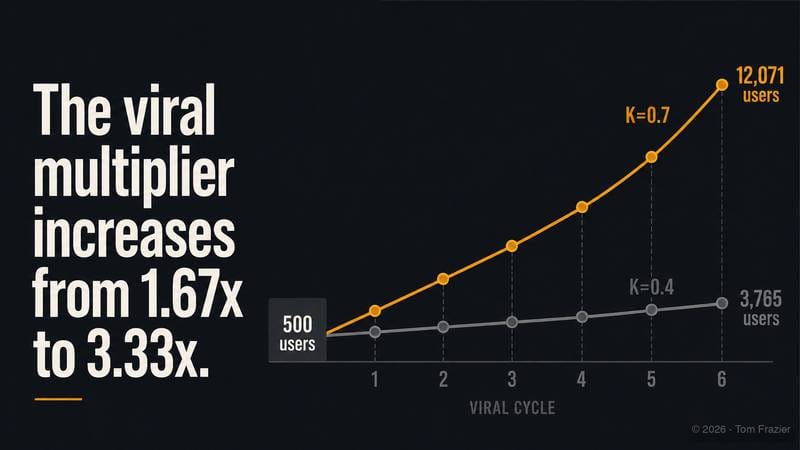
Example 2: Theoretical SaaS Startup
K = 2 × 0.20 = 0.4
At 500 users, the referral loop produces 200 new users per acquisition cycle without paid spend. Over six cycles, the compounding effect becomes meaningful.
Now change one variable: improve the invited user's onboarding experience so that conversion rate increases from 20% to 35%.
K = 2 × 0.35 = 0.7
The viral multiplier increases from 1.67x to 3.33x. Every dollar of paid acquisition now generates 3.33 total users instead of 1.67. That gap is the difference between a product that competes on ad budget and one that grows efficiently.
The levers are clear: increase invitations per user by making sharing frictionless, or increase conversion rate by improving the referred user's first experience. Both are product decisions before they are marketing decisions.
The Counterargument
The most common objection to viral coefficient thinking is that it prioritizes mechanics over product quality. The argument: if the product is genuinely good, virality happens naturally. Build something worth sharing and people will share it.
This is true yet insufficient.
Product quality is the necessary condition. Viral architecture is the sufficient condition.
WhatsApp built a product people genuinely needed for cross-border messaging with no per-message fees. But WhatsApp also required every contact to have the app for the product to work. That requirement is a designed viral mechanic: the product cannot deliver its core value unless both parties participate. The quality generated the demand. The architecture ensured the spread.
The belief that virality will emerge organically from a good product is the most expensive form of patience available to a founder. You can design for it. You should.
The Action Layer

Three moves to make now.
- Calculate your current K. Take the number of invitations your users send per month, divide by your active user count to get invitations per user, and multiply by your conversion rate on those invitations. If you do not know these numbers, you do not have a viral loop. You have a referral page that nobody tracks.
- Identify your natural dispersal type. Is your product's output shareable? Does using the product in public generate visible impressions? If yes, you have concealed dispersion potential: design the attribution into the output now. If no, design an explicit two-sided referral program where the incentive matches your product's core value, not a generic discount.
- Pick one channel and seed deliberately. Find the community, newsletter, or platform where your target users already trust recommendations. Reach one warm introduction to 1,000 pre-qualified people before you pay for cold distribution to 100,000 strangers. One trusted referral source beats any volume of impressions.
Virality does not require luck. It requires math, product design, and channel discipline. The coefficient is the output. Everything else is the work.
This is the fifth and final article in Phase 3 — Growth & Scaling. You can access the AI tool below.
Use the Viral Validator GPT to design exponential growth. A free AI tool just for subscribers. ⤵️
This article is why I built the Viral Validator GPT. It excels in analyzing and devising viral marketing strategies, identifying appropriate business models, and estimating viral coefficients to boost business growth and online presence.
Get virality estimations.
Common Questions About Viral Validator
How can it ensure my marketing campaign will go viral?
Viral Validator applies proven scientific methods and data-driven strategies to significantly increase the likelihood of virality in marketing campaigns. So while it still depends on your execution it can produce a solid analysis.
Isn't viral marketing just about luck?
Viral Validator utilizes comprehensive research and analysis, debunking the myth that virality is merely luck-based, and instead, relies on strategic planning and execution.
How does it choose the right business model for my company?
Viral Validator conducts an in-depth analysis of your business's core activities and market dynamics to select the most beneficial and fitting business model.
Can it really predict the viral coefficient of my campaign?
Viral Validator employs advanced techniques to estimate and optimize the viral coefficient, ensuring your campaign's content has a higher propensity to go viral.
What if my industry is too niche for viral marketing?
Viral Validator specializes in tailoring strategies to any industry, leveraging unique aspects of niche markets to create highly effective viral marketing campaigns.
This post is for subscribers only
Sign up now to get access to the post.
Already a member? Sign in