


Tom Peters Was Right. But Founders Need More Than Excellence.
Excellence is not enough if it arrives out of order. Founders don't have a motivation problem. They have a sequencing problem.
Tom Peters was more right than wrong. The companies that endure are closer to customers. They move faster. They push decision-making closer to the edge. They treat people as the source of productivity, not a cost center. They are values-driven without becoming slogan-driven. They keep the organization simple enough to act. That all holds up.
But here is the founder problem: excellence is not enough if it arrives out of order.
What Holds Up
Peters and Robert Waterman studied forty-three companies for In Search of Excellence and came away with eight themes:
a bias for action, staying close to the customer, autonomy and entrepreneurship, productivity through people, hands-on values, sticking to what you know, simple structure, and the discipline to hold a few things tight while loosening everything else.
Four decades later, most of that list still reads as correct Bias for action beats analysis paralysis. Closeness to the customer beats guessing. People treated as a source of quality beat people treated as a line item.
None of that is in dispute here. The book earned its place. What it does not do, because it was never trying to, is tell you what order to build a company in.
The Founder Problem
Peters and Waterman studied companies that already existed. They looked at forty-three organizations that had survived long enough to have a culture worth describing, then reverse-engineered what made them excellent. That is a legitimate way to study companies. It is not the same problem a founder has.
A founder has not built the company yet. There is no culture to study, no bias for action to observe, because there is no action history longer than a few months. The founder is living in the fog before any of that exists: the fog between an idea and evidence it's worth building, between evidence and a real launch, between a launch and something repeatable, between repeatable and manageable, between manageable and an outcome someone actually wanted.
Excellence, applied inside that fog, does not protect you. It can actively mislead you.
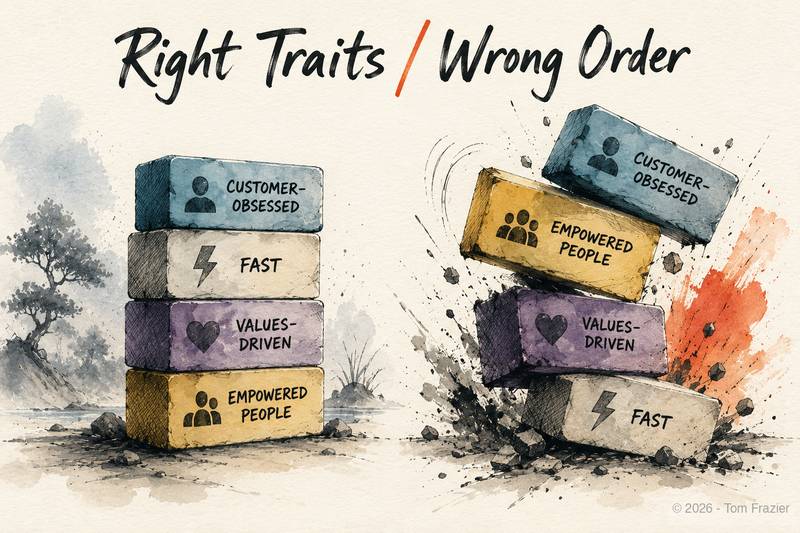
Take each excellence trait on its own and it still fails a founder who applies it too early. Customer obsession doesn't tell you which customers to trust before anyone has paid you a dollar. A startup can be genuinely obsessed with its customers and still build the wrong first product, because obsession doesn't select the right customer voice from the wrong one.
Speed has the same trap. Today AI can help you move fast, exactly as the bias-for-action principle recommends, and you can use that speed to accelerate straight into the wrong market.
However, speed doesn't check your direction. It just gets you there faster, wherever "there" turns out to be.
Then there's people. Hand your team real responsibility before you've designed the roles they're supposed to fill, and you've handed someone authority over a job that shouldn't exist yet. That's a quiet failure. It doesn't announce itself the way a missed deadline does. A strong, values-driven culture built around a business model that never had a shot is the hardest kind of failure to walk away from. The culture is real. The people inside it care.
Every one of those is an excellence principle, applied correctly, at the wrong moment. That is not a motivation problem. It is a sequencing problem.
Why This Isn't Semantics
The obvious pushback: isn't "do things in the right order" just another way of restating discipline, which is itself an excellence trait? Not quite. Discipline tells you to do the thing well. Sequence tells you when the thing is safe to do at all.
I made a version of this same argument recently about the MVP. The MVP wasn't a bad idea. It was genuinely disciplined and well-executed, deployed in an era where building it accidentally forced founders to encounter real customers along the way. Take away that accidental timing and the same well-built MVP becomes evidence of nothing, because it was never actually testing demand. The tool didn't change. The order it belonged in did.

That is the distinction Peters' framework doesn't carry, because it was never designed to. Excellence describes how you behave once you're inside a company that has already found its shape. Sequence describes which decision is safe to make first, second, and twenty-second, before that shape exists.
What Sequence Actually Buys You
Here is the benefit, stated plainly: a founder who gets the sequence right doesn't need to be excellent at everything simultaneously. They need to be right about this decision, at this stage, and defer the ones that aren't ready yet.
That is the premise behind The Idea Chose You. The book is built around twenty-two decisions across five stages, from Proof of Demand through the design of an exit. The order matters. It follows the order a founder actually faces those decisions in, not the order a case study of a mature company would suggest. It runs the same premise as the free Operator's Edge series: eighteen articles covering the phases that define whether a company scales or stalls, laid out in the sequence founders actually hit them, not after the fact.
 Tom Frazier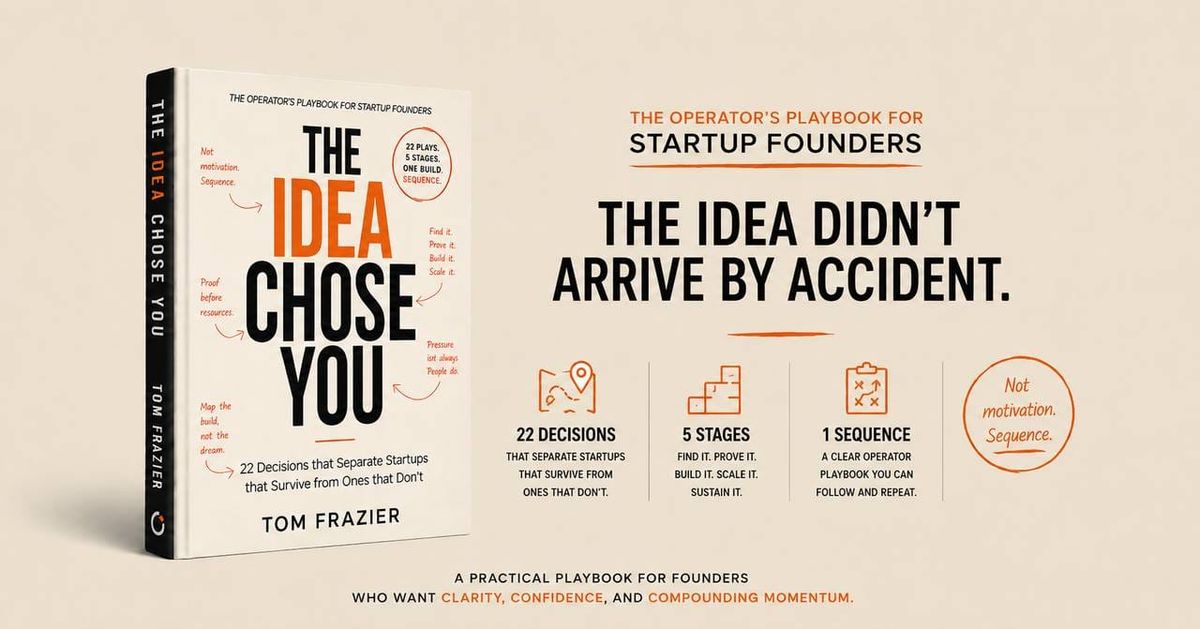
Not because founders need more advice. Most founders already have more advice than they can act on. The problem is timing. Advice arriving out of order becomes noise no matter how good it is. That's the trap. A founder drowning in correct-but-mistimed guidance is no better off than one with no guidance at all.
The question worth asking is not, "How do excellent companies behave?" Peters already answered that one, and answered it well. The better question, the one a founder actually needs answered before the excellent-company version of the question is even relevant, is:
"What decision comes next?"
Four Decisions, In Order
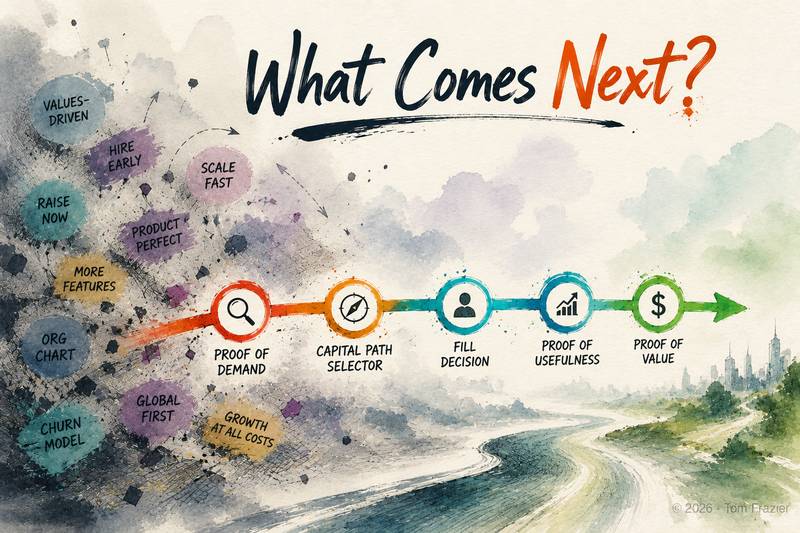
Here is what sequence actually looks like inside the "The Idea Chose You". Proof of Demand you have already seen. The other three have not been public until now.
Proof of Demand comes first. Before you build anything, get a stranger to commit before you commit. Not a survey. Not a waitlist. A real yes that costs them something.
The Capital Path Selector comes next. Not because you need money yet. Because the path you eventually take should be chosen on purpose, not copied from a Silicon Valley ladder built for one kind of company. Funding source, business model, and the cost of control pull in different directions. Pick before you are forced to.
Later, when you are ready to hire, the Fill Decision comes before the org chart does. Every role gets defined first. Then, and only then, you decide whether it is filled by a person, by intelligence, or by a tool, in that order. Most founders reverse this: hire a person, then invent the job to justify them.
Much later, once something is actually running, Proof of Usefulness and Proof of Value close the loop Proof of Demand opened. One tells you the customer feels what you promised. The other tells you the business is actually working, not just surviving on momentum.
None of that is complicated on its own. What is hard is not skipping ahead. A founder who chases Proof of Usefulness before they have secured Proof of Demand is optimizing a product nobody has proven they want. A founder who makes the Fill Decision before defining the role is hiring to solve a problem they have not named.
Ask yourself which of these four you are actually facing right now. Not which one feels urgent. Which one comes next in your own sequence. That answer, not another dose of excellent behavior, is what moves you forward.
Excellence Still Matters
Peters helped make the case, correctly, that companies are human systems and not just strategy documents. That case still stands, and nothing here argues against it.
The next step is making those systems buildable from day one, in an order a founder living inside the fog can actually follow.
Excellence still matters. But for founders, sequence comes first.


