


Sales Strategies: Thrive While Your Competitors Wonder What Happened
Most founders pick a sales methodology like they pick software — someone recommended it. The mismatch with your actual business model is where growth quietly dies.

Phase 3 — Growth & Scaling
How to read the market, own your category, sell with a system, build a funnel that converts, and engineer growth people actually share.
It is a Serial Entrepreneur's Playbook From Idea To Long-Term Success.
Sales Strategist
Designed to identify the most suitable business model for your company, refine your sales methodology, and suggestions to enhance your business's sales effectiveness.
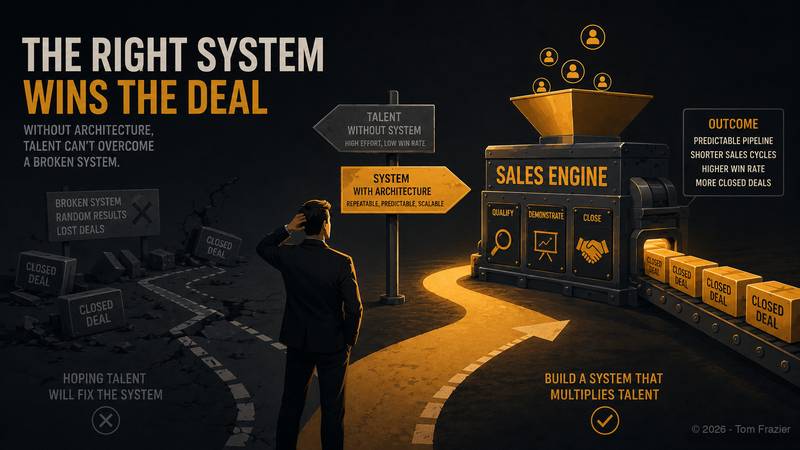
Most early-stage companies have sales activity. Very few have a sales system. The difference isn't effort, it's architecture.
A founder who closes deals through force of personality has a job. A founder who builds a repeatable sales engine has a company. The gap between those two states is where most growth-stage businesses quietly stall. They're generating revenue, which masks the problem. But the economics don't work, the team can't replicate the founder's results, and every new hire becomes a coin flip rather than a predictable multiplier.

There's a reason this happens so consistently. Most founders choose a sales methodology the same way they choose software: someone recommended it, or they copied what a competitor appeared to be doing. They never stopped to ask whether the methodology actually fits the business model they're running.
That mismatch is expensive. The fix starts with understanding what you're actually selling and to whom.
The Model Comes First
Your business model is not just a revenue structure. It's the primary constraint on every sales decision downstream: who your buyers are, how they discover you, how they decide, how fast they move, and how much human involvement the economics can support.
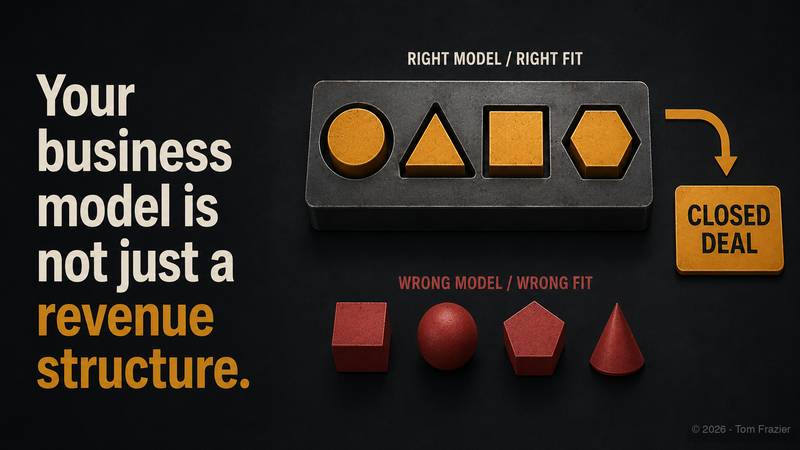
The twelve most common business model types each carry a distinct sales motion. E-commerce companies don't sell the way consulting firms sell. Marketplace businesses don't close deals the way SaaS companies do. Franchises run a fundamentally different motion than subscription services. Running the wrong methodology on the wrong model isn't a minor inefficiency... it's a structural mismatch that no amount of hiring or training will fix.
I've built a reference guide that maps all twelve model types to the sales methodology built for each one, along with the thought leader whose work defines best practice in that model. It covers every major archetype: e-commerce, retail, local services, SaaS, subscription, freemium, franchise, consulting, on-demand, affiliate, content/creator, and marketplace.

Use it before you read the rest of this article. Identify your primary model. The methodology in that row is where you start.
No email address required.
Use it before you read the rest of this article. Identify your primary model. The methodology in that row is where you start.
Twelve Models. Twelve Motions.
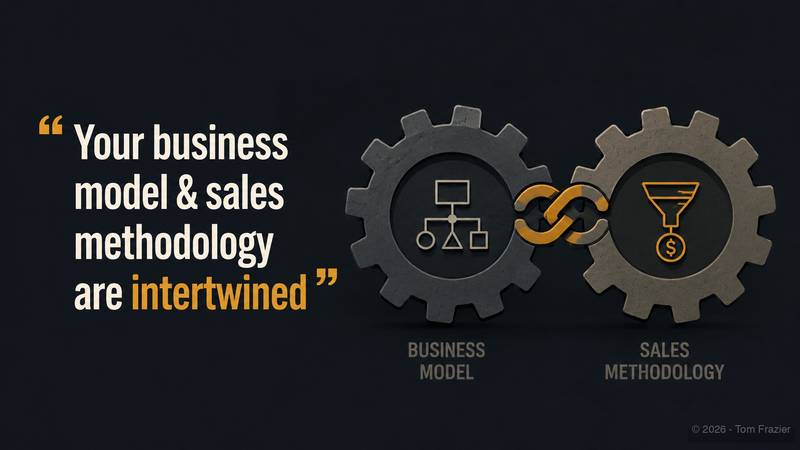
The reference guide does the mapping work. Here's the logic behind why model and methodology can't be separated.
E-Commerce
AIDA. The buyer is anonymous until they convert. The sales motion is entirely funnel architecture — Attention, Interest, Desire, Action — because no sales rep is ever in the room. Jeff Bezos built Amazon on relentless funnel optimization, not relationship-building. If you're running an e-commerce business and wondering why consultative selling techniques aren't moving revenue, that's your answer.
SaaS
Challenger Sale. Jason Lemkin's operating principle for SaaS is that the sales motion has to match the subscription economics: long-term retention matters more than a single close. The Challenger Sale, developed by Matthew Dixon and Brent Adamson at CEB, works here because SaaS buyers are often solving problems they haven't fully articulated. Teaching them something they don't already know about their own situation is how you build a defensible position before the competitor demo.
Consulting
Miller Heiman (Now Korn Ferry) Strategic Selling. David Maister wrote the canonical framework for professional services firms: the relationship is the product. Miller Heiman's structured approach to multi-stakeholder navigation fits because consulting decisions almost always involve more than one decision-maker, a long evaluation period, and a high degree of risk on the buyer's side. Transactional close techniques don't just underperform here, they actively destroy trust.
Marketplace
Network Effect Sales Strategy. Pierre Omidyar's model at eBay was never about selling to one buyer. The motion is about building liquidity on both sides simultaneously. Reid Hoffman's framework for network-effect-driven growth treats every new participant as a value multiplier for existing ones. The sales focus is acquisition velocity and activation, not individual deal closure.
Subscription Services
Value-Based Selling. Robbie Kellman Baxter, author of The Membership Economy, is clear on this: subscription businesses live and die on lifetime value, not initial conversion. Value-Based Selling, built on the principle that you're selling an outcome, not a product, is the right motion because you need the buyer to commit to a recurring payment. They will only do that if they believe the outcome compounds over time.
Freemium
Inbound Selling. Fred Wilson's investment thesis on freemium companies is grounded in conversion economics: you're acquiring a large free user base and converting a percentage to paid. Inbound Selling, pioneered by HubSpot's Brian Halligan and Dharmesh Shah, is the methodology that matches this model — attract through value, earn trust, convert when the user is ready. Outbound tactics layered onto a freemium model typically cannibalize the product-led conversion that makes the economics work.
The remaining six models for retail, local services, franchising, on-demand, affiliate, and content/creator follow the same logic. Each has a primary methodology matched to the natural shape of how buyers in that model actually make decisions.
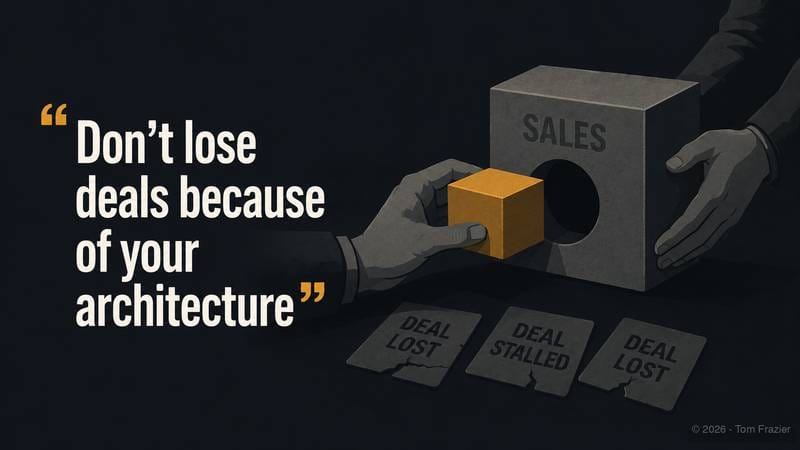
If you're running the methodology built for a different model, you're not losing deals because of your team. You're losing them because of your architecture.
Building the Engine, Not Just Closing Deals
Identifying the right methodology is step one. Making it repeatable is the work that most founders avoid.
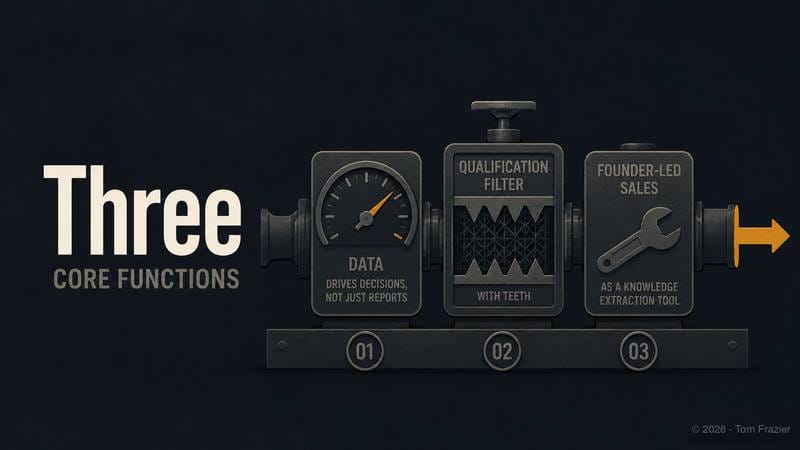
Three components make a sales engine actually function:
Data that drives decisions, not just reports. At minimum, track: qualified opportunities created per week, average days from first contact to close, win rate by deal source, and average contract value by segment. The purpose isn't a dashboard — it's to identify where deals are dying. If win rate is strong but close time is extending, the problem is mid-funnel stall, not closing skill. If win rate drops sharply at demo stage, the problem is qualification or product-market fit. The number tells you where to look; it doesn't replace looking.
A qualification filter with teeth. Most early-stage sales teams are too generous with "qualified." They advance deals that aren't ready, burn time on bad-fit prospects, and call a dead deal a loss six months later. A working qualification filter forces a binary judgment at each stage: does this prospect meet the criteria or not? Budget, authority, timeline, and fit are exit criteria — not check-the-box questions. Deals that don't pass get a clear "not yet" and a follow-up date, not a placeholder in the pipeline.
Founder-led sales as a knowledge extraction tool. The first twenty to thirty customers should come from direct founder involvement — not because no one else can sell, but because the patterns in those conversations are the foundation of your playbook. What objections appear in every call? Which customer profile closes fastest? Which use case generates the most post-sale expansion? That intelligence can't be purchased or delegated. It has to be earned, then codified into a playbook the team can execute without the founder in the room.
For deeper work on the business model decisions that upstream your sales architecture, the Mastering Your Business Model article in Phase 1 of this series covers value proposition, cost structure, and scalability decisions that determine your ceiling before you spend a dollar on sales.
Where to Find Your People
Your market already has gathering points — communities where buyers, practitioners, and competitors exchange information, validate decisions, and develop preferences. Being absent from those conversations is a competitive choice, not a neutral one.
The communities worth investing in split across three dimensions: your business model type, your sales methodology, and your specific industry. Here's how to find the right ones rather than defaulting to a generic list.
By business model
- SaaS and Subscription: Product-Led Growth community (15,000+ practitioners), SaaStr (the largest B2B SaaS operator community), IndieHackers for bootstrapped and early-stage, and r/SaaS (250,000+ members)
- E-Commerce and Marketplace: Shopify Community, r/ecommerce, and EcommerceBytes for marketplace operators
- Consulting and Professional Services: Pavilion (revenue leaders across complex sales), r/consulting
- Content and Creator models: Creator Economy Club, Indiehackers, and the Substack Writer Network
By sales methodology
- General practitioner: r/sales — 200,000+ members with real-world debate, not vendor content
- Revenue leadership: Pavilion for VPs and above; Sales Assembly for structured enablement
- Challenger Sale and MEDDIC practitioners: MEDDIC Academy for qualification methodology depth; CEB/Gartner's published research for Challenger methodology
By your specific industry
This is the layer most founders skip, and it's often where the highest-ROI relationships live. Every major industry has an association that publishes research, runs conferences, and maintains member directories. The buyers you're pursuing are almost always already members.
Search "[your industry] + association" and cross-reference with your existing customers: where do they present, where do they attend, what trade publications do they read? That's your target community. Show up there with genuine value before you need anything from anyone.
Fallbacks when industry associations aren't obvious
If your business crosses multiple verticals, or your category doesn't yet have a dedicated home, these are worth more than most founders give them credit for:
- US: US Chamber of Commerce nationally; local Chamber affiliates for market-specific B2B networking
- UK: Federation of Small Businesses
- Australia: Australian Chamber of Commerce and Industry
- Canada: Canadian Chamber of Commerce
- Europe: National chambers under EuroChambers
For technology companies specifically: CompTIA and TechUK maintain practitioner networks that surface buyer relationships, partnership opportunities, and market intelligence regardless of your specific vertical.
The Counterargument Worth Taking Seriously
Some operators will push back: our business is relationship-driven, and you can't systematize relationships.
Partially true. Mostly wrong.
You can't systematize chemistry. You can systematize everything that creates the conditions for chemistry to matter. A well-built process doesn't remove the human from the sale — it gives the human more time for the conversations that require them. A qualification framework doesn't prevent trust from forming — it stops you from investing trust-building effort in prospects who were never going to buy.
The founders who resist systematization are often secretly afraid that if the engine is built, their personal contribution becomes replaceable. That fear is usually misplaced. The founders who build the system still close the biggest, most complex deals. They just also have a team closing the other ones.
What to Do Next
The audit is a single afternoon's work. Open the reference guide. Identify your primary business model. Look at your current sales motion, the actual sequences, conversations, and close process then and ask whether it was designed for your model or inherited from somewhere else.

12 business model types, matched methodologies, and the thought leaders behind each one. Absolutely free.
No email required.
If there's a mismatch, the fix is architectural, not motivational. Strip the incompatible elements, rebuild around the methodology in your row, and run a qualification audit on your current pipeline using the criteria that actually apply to your model.
Then find two communities — one for your model, one for your industry — and spend thirty minutes a week in each. Not to pitch. To learn what your buyers are complaining about before they complain to you.
The gap between "we close deals" and "we have a sales engine" is not a talent gap. It's an architecture gap.
The founders who close the deal gap don't work harder, they work on the right problem.
This is the third article in Phase 3 — Growth & Scaling. You can access the AI tool below.
Use the Sales Strategist GPT to thrive while others only survive. A free AI tool just for subscribers. ⤵️
This article is why I built the Sales Strategist GPT. It is designed to identify the most suitable business model for your company, refine your sales methodology, and provide tailored resources and suggestions to enhance your business's sales effectiveness.
Expand your business network and knowledge.
Common Questions About Sales Strategist
How can Sales Strategist help if I'm unsure about my business model?
Sales Strategist GPT can map your business to the most fitting model, providing clarity and direction for your sales strategy.
What if I need a sales methodology but don't know where to start?
Sales Strategist GPT can help develop a step-by-step sales methodology, customized to your business's unique needs and goals.
Is Sales Strategist able to offer current market insights?
Sales Strategist can leverage web browsing capabilities to present up-to-date market insights, ensuring your strategy stays relevant.
Can it help me find communities relevant to my business?
Yes. Sales Strategist GPT identifies and connects you with key communities, enhancing your network and business opportunities.
How does Sales Strategist handle complex sales challenges?
Sales Strategist tackles sales challenges with a tailored approach, using a vast knowledge base and expertise to provide effective solutions.
This post is for subscribers only
Sign up now to get access to the post.
Already a member? Sign in
