


Competition Crusher: How to Outmaneuver Rivals Who Don't See You Coming
Most founders monitor competitors. The operators who win run intelligence on them. Here's the three-tool framework that turns competitive analysis into a decision machine — not a document.

Phase 3 — Growth & Scaling
How to read the market, own your category, sell with a system, build a funnel that converts, and engineer growth people actually share.
It is a Serial Entrepreneur's Playbook From Idea To Long-Term Success.
Competition Crusher
Refine your strategies based on competitors' strengths, weaknesses, opportunities, and threats.
Most founders treat competitive analysis as a quarterly ritual. They build a spreadsheet, populate it with competitor websites and Crunchbase profiles, present it in a slide deck, and then file it somewhere it won't be read until the next funding round.
Intelligence is what you do when you actually intend to win.
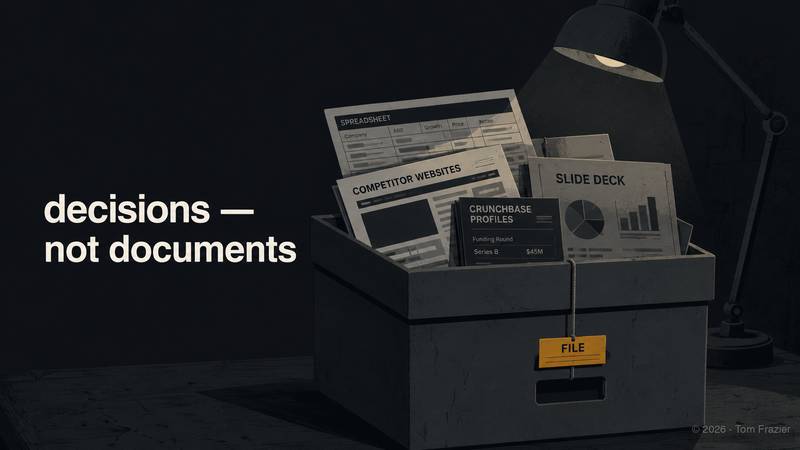
It's ongoing, adversarial, and designed to produce decisions not documents. The operators who consistently outmaneuver their competition aren't watching from the sidelines. They're running a war room. They know where their rivals are overextended, where their positioning is soft, and what structural forces the market is about to apply to both of them equally.
This article gives you the three tools that make that possible:
- a competitor SWOT framework designed for field intelligence (not template-filling),
- a Five Forces audit that tells you where structural pressure is highest in your market, and
- a Competition Curve analysis that shows you where to play a game your competitors can't follow.
The Competitor Map: SWOT as Field Intelligence
Forget the 2x2. The SWOT template everyone learned in business school produces sanitized observations that generate no decisions.
Here's what actually matters when you map a competitor: you're looking for the gap between what they claim and what they can actually deliver. That gap is your attack surface.
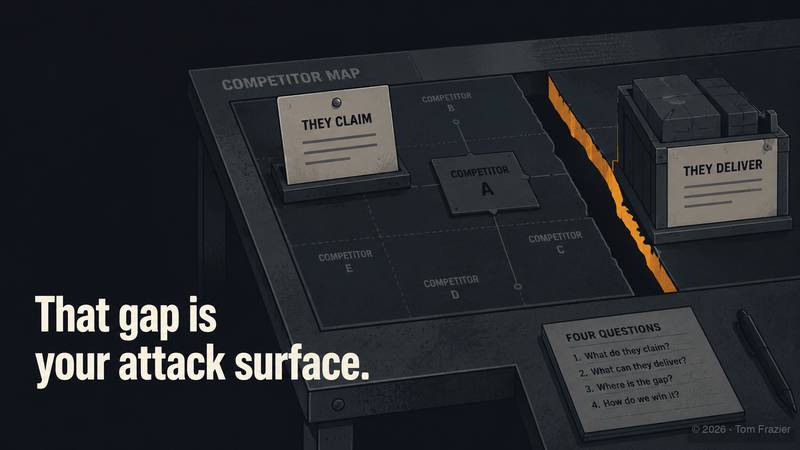
For each significant competitor, build a profile around four questions:
- What is their overall strategy? Not what they say on their website, what the evidence says. Are they land-and-expand, enterprise-direct, product-led growth? How is their pricing structured? Where are they spending marketing dollars? Strategy leaves footprints. Read them.
- Where are they genuinely strong? This is the most important and most skipped part of the exercise. Founders want to catalog competitor weaknesses. The better discipline is to accurately understand competitor strengths because those are the fronts on which you probably should not fight. A competitor with a 6-year enterprise sales motion and deep procurement relationships has an advantage you won't close in a product cycle. Don't pretend otherwise.
- Where are they exposed? Weaknesses that matter are operational, not cosmetic. Poor NPS scores in a specific customer segment. A feature backlog that's been stagnant for three quarters. A pricing model that was built for a market that no longer exists. Former employees who describe execution gaps publicly on LinkedIn and in reviews. These are real intelligence signals, and they're freely available to anyone willing to look past the marketing surface.
- What is their market share and positioning claim? What percentage of the addressable market do they own, and what differentiator are they defending? A competitor claiming the "enterprise" position while losing mid-market is overextended. That overextension is a door.
The output isn't a slide. It's a one-page brief per competitor with their strategy, their exposed flanks, and a single differentiator statement: the claim they're making to the market that you can either undercut, outflank, or make irrelevant.
The Five Forces Audit: Reading Market Structure
Before you can position intelligently, you need to understand the structural forces acting on your market. Michael Porter introduced this framework in his 1979 Harvard Business Review article "How Competitive Forces Shape Strategy," and it remains the most useful lens for understanding why some markets produce fat margins and some produce a race to zero.
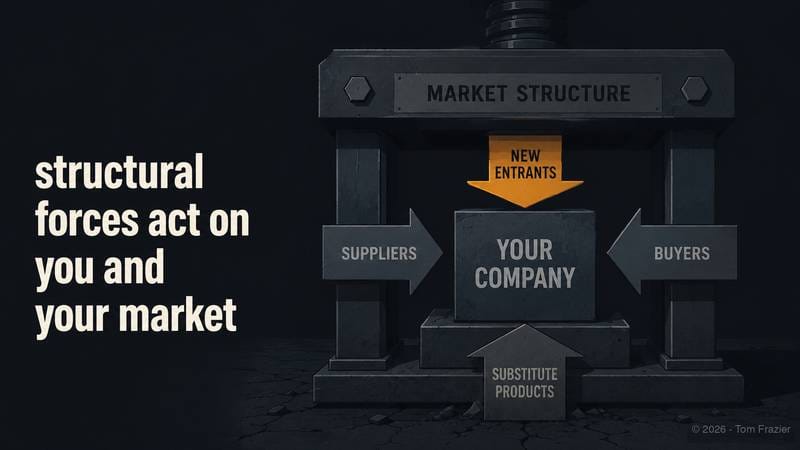
The point isn't to fill out five boxes. The point is to identify where the structural pressure is highest and position accordingly.
Rate each force as Low, Medium, or Strong.
Buyers — How Many, and How Much Leverage Do They Have?
Buyer power is a function of concentration and switching costs. In a market with thousands of SMB buyers who churn frequently but are easy to replace, buyer power is Low. In a market with fifteen enterprise accounts that collectively represent 80% of industry revenue, buyer power is Strong and those buyers will extract pricing concessions, demand custom contracts, and set your roadmap for you whether you want them to or not.
 Tom Frazier
The less concentrated your buyer base and the higher the switching cost of your product, the more pricing power you retain. Map this honestly. If you're building toward a handful of large accounts, you're also building toward a negotiation in which you are consistently the smaller party.
Suppliers — What Controls Your Input Costs?
For most software companies, the relevant suppliers are cloud infrastructure providers, AI API vendors, and talent markets. If you're running on AWS and your product is deeply integrated with a single AI model provider, your supplier power exposure is real. A price change or terms change from either party affects your unit economics directly.
Tom Frazier
Strong supplier power constrains your margins. Low supplier power like multiple interchangeable inputs, commoditized infrastructure, no single dependency gives you structural flexibility. Know which situation you're actually in.
Substitutes — How Many Workarounds Exist?
This is the question most founders answer too narrowly. The relevant substitutes aren't just direct competitors, they're the other ways buyers solve the same problem. A project management SaaS doesn't just compete with other project management tools. It competes with spreadsheets, email, Notion databases, and doing nothing.
When substitutes are abundant, your pricing ceiling is defined by the cost of the next-best alternative. When substitutes are genuinely scarce, you have pricing power. If the answer to "what does someone do if they don't use us?" is "nothing good," that's structural leverage.
Competitive Rivalry — How Intense Is the Fight?
Competitive rivalry is a function of competitor count, similarity of offerings, and market growth rate. In a fast-growing market, there's enough new demand that competitors can each grow without directly taking from each other. In a stagnant market with ten similar products, every customer win is someone else's loss.
High rivalry compresses margins, accelerates product commoditization, and increases customer acquisition costs across the board.
The honest question here isn't "are we better than the competition." It's "is this market structure one where being better translates to winning, or are we fighting in a pool where the rules favor whoever runs out of money slowest?"
New Entrants — How Hard Is It to Join This Market?
Low barriers to entry mean your competitive advantages have a shorter shelf life. If your market can be entered by a well-funded startup with six engineers in six months, every advantage you've built is being clocked. High barriers like proprietary data, regulatory requirements, established distribution relationships, network effects protect your position over time.

If barriers to entry are Low, you need to be building them. That's not optional... it's the primary Phase 3 strategic task.
The Competition Curve: Where You Play the Game Alone
The Five Forces audit tells you what the market looks like structurally. The competitor SWOT tells you where rivals are exposed. The Competition Curve is where you synthesize both into a strategic choice about where to compete.
Three questions drive it.
1. What Is Your Unfair Competitive Advantage?
An unfair competitive advantage is an asset that would take a competitor years and significant capital to replicate, if they could replicate it at all. This isn't a better feature set. It's a structural moat: proprietary data that only accumulates with usage, a distribution channel that took a decade to build, a regulatory credential that costs 18 months to obtain, or domain expertise so specialized that the hiring market can't produce the people who'd need to close the gap.
Every company has features. Very few have genuine unfair advantages. If you can't name yours in one sentence, you probably don't have one yet!
2. What Is Your Blue Ocean?
W. Chan Kim and Renée Mauborgne's framework, published in 2004 and still the most practically useful competitive strategy concept for operators building in competitive markets, makes a simple argument: the best competitive move is often the one that makes competition irrelevant.
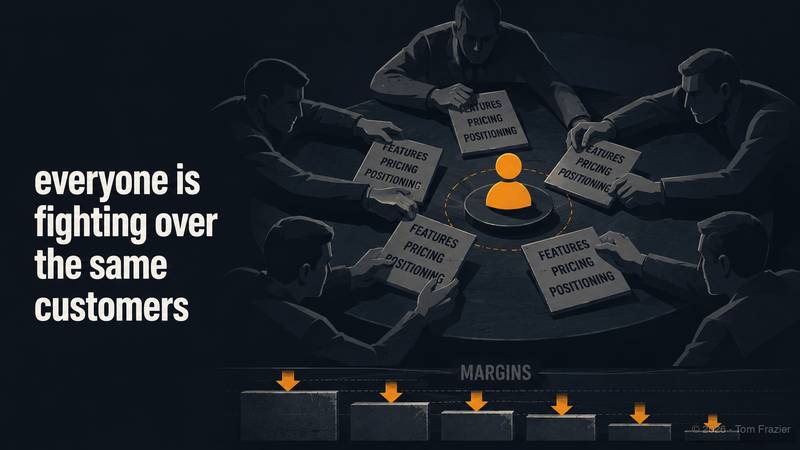
A Red Ocean is an existing market with defined rules and established players. Everyone is fighting over the same customers, the same positioning, the same features. Margins compress. Differentiation becomes cosmetic.
Tom Frazier
A Blue Ocean is a market space you create by eliminating factors the industry treats as essential, reducing factors it over-delivers on, raising factors it underserves, and creating factors it's never offered. The result is a value curve that doesn't map to your competitors' because you're not playing the same game.
The examples that get cited are large companies like Cirque du Soleil, Stripe, Canva. But the underlying logic applies at any scale. Canva didn't beat Adobe. Canva found 50 million people who weren't using Adobe and gave them something designed for them. Stripe didn't beat PayPal. Stripe built an API-first payment infrastructure for developers who were being ignored by every payment provider that existed.
The question for your company is: who are the buyers your competitors are systematically ignoring? What would it look like to design specifically for them? The answer to those questions is frequently a door into market space where you can operate without fighting for every inch.
3. What Are the Barriers to Your Growth?
This is the discipline most Phase 3 operators skip because it requires honesty about constraints rather than optimism about opportunities. Barriers to growth are the factors that will cap your scaling velocity if left unaddressed and they're almost never the ones founders put in pitch decks.
Common ones: a sales motion that requires deep domain knowledge to execute, which means it can't scale past the founder; a product that requires significant implementation time, which compresses your win rate as the sales cycle lengthens; a customer segment with high churn that requires constant replacement acquisition to show growth; a regulatory environment that will require capital and time to navigate as you move upmarket.
Name them. If you can't, you haven't looked hard enough. Identifying a growth barrier clearly is the first step toward removing it or deciding deliberately to circumvent it by repositioning which market you're targeting.
The Counterargument Worth Addressing
The strongest objection to spending serious time on competitive intelligence at the Phase 3 stage goes something like this: "We don't need to track competitors. We need to focus on building a great product. The market will sort itself out."
This is not entirely wrong, and it's worth engaging honestly.
Product quality matters. If your core offering is weaker than an incumbent's in the ways your target buyers care about most, no amount of competitive positioning fixes that. The intelligence operation described in this article is not a substitute for product excellence.
But here's the limit of the argument: markets don't reward product quality in isolation. They reward product quality relative to alternatives, at a price point within the buyer's consideration set, through channels the buyer actually uses. Every one of those variables is a competitive variable. Ignoring your competitors doesn't put you outside the competitive dynamics of your market; it just means you're navigating those dynamics blind.
The founders who say "we don't watch competitors" and win are typically operating in a market where competitive dynamics are genuinely minimal. That's fine until competitors appear, which they will, the moment the market proves out.
What to Do This Week
If you've never done a structured competitive analysis, start with the two or three rivals your customers most frequently mention before choosing you or instead of choosing you. Those are your real competitors, regardless of who's on your internal list.

Build a one-page brief per competitor using the field intelligence structure: their strategy, their genuine strengths, their exposed weaknesses, their positioning claim, and their current market position.
Run the Five Forces audit on your market. Rate each force. The forces rated Strong are your strategic constraints. The forces rated Low are your structural tailwinds. This picture changes your resource allocation decisions.
Tom Frazier
Map your Competition Curve. Write down your unfair competitive advantage in one sentence. If you can't, that's the most important strategic problem you have in Phase 3. Write down the customer segment your competitors are ignoring. That's your blue ocean candidate. Write down the three factors most likely to cap your growth rate. That's your constraint roadmap.
Competitive intelligence isn't a quarterly exercise. It's a standing operating procedure. The operators who run it continuously find market shifts before their competitors do, see windows of attack before those windows close, and build position in market spaces that didn't exist until they made them.
Tom Frazier
This is the first article in Phase 3 — Growth & Scaling. You can access the AI tool below.
Outmaneuver Market Rivals with Competition Crusher. A free AI tool just for subscribers. ⤵️
This article is why I built the Competition Crusher GPT. It delivers tailored competitor insights, including summaries, comprehensive market analysis, and strategies for gaining competitive advantage in your specific market.
Blueprint your business position against rivals to find new opportunities for differentiation & market capture.
Common Questions About Competition Crusher
I'm concerned that an AI can't really understand my specific business needs. How can you help?
Competition Crusher is designed to deeply analyze market dynamics and competitor strategies using Porter's Five Forces framework. It leverages extensive data foraging skills and competitor analysis expertise to provide tailored insights specific to your business.
How can you keep up with the latest market trends and competitor moves?
Competition Crusher utilizes advanced web browsing capabilities to gather the most current information on market trends and competitors. This allows it to provide up-to-date analysis and insights, ensuring your business strategy stays ahead of the curve.
Is there a risk of getting generic advice that doesn't apply to my unique situation?
Competition Crusher customizes its analysis and recommendations based on specific information about your business and its competitors. It avoids generic advice by focusing on the unique aspects of your industry and market position.
Can an AI really help me understand complex market forces like Porter's Five Forces?
Competition Crusher is proficient in applying Porter's Five Forces analysis to any business context. It breaks down complex market forces into understandable segments, providing clarity on how these forces impact your business.
What if I need more than just market and competitor analysis?
Competition Crusher focuses on market and competitor analysis as its core expertise, aligning with the Porter's Five Forces framework.
This post is for subscribers only
Sign up now to get access to the post.
Already a member? Sign in