


The Third Pig Principle — AI built your house and the wolf is already at the door.
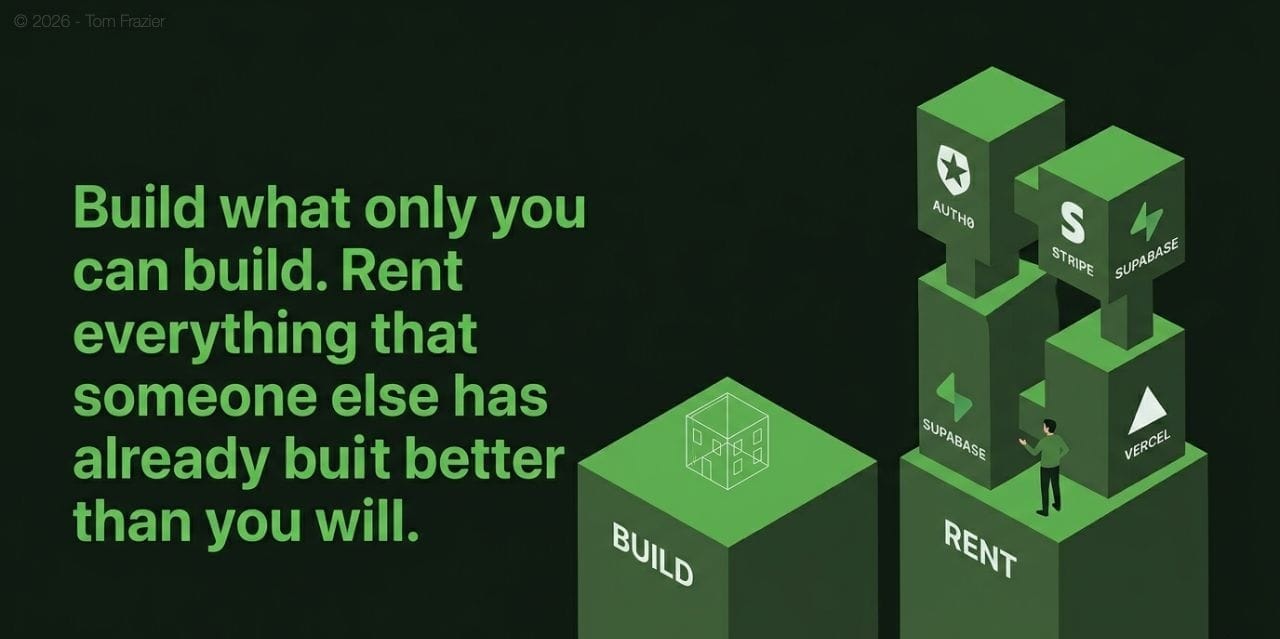
Everyone is excited about what AI can now build from scratch. Fewer people are asking whether they should. Build what only you can build. Rent everything that someone else has already built better than you will.
AI gurus everywhere show you how AI can build not just anything but everything. That pattern, developing in real time across the builder community, should cause a lot of concern. Developers and founders who have just discovered that AI can write working code are drawing the wrong conclusion. They're not just using AI to build applications faster. They're using it to replace infrastructure they have no business running themselves.
The reasoning sounds logical on the surface: if AI can generate the code, why pay for a platform? If I can build it, why rent it?
Because building it and operating it are two entirely different problems — and most people conflating them have never run a production service at any meaningful scale.
The Production Gap Nobody Talks About
Running software in production is not the same as building software. This is a distinction that experienced engineers learn the hard way, usually at someone else's expense. It means being responsible for uptime at 3am. It means patching zero-day exploits before your users are exposed. It means having the monitoring infrastructure to know something is wrong before your customers tell you. It means role-level security that was designed correctly the first time, not bolted on after the fact.

These are not features. They are ongoing operational disciplines that compound in complexity as your user base grows. And they are exactly what you are walking away from when you decide to roll your own version of something that already exists and already works.
The question isn't whether AI can generate the code. It can. The question is whether you're prepared to own everything that happens after you deploy it.
Take Supabase as a concrete example. I have several AI-built apps on Supabase. Not because I couldn't build a database layer myself, but because Supabase ships with hundreds of features I would otherwise have to design, build, test, monitor, and maintain — permanently. Role-level security. Auth flows. Real-time subscriptions. Audit logging. Proactive security monitoring that operates at scale across their entire customer base, not just my one instance.
When a zero-day exploit surfaces — and they do, consistently, on a schedule nobody controls — Supabase responds to it across their entire infrastructure. I get that protection as a byproduct of being a customer. If I had built my own version, I would be personally responsible for detecting, assessing, and patching that vulnerability in my production system, under time pressure, while also running my actual business.
That is not a reasonable trade. The platform cost is not a line item to be optimized away. It is the price of not having to become an infrastructure security team.
The Problem with "AI Can Just Build It"
The specific failure mode I'm watching play out: people are now treating AI-generated code as equivalent to production-hardened infrastructure. They are not the same thing, at all, and treating them as interchangeable reflects a fundamental misunderstanding of what infrastructure actually does.
• Working code that solves the problem as stated today.
• A functional authentication flow that passes a basic test.
• A database schema that stores the data you described.
• A tax calculation that handles the cases you specified.
• Years of edge cases, failure modes & security patches already absorbed.
• SOC2 compliance, breach detection, session management, token rotation.
• Replication, failover, point-in-time recovery, and performance at scale.
• Regulatory updates, audit trails & liability frameworks you shouldn't build.
Authentication is the clearest example. If you are seriously considering building your own user authentication and account management system because AI made it feel easy, stop. This problem has been solved. It has been solved by teams who spent years dealing with every failure mode, edge case, and security vulnerability that you have not yet encountered and will not anticipate. Auth0, Clerk, Supabase Auth, Firebase — pick one. The cost is trivial relative to the liability of doing it yourself and getting it wrong.
The same logic applies to deployment infrastructure. Vercel's value is not auto-deploy from a GitHub repo. That's the surface feature. The value is the global edge network, the preview environment workflow, the rollback capability, the performance optimization layer — all of it running continuously, maintained by people whose only job is to make that infrastructure reliable. You could build a deployment pipeline. You should not build Vercel.
Where AI Actually Belongs in This Stack
Here's what I think the right mental model looks like, and it's not complicated once you see it clearly. The stack has two distinct zones. AI belongs in one of them.
YOUR APPLICATION LAYER
The bespoke front — your UX, your workflows, your competitive differentiation
AUTHENTICATION & IDENTITY
Clerk, Auth0, Supabase Auth, Firebase
DATABASE & STORAGE
Supabase, PlanetScale, Neon, Firebase
DEPLOYMENT & EDGE
Vercel, Netlify, Cloudflare
PAYMENTS & BILLING
Stripe, Shopify, Paddle
COMPLIANCE, TAX & INDUSTRY LOGIC
Avalara, TaxJar, established vertical software
The bespoke layer — your application, your UX, your workflows, the specific problem your product solves for your specific user — that is exactly where AI-generated code changes the game. You can now build software tailored to your precise need, with your domain logic, your data model, your user experience. That used to require months and a team. It no longer does.
But the usefulness of bespoke software lives at the front. It lives in how the product behaves for the user, how it solves the specific problem, how it fits the workflow. It does not live in reinventing the database engine, the auth system, or the deployment pipeline. Those problems have been solved better than you will solve them, by teams that have been solving nothing else for years.
The Real Cost of Rolling Your Own
The economics here are straightforward once you account for the full picture. Platform costs — Supabase, Vercel, Stripe, whatever your stack requires — are real and recurring. They feel like something to be optimized. But compare them to the actual cost of the alternative: the engineering time to build it, the operational overhead to maintain it, the security exposure while you're figuring it out, and the liability when something goes wrong that a mature platform would have caught.
is not the initial build.
It's the permanent operational tax on every person in your organization, forever — pulled away from building your actual product to maintain plumbing that someone else already built better. Every hour spent managing infrastructure you should be renting is an hour not spent on the thing that actually differentiates you.
The hidden cost of rolling your own infrastructure is not the initial build. It's the permanent operational tax on every person in your organization, forever — pulled away from building your actual product to maintain plumbing that someone else already built better. Every hour spent managing infrastructure you should be renting is an hour not spent on the thing that actually differentiates you.
This is what economies of scale actually mean in practice. Supabase's security monitoring is effective not because they have better engineers than you, but because they're defending thousands of instances simultaneously. The signal-to-noise ratio on their threat detection is orders of magnitude better than anything you could run on a single application. You cannot replicate that at your scale. You shouldn't try.
What AI Has Actually Changed
AI has genuinely changed what's possible for small teams and individual builders. The ability to generate working, useful, bespoke software for a specific problem — without a large engineering team — is a real and significant shift. I'm living that shift. It changes what a two-person company can ship.
But it has not changed the laws of production engineering. It has not made authentication easier to get right. It has not made database security a solved problem for people who have never run a database in production. It has not eliminated the operational complexity of running software that real users depend on.
What it has changed is the layer where differentiation actually happens. You can now build the bespoke front — the part of the stack that is specific to your problem, your user, your insight — faster and with less capital than ever before. That is the unlock. Use it there.
Build what only you can build. Rent everything that someone else has already built better than you will.
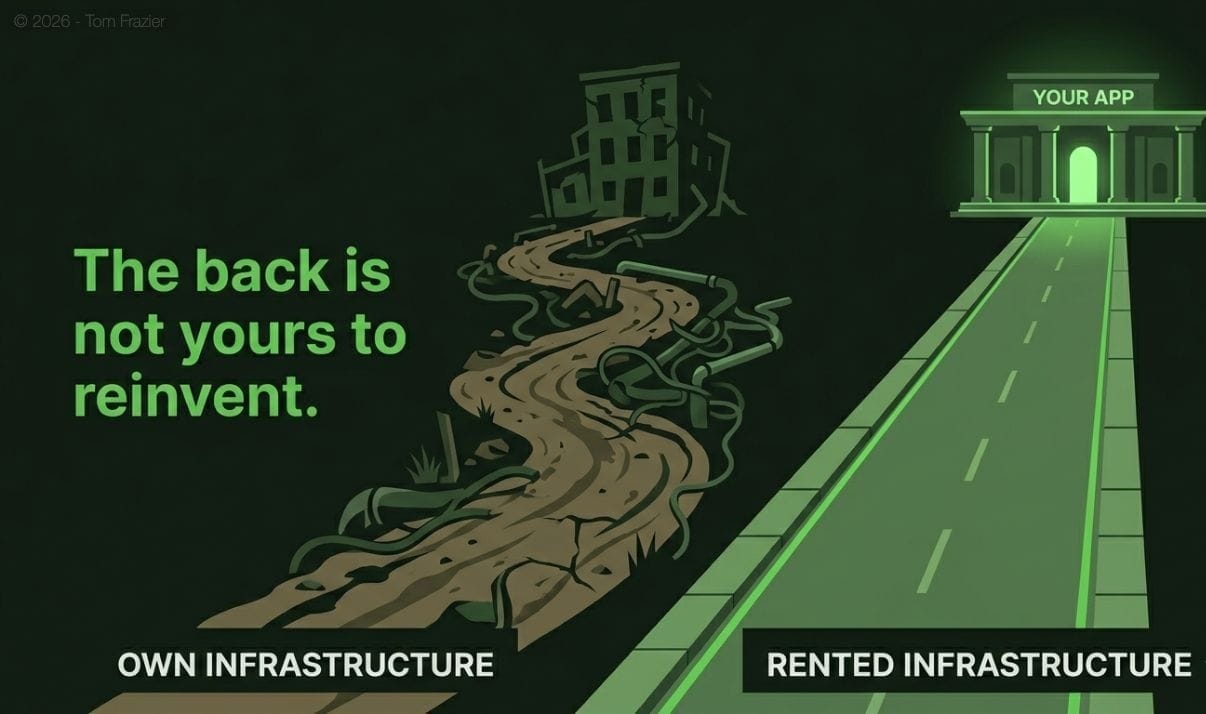
The current and future state of AI is bespoke software — tailored precisely to your problem, built faster than ever. But bespoke means the front. The back is not yours to reinvent.