


The $100,000 Question Nobody's Asking
I did some token math this morning that broke my brain a little. The same annual output that costs an employer $100,000 costs an AI roughly $25. Even with a 10x friction tax, we're looking at a 20:1 cost advantage. Here's what that actually means.
I did some token math this morning that broke my brain a little.
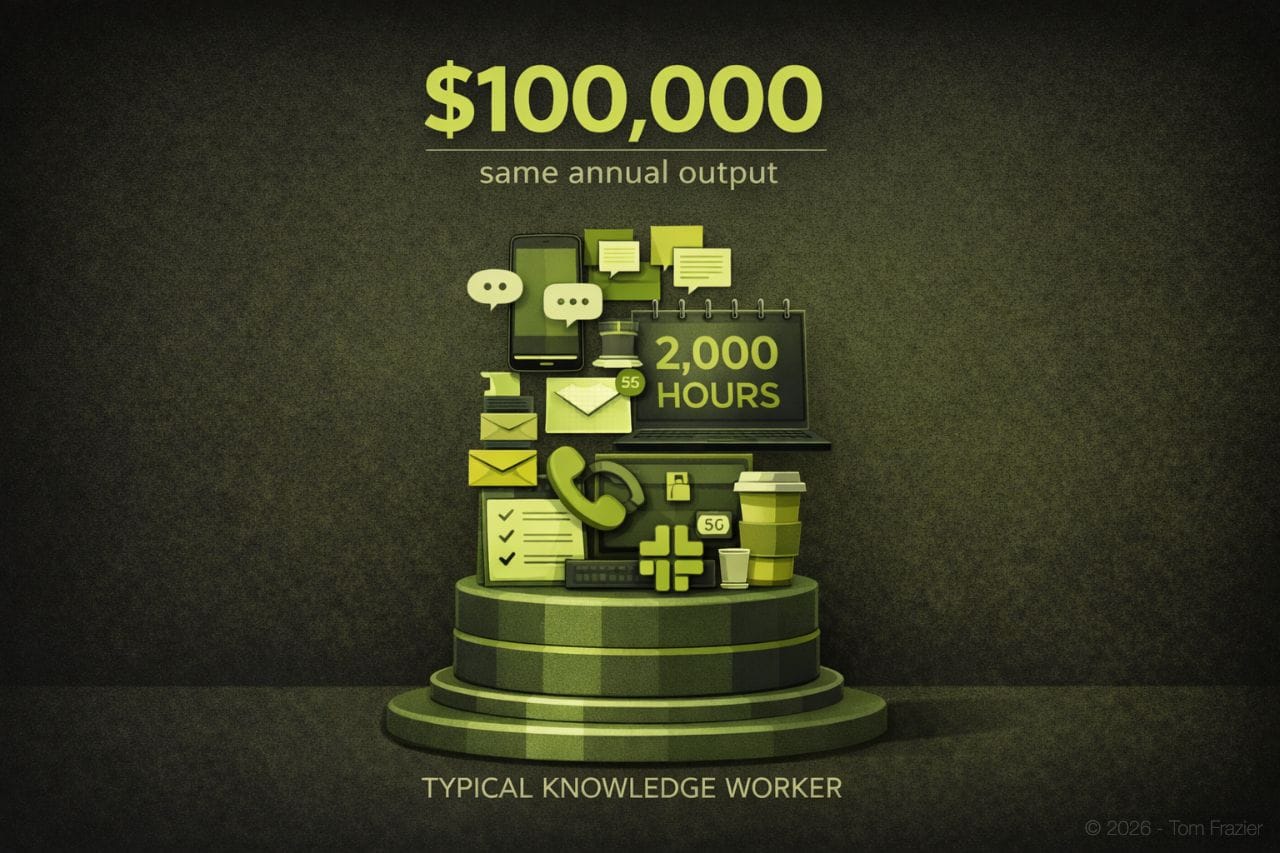
Here's the setup. You're a knowledge worker in America. Forty hours a week, fifty weeks a year. Two thousand hours of thinking, writing, analyzing, deciding. Median weekly earnings for full-time workers sit around $1,145. Annualized with benefits, you're looking at $75,000 to $100,000 for that output — more depending on the role.
Now let's translate that into tokens.
The Output Translation
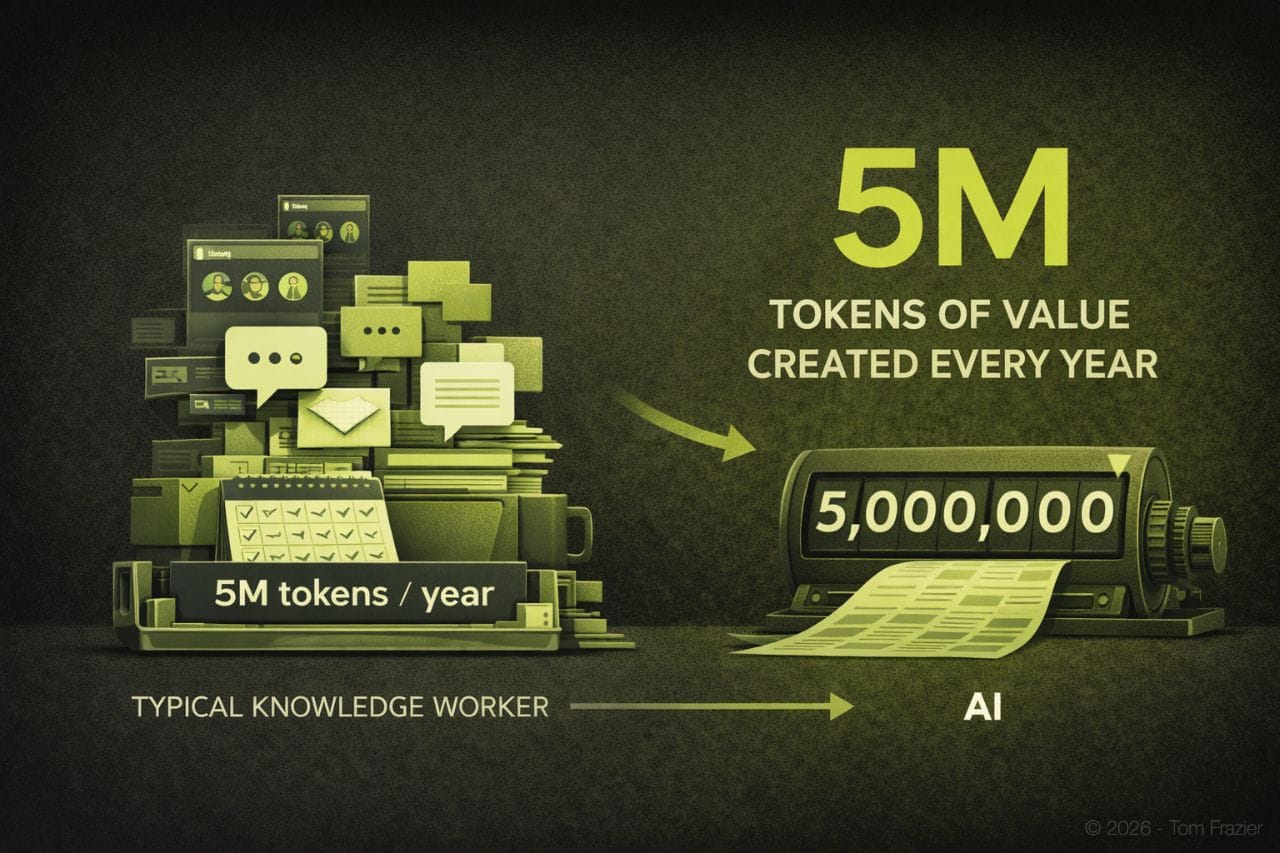
A typical knowledge worker produces somewhere between 5,000 and 10,000 words per day. Emails, documents, Slack messages, code, analysis. Multiply across 250 working days and you get 1.25 to 2.5 million words annually. At roughly 1.3 tokens per word, that's around 5 million tokens of value created every year.
Here's where it gets strange.
Current frontier models run somewhere in the range of $5 per million tokens blended across input and output for typical knowledge work. Five million tokens of output costs about $25.
The same annual output costs an employer $100,000.
The Friction Tax
I know what you're thinking. Real-world AI usage isn't that clean. You have to feed models context every session. There's overhead — retry loops, system prompts, the compounding cost of getting a model oriented on your actual situation. The chat tax is real.
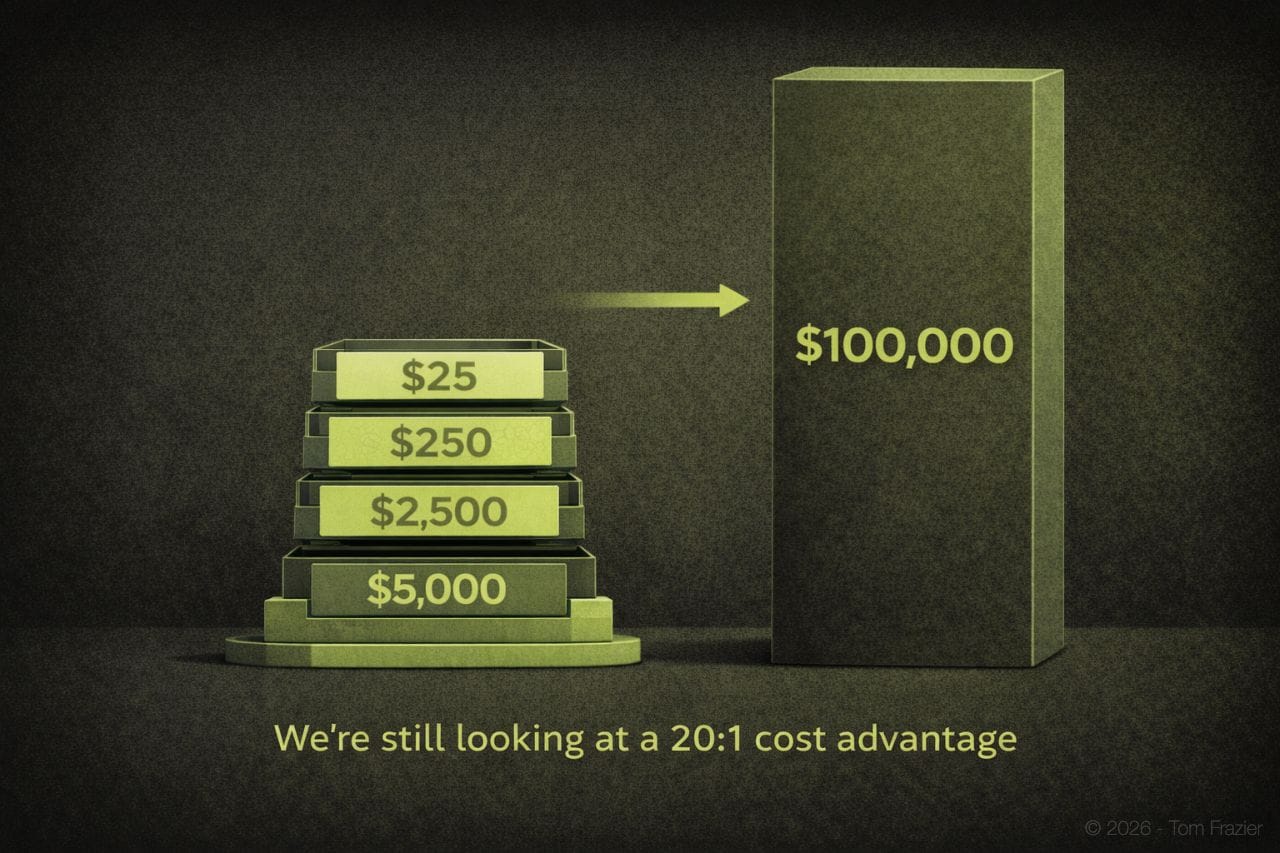
So let's be conservative and 10x that token cost to account for friction. That brings us to $250.
I might be off by an order of magnitude. The real number could be $2,500 or even $5,000.
We're still looking at a 20:1 cost advantage at the low end. That gap doesn't close with incremental efficiency improvements on the human side.
The Productivity Illusion
Here's what makes this inversion more uncomfortable than previous automation waves.
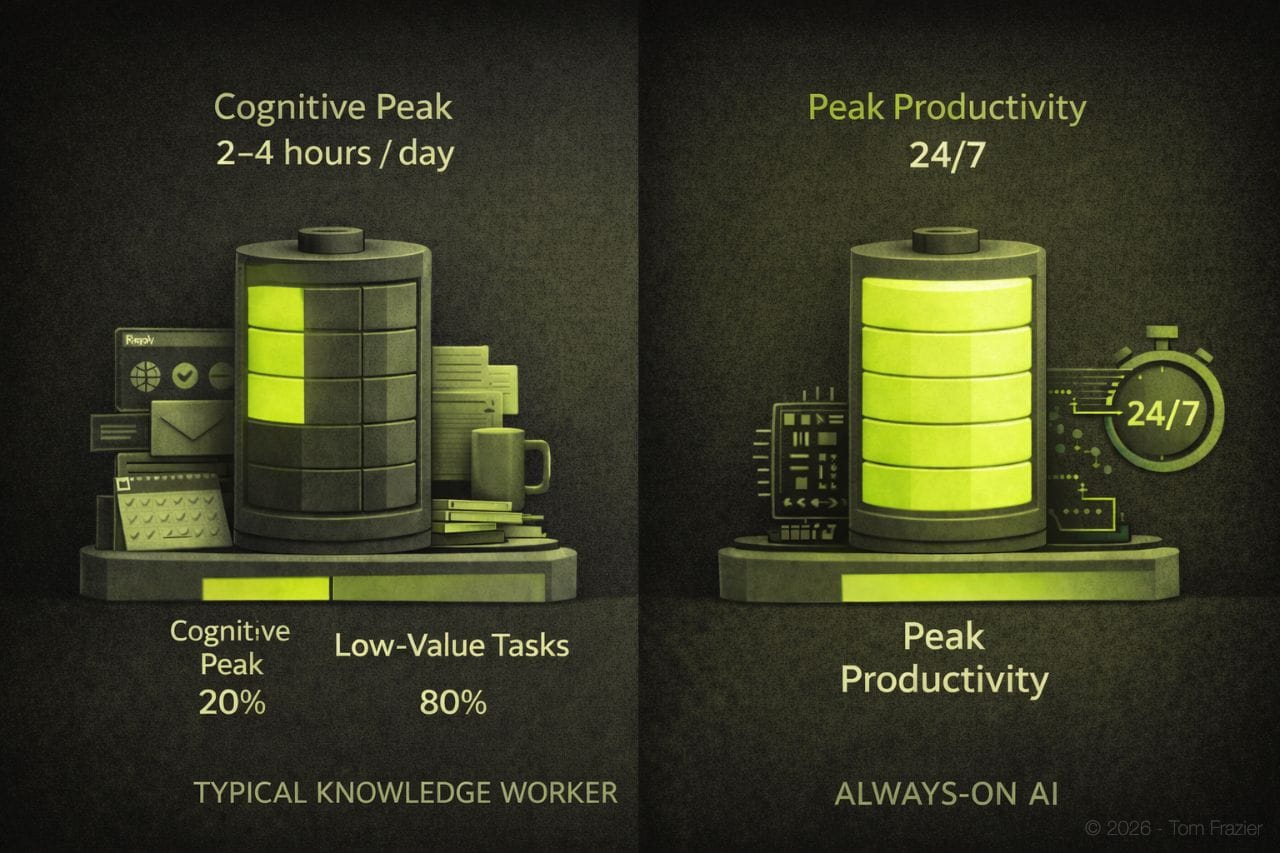
Knowledge workers typically hit cognitive peak for only two to four hours per day. Organizations pay for eight-hour days but extract meaningful value from a fraction of that time. Studies suggest more than 20% of knowledge worker time goes to low-value tasks — the kind of work that feels like work without producing much.
So you're not just competing against AI that costs less. You're competing against AI that operates at something closer to peak capacity continuously. No context switching. No afternoon slump. No inbox.
The Temporary Window
There's an important caveat worth naming honestly: AI is not inherently cheaper than human labor right now. It's heavily subsidized. The economics we're seeing reflect companies buying market share and training better models, not the long-run equilibrium price of inference.
Even if AI costs increase 10x from here, the math still favors automation for a wide range of knowledge tasks. The gap is that wide. Organizations that treat the current window as a free pass rather than a strategic advantage are going to find themselves on the wrong side of a structural shift that already happened while they were waiting for clarity.
What This Actually Means
The scarce resource isn't intelligence anymore. It's judgment. Taste.
The ability to know what question to ask. The capacity to recognize when an answer is wrong even when it sounds right. The skill of building trust with other humans — the kind that compounds over time and can't be approximated by a model that forgets you between sessions.
For repetitive, rule-based tasks, AI error rates have dropped below 1%, compared to human error rates of 3% to 5% for equivalent work. Quality improvement accompanies cost reduction rather than trading off against it. That combination — cheaper and more accurate — is the pattern that historically does the most structural damage to incumbents.
The companies I'm watching are figuring out that throwing headcount at a problem doesn't scale the way systems do. The ones building AI leverage before adding people are moving faster, compounding faster, and operating with a structural cost advantage that widens every quarter.
We are the expensive part of every business process now. That's not a reason to panic. It is a reason to be honest about what you're actually building.
The Big Questions
- Are you building systems that make your judgment more valuable? Or,
- Are you doing work that gets cheaper to automate every quarter?


