


The Pending Satoshi Settlement
The dollar has held the world's reserve currency crown longer than any empire before it — not through natural dominance, but through deliberate extension. That runway is now exhausted. What comes next isn't another nation's currency. It's mathematics. I call it the Satoshi Settlement.
Let me state my position plainly, before the argument.
The United States dollar's reign as the world's reserve currency is ending. Not dramatically. Not next Tuesday. But structurally, irreversibly, and faster than most people are willing to say out loud. The process has been underway for years, decades maybe.
I have shared this view repeatedly for many years now. Things seem to be accelerating given what is happening right now in Washington. While the US political landscape is not the cause of that ending, the tariffs, the debt spiral, the weaponization of dollar access is most definitely an accelerant.
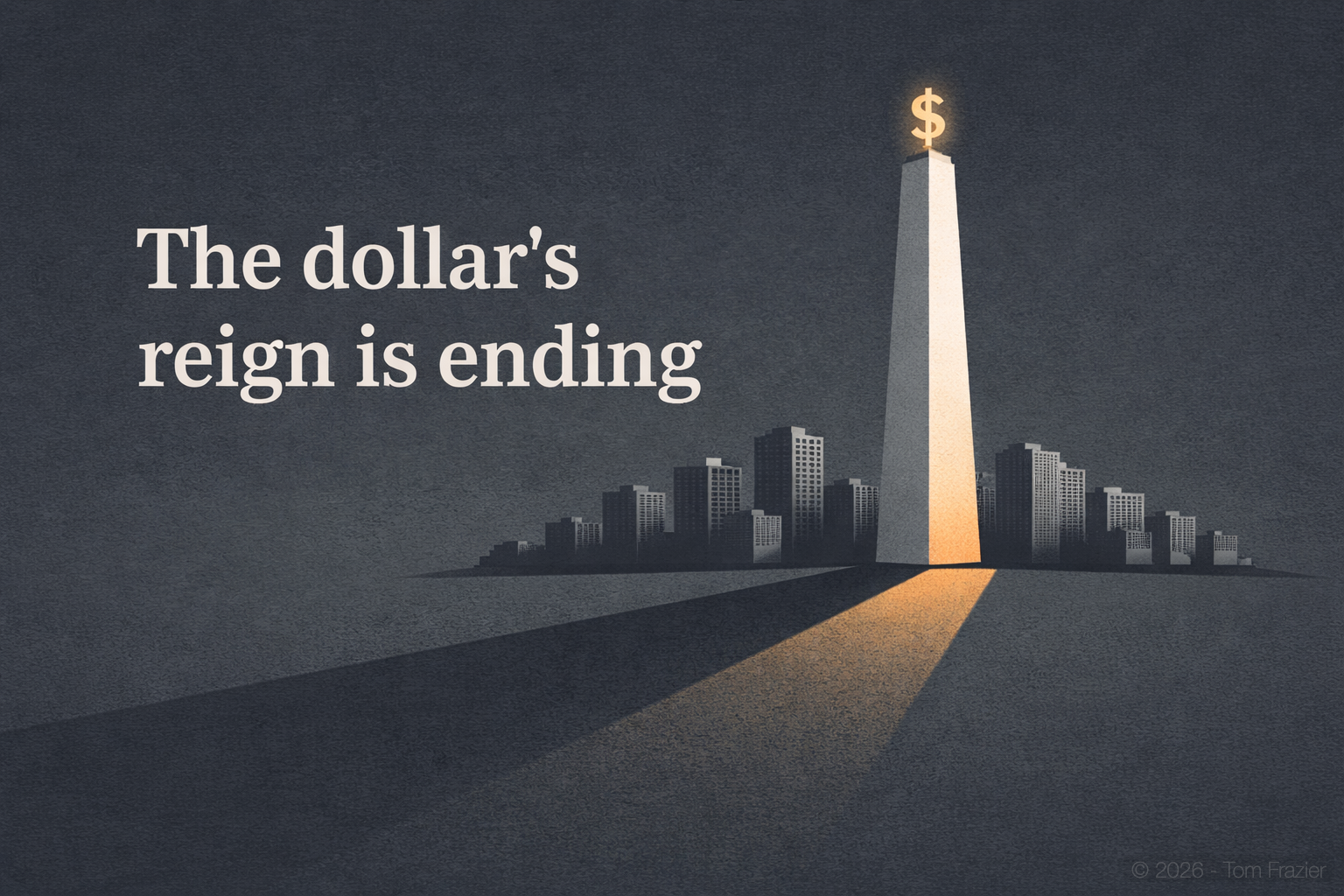
Bitcoin is what comes next - not the euro, not the yuan, not a BRICS basket. Not as a replacement for national currencies, but as the neutral settlement layer beneath a world that no longer trusts any single nation to hold the keys to global trade.
I call what is coming the Satoshi Settlement — the slow, structural shift from a manipulated, dollar-denominated world to a mathematically mediated one. The Cold War defined a generation by the tension between two competing systems. The Satoshi Settlement will define the next generation by the emergence of a third option: a system that belongs to no one, run by mathematics, accountable to no government.
Here is why I believe this. And here is why the peer-to-peer definition of Bitcoin will reach it's final form and the fantastic short-lived moment in which we can all participate.
Every Empire Gets Its Century. The Dollar Is Overdue.
Boring I know but let's start with history, because it is the most honest argument available. Since the age of exploration, only six powers have successively held the reserve currency crown:
- Portugal from 1450 to 1530
- Spain from 1530 to 1640
- the Netherlands from 1640 to 1720,
- France from 1720 to 1815,
- Great Britain from 1815 to 1920, and
- the United States from 1921 to the present.
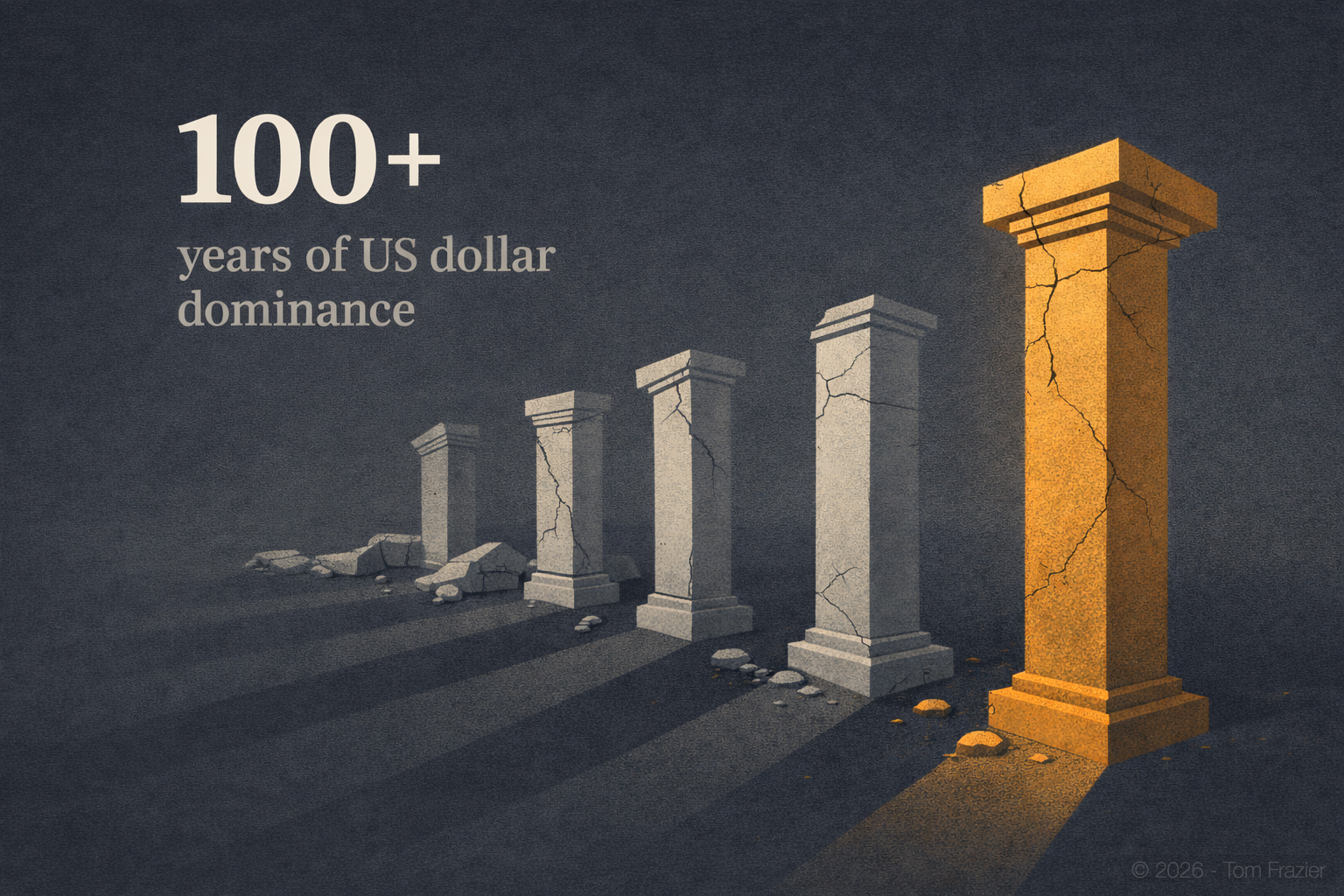
The average reign across those first five was roughly 94 years. Modern reserve currencies have led global dominance for an average of 95 years with an average variance of 10 years.
USD longevity is not accidental.
It is the product of deliberate, sophisticated, and sometimes ruthless policy decisions designed to extend the dollar's dominance well past its natural expiration date. What is different about the dollar's situation is how many times American policymakers have successfully manufactured new reasons for the world to keep trusting it.
The first extension came in 1944. At the end of the Second World War, there was literally no functioning global economy, so nations got together to create a new trading system and a new monetary system. One of the key elements was that the dollar would be pegged to gold at $35 an ounce. Other central banks could exchange the dollars they held for gold. In that sense, the dollar was as good as gold. The Bretton Woods system institutionalized dollar dominance at a moment when the United States held two-thirds of the world's gold reserves and was the only major economy whose industrial infrastructure had survived the war intact. The system was not designed to be permanent. It was designed to serve American interests while appearing to serve everyone's.
It worked brilliantly, for about 25 years.
By the late 1960s, the cracks were showing. More and more dollars were being printed in Washington, then being pumped overseas to pay for government expenditure on the military and social programs. In the first six months of 1971, assets worth $22 billion fled the US. The math had broken down. The world held more dollars than the United States had gold to back them. France, always clear-eyed about American monetary power, sent a ship to New York to retrieve its gold deposits before the window closed.
Nixon closed it first. On August 15, 1971, he unilaterally severed the dollar's convertibility to gold — an act that should, by all historical precedent, have ended dollar dominance. Contrary to widespread expectations, the suspension of dollar-gold convertibility did not erode confidence in the dollar; instead, it marked the beginning of a new era of dollar dominance. This outcome was not automatic but the result of deliberate US policy choices — including the petrodollar system, the Volcker-led restoration of monetary credibility, and strategic coordination through institutions like the IMF and G7.
The second extension.
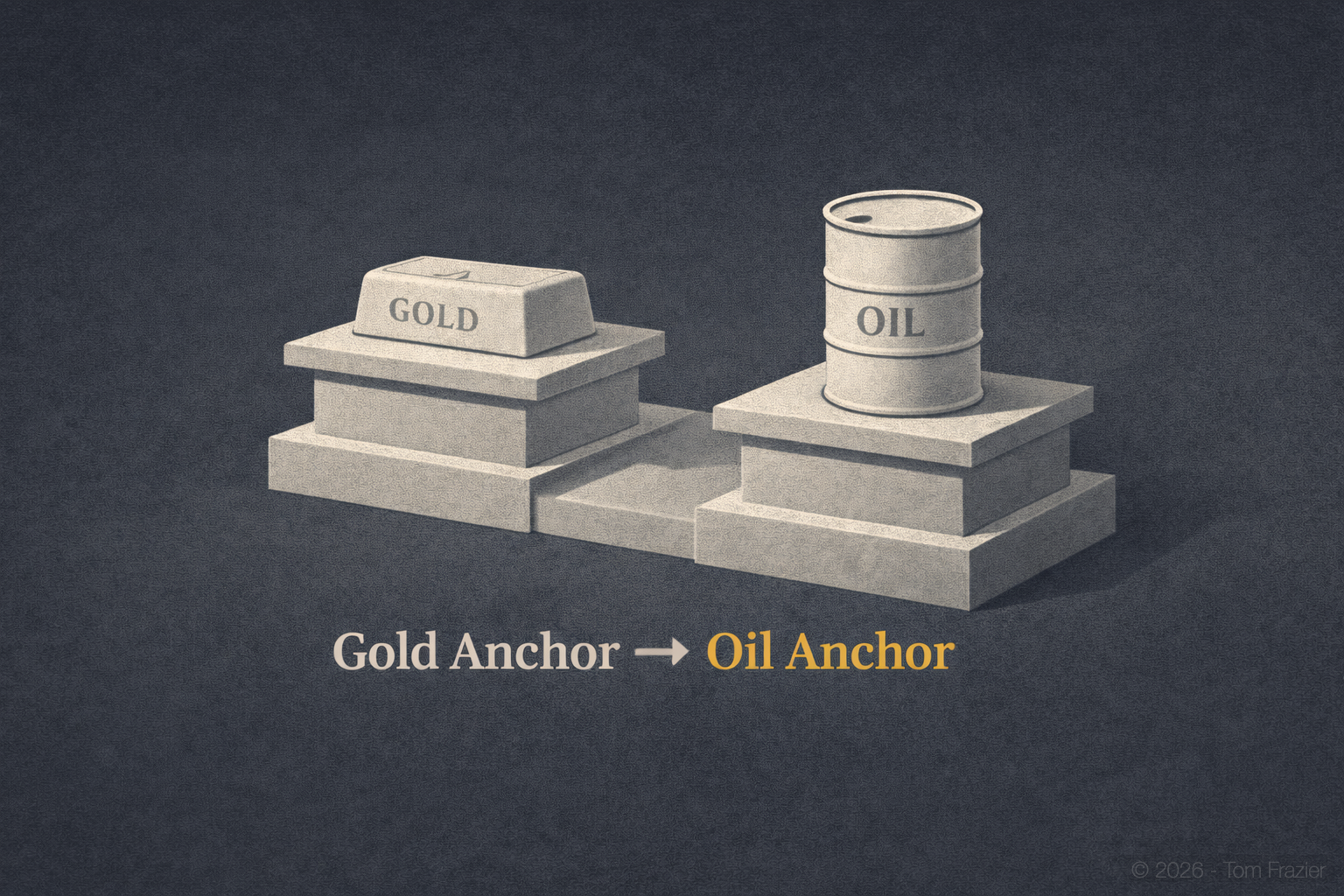
Gold was replaced with oil. Henry Kissinger negotiated the petrodollar system — Saudi Arabia would price oil exclusively in dollars, the US would guarantee Saudi security, and the world would need dollars to buy energy. Overnight, the dollar had a new anchor. Not a metal. A commodity that every economy on earth needed to function.
But that extension is now exhausted. The current US response to systemic stress lacks the strategic renewal that underpinned the dollar's past resilience. There is no third extension being engineered. There is no Kissinger in the room. What there is instead is a debt spiral, a collapsing credibility premium, and a trade policy that is actively pushing the dollar's closest allies toward the exit.
The Debt Has No Floor
Reserve currency status is built on trust. Trust is built on credibility. And credibility requires demonstrating, consistently, that you will manage your finances responsibly. The United States has not done that for decades. The bill is coming due.
The federal government spent $1 trillion on interest payments in FY2025 — net interest was the second-largest government expenditure, behind only Social Security, and totaled nearly one-fifth of all federal revenue collections.
The federal government currently spends more on interest payments than it does on Medicare, national defense, Medicaid, veterans' benefits and services, food and nutrition services, transportation, and science, space, and technology combined.
Let that settle. The United States now spends more servicing its debt than it spends defending itself.
The Congressional Budget Office projects gross federal debt rising from 123% of GDP in 2025 to 190% of GDP in 2056, by far the highest level in American history. Gross federal debt has averaged 70% of GDP over the past fifty years. The US Treasury's own financial report is explicit: the debt-to-GDP ratio was approximately 98% at the end of FY2024 and under current policy is projected to exceed 200% by 2049 and reach 535% by 2099. The continuous rise of the debt-to-GDP ratio indicates that current policy is unsustainable.
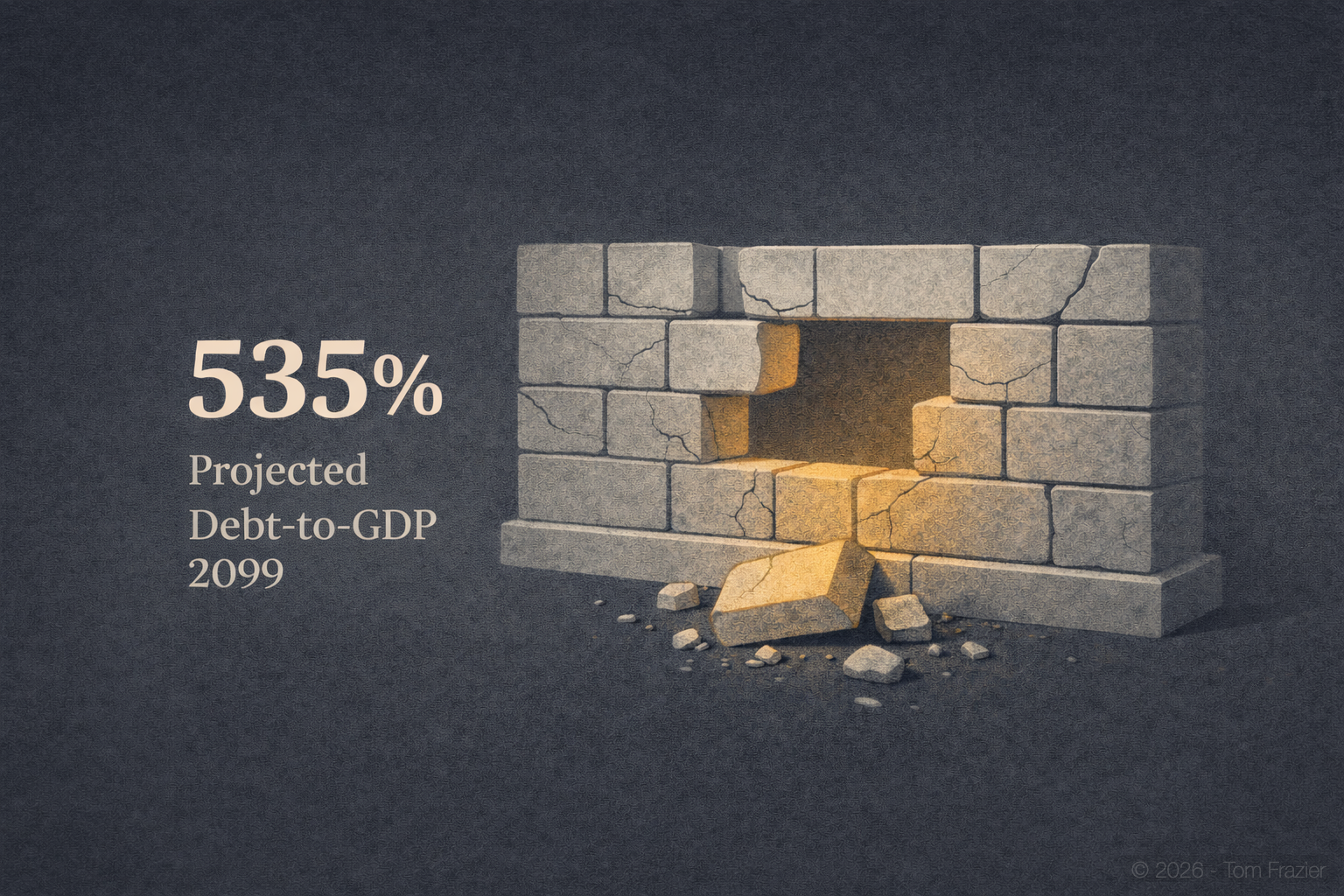
535% of GDP! That is the US Treasury's own numbers. Not a partisan estimate. A projection from the entity responsible for issuing the debt. What is wrong with us?!
The exorbitant privilege fallacy.
The dollar's reserve status has historically allowed the United States to borrow cheaply from the entire world. Foreign governments held dollars not because they were forced to but because dollar assets were considered the world's safest store of value.
That premium — the invisible subsidy that funded American military spending, social programs, and tax cuts simultaneously — is now in measurable decline. Stanford researchers documented something precise after the Liberation Day tariffs: European investors suddenly required significantly higher yields to hold US Treasuries. The safety premium started unwinding in real time.
When creditors start demanding higher rates to hold your debt, you are one step away from the currency spiral that ended every previous reserve currency reign.
Washington Is Doing the Work For Them
Here is where I want to be direct about something that most financial commentary is still dancing around.
The primary cause of accelerating de-dollarization now is not Chinese ambition nor BRICS coordination. It is American policy. Specifically, the decision to use dollar access as a weapon against trading partners — through sanctions, through tariff threats, through the weaponization of the SWIFT system — has done more to motivate reserve currency diversification than any amount of Chinese lobbying ever could.
In April 2025, the administration imposed sweeping tariffs on virtually every trading partner simultaneously. Canada. Mexico. The European Union. Japan. Countries that have been allied with the United States through multiple generations of economic architecture. The market reaction was not what economic theory predicted. The dollar fell — losing significant value against other major currencies in the first half of 2025, at a moment when tariffs should theoretically have strengthened it.
Then the Supreme Court ruled 6 to 3 that the emergency powers act invoked to justify the tariffs — IEEPA — cannot legally be used to impose tariffs at all.
The constitutional foundation for the policy was struck down while the economic damage was already in motion.
The countries on the receiving end of all of this watched every step. They are drawing conclusions. And the conclusion most of them are drawing is identical to the conclusion that ended every previous reserve currency reign: the issuing nation can no longer be trusted to manage its monetary responsibilities in the interest of global trade. It is managing them in the interest of its own political moment.
India began settling oil purchases from Russia in rupees rather than dollars. Brazil and China are settling energy transactions directly. Canada and India are actively expanding bilateral trade relationships — in potash, uranium, and energy — that are explicitly designed to reduce dependence on any single market or settlement system. These are not fringe actors. These are significant economies making deliberate architectural decisions about how they structure trade.
As Ken Rogoff, the Harvard economist and former IMF chief economist, has stated:
American unreliability as a partner is turbocharging de-dollarization. Not causing it — accelerating something already in structural motion.
The Problem With Going Multipolar
Here is the complication that advocates of de-dollarization rarely address honestly.
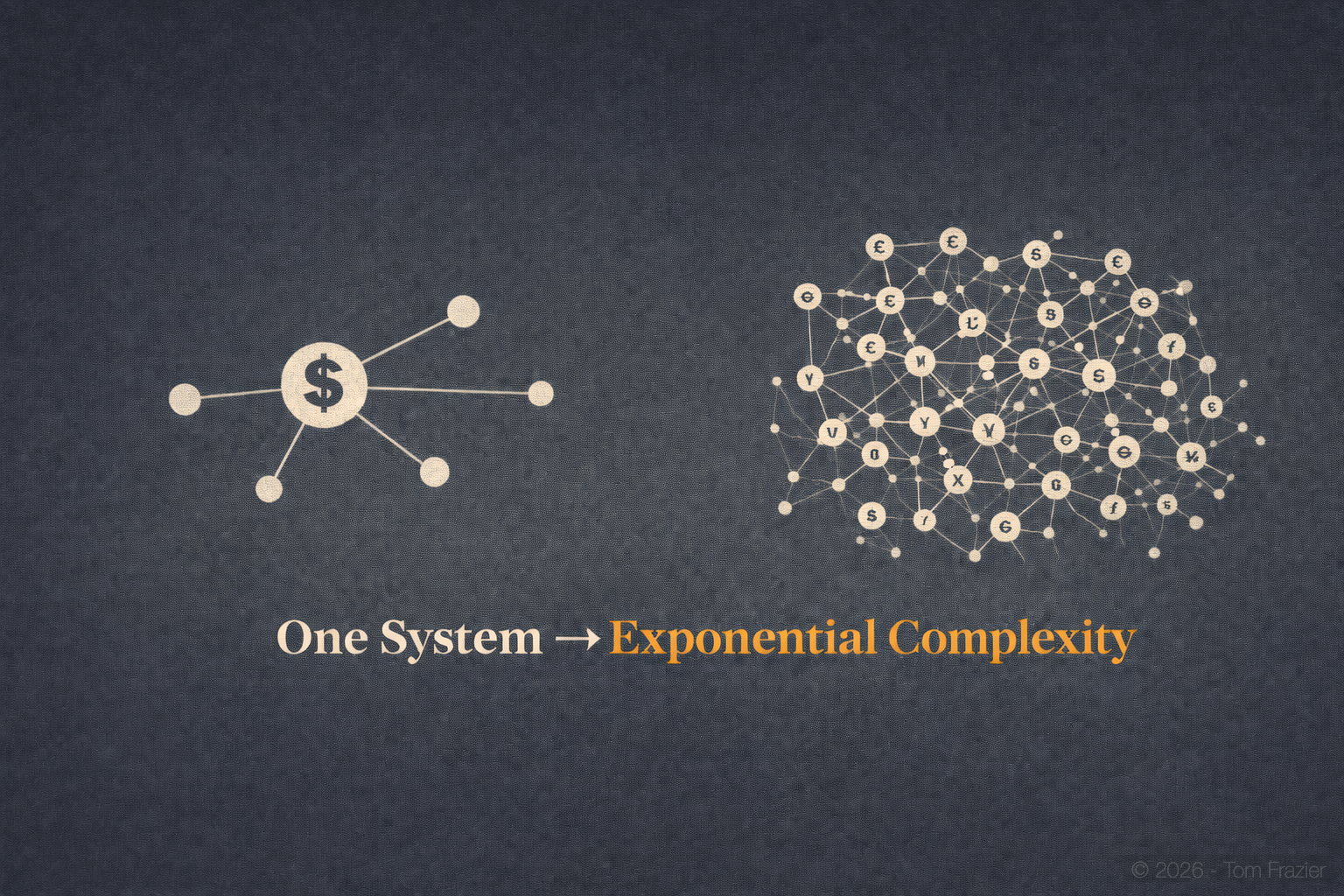
- A world where every nation pair settles trade in bilateral currency arrangements is not simpler than the dollar system. It is exponentially more complex. If Canada trades with India in rupees, Japan in yen, and Brazil in reais, someone has to manage the currency risk, conversion friction, and political reliability of each bilateral relationship. The dollar system was inefficient and politically loaded. But it was simple. One language. One rail. One universal translation layer between any two economies on earth.
- A genuinely multipolar trade world needs a genuinely neutral settlement layer. Something that does not belong to any nation. Something that cannot be weaponized by any single government's monetary policy or political emergency. Something mathematically consistent regardless of which two parties are using it and regardless of their relationship with the United States.
- Every previous reserve currency transition solved this problem by substituting one dominant nation's currency for another's. Portugal gave way to Spain. Spain gave way to the Netherlands. Britain gave way to America. In each case, one political system replaced another at the center of global trade.
The Satoshi Settlement is different. It does not replace one nation's currency with another. It removes the nation-state from the center of the settlement equation entirely.
Bitcoin as the Settlement Layer
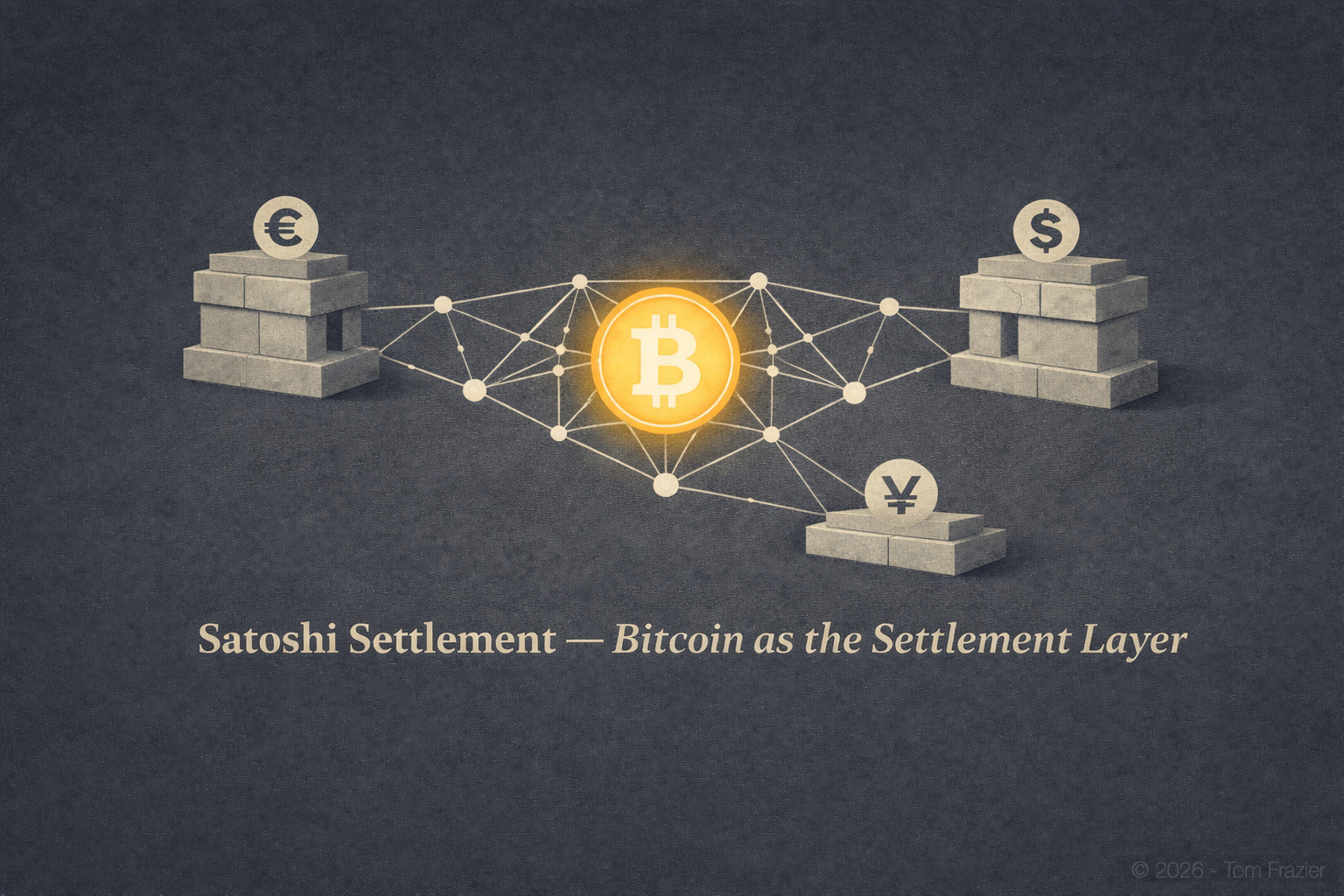
Most people think about Bitcoin as a speculative asset. The price goes up. The price goes down. People get rich. People get wrecked. That is the version of Bitcoin that makes news.
The more useful framing — and the one that explains why I hold it — is infrastructure. Neutral settlement infrastructure. A mathematical protocol that any two parties can use to transfer value without routing through a system controlled by either party's government or any third party's political agenda.
The rules of Bitcoin are set by mathematics and enforced by a distributed network that no government, no central bank, and no political administration controls. It cannot be sanctioned into irrelevance. It cannot be weaponized against a trading partner. It does not care whether you are India or Canada or Russia or Germany. It processes your transaction according to the same mathematical rules it applies to everyone else.
This is what Satoshi Nakamoto described in 2008 as peer-to-peer electronic cash — transactions between parties without a trusted intermediary. What is interesting now is where that vision is most likely to realize its full potential. Not between individuals buying coffee. Between nation-states settling commodity trades in a world where the universal intermediary has become untrustworthy.
The original Cold War was a competition between two systems — capitalism and communism — for ideological and geopolitical dominance. The world divided into camps. Each side built infrastructure, alliances, and institutions to serve its system. The tension lasted forty years and shaped everything.
The Satoshi Settlement is not a competition between two systems. It is the emergence of a third option that makes the competition obsolete. A system that belongs to no camp. Built on mathematics rather than ideology.
Accessible to every nation, every company, and every individual on identical terms. No VIP lanes. No political override. No Washington in the middle.
Nation-states are going peer-to-peer. That is the revolution. Bitcoin is the infrastructure the revolution runs on.
Where This Argument Differs From the People Already Making It
I am not the first person to observe that Bitcoin could serve as a neutral settlement layer for a post-dollar world. Two thinkers have gotten closest to this argument and are worth engaging directly — because understanding where their positions end is where mine begins.
Michael Saylor, the executive chairman of MicroStrategy and Bitcoin's most prominent institutional advocate, has argued for years that Bitcoin will become the world's dominant settlement layer — a $200 trillion asset class that transforms international finance. He envisions the largest banks, sovereign nations, and technology platforms ultimately transacting on Bitcoin rails. On the destination, we largely agree.
Where we diverge is on the framing. Saylor's argument is American triumphalism. He wants the United States to accumulate the most Bitcoin, dominate the new system, and effectively extend American financial hegemony into the next monetary era. His vision replaces dollar dominance with Bitcoin dominance — with America still holding the most chips. That is a coherent position. It is also, I would argue, precisely what the rest of the world is trying to avoid. A system that any single nation dominates — even through Bitcoin holdings rather than monetary policy — is not a neutral settlement layer. It is hegemony in a new wrapper.
The argument I am making is different:
Bitcoin's value as settlement infrastructure is inseparable from the fact that no nation owns it.
The moment any government accumulates enough Bitcoin to exert meaningful influence over the system, the neutrality that makes it useful evaporates. Bitcoin works as the Satoshi Settlement layer precisely because it belongs to no one. Saylor's vision of American Bitcoin dominance would, if realized, could recreate the same trust problem it was supposed to solve.
Zoltan Pozsar is the more intellectually rigorous voice in this conversation. The former Credit Suisse strategist and Federal Reserve official coined the term "Bretton Woods III" in 2022, arguing that we are entering a third monetary era — the first backed by gold, the second by American government paper, the third by what he calls "outside money": commodities and hard assets that no single government controls. His analysis of why this transition is happening is excellent. His identification of the weaponization of dollar reserves — specifically the seizure of Russian foreign exchange assets — as the triggering event is prescient and correct.
Where Pozsar and I part ways is on Bitcoin specifically. He has argued that money must have a direct link to government to endure — that Bitcoin lacks the institutional anchoring that gives currency its staying power. He owns none. He sees the destination but doubts the vehicle.
I think this reflects a category error. Pozsar is evaluating Bitcoin as a currency — a store of value that people transact with daily. By that standard, his skepticism is reasonable. But Bitcoin as a settlement layer between sovereign entities is a different function entirely. Nation-states do not need Bitcoin to be their domestic currency. They need it to be a neutral bridge between their domestic currencies — a trustless intermediary for the moments when they need to transact with a counterparty they cannot fully trust and whose government they do not want sitting in the middle of the deal.
That function does not require Bitcoin to replace the rupee or the Canadian dollar or the euro. It requires Bitcoin to be mathematically consistent, politically unownable, and available to any two parties regardless of their relationship with Washington. On those three criteria, no other asset comes close.
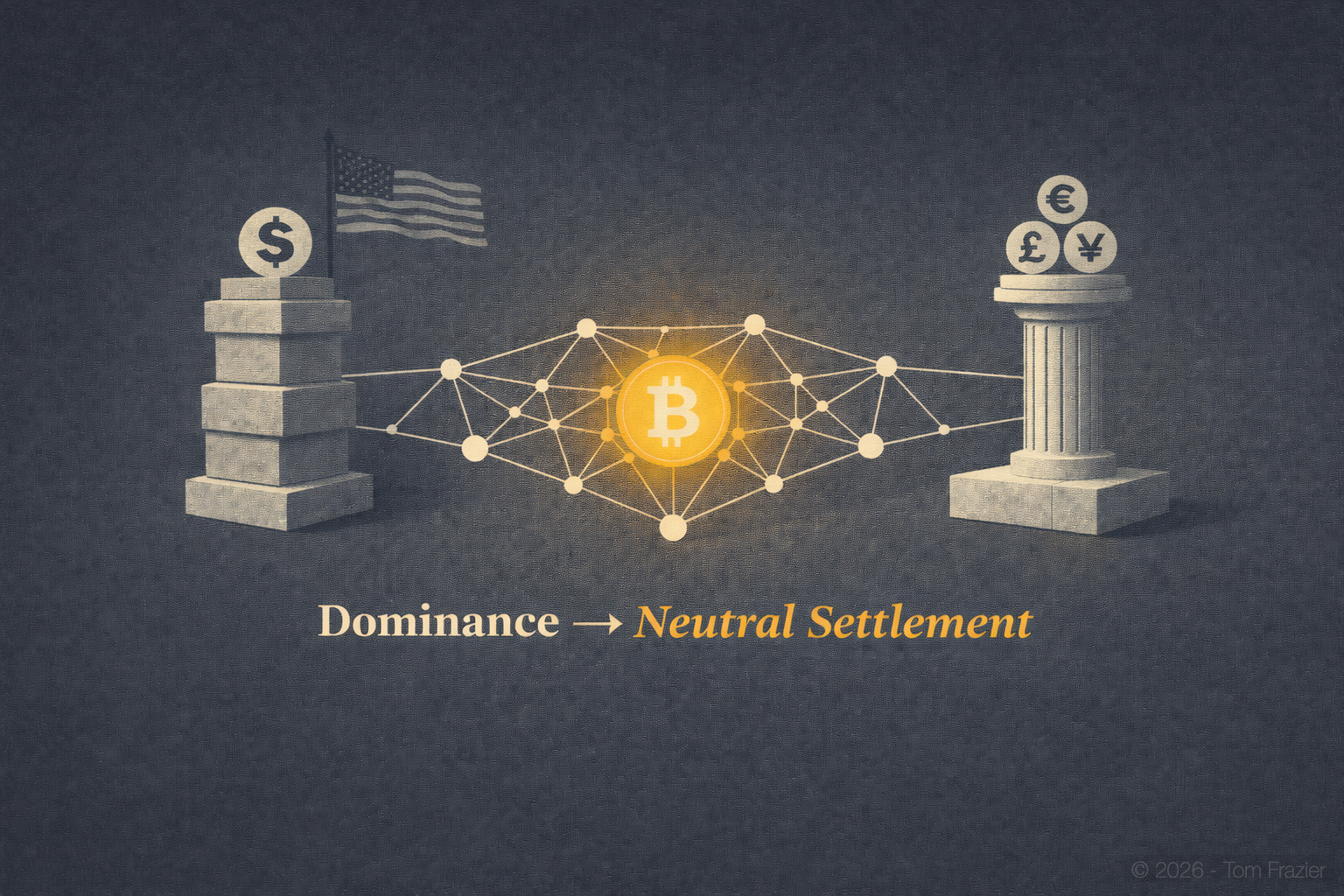
Pozsar identified the right problem. Saylor identified the right asset. The Satoshi Settlement is the argument that connects them.
Removing the American pomp, the category error, and grounding in specific political and fiscal conditions could make this transition not just possible but structurally inevitable.
What This Means for Everyone Else
Here is what I find most significant about this moment.
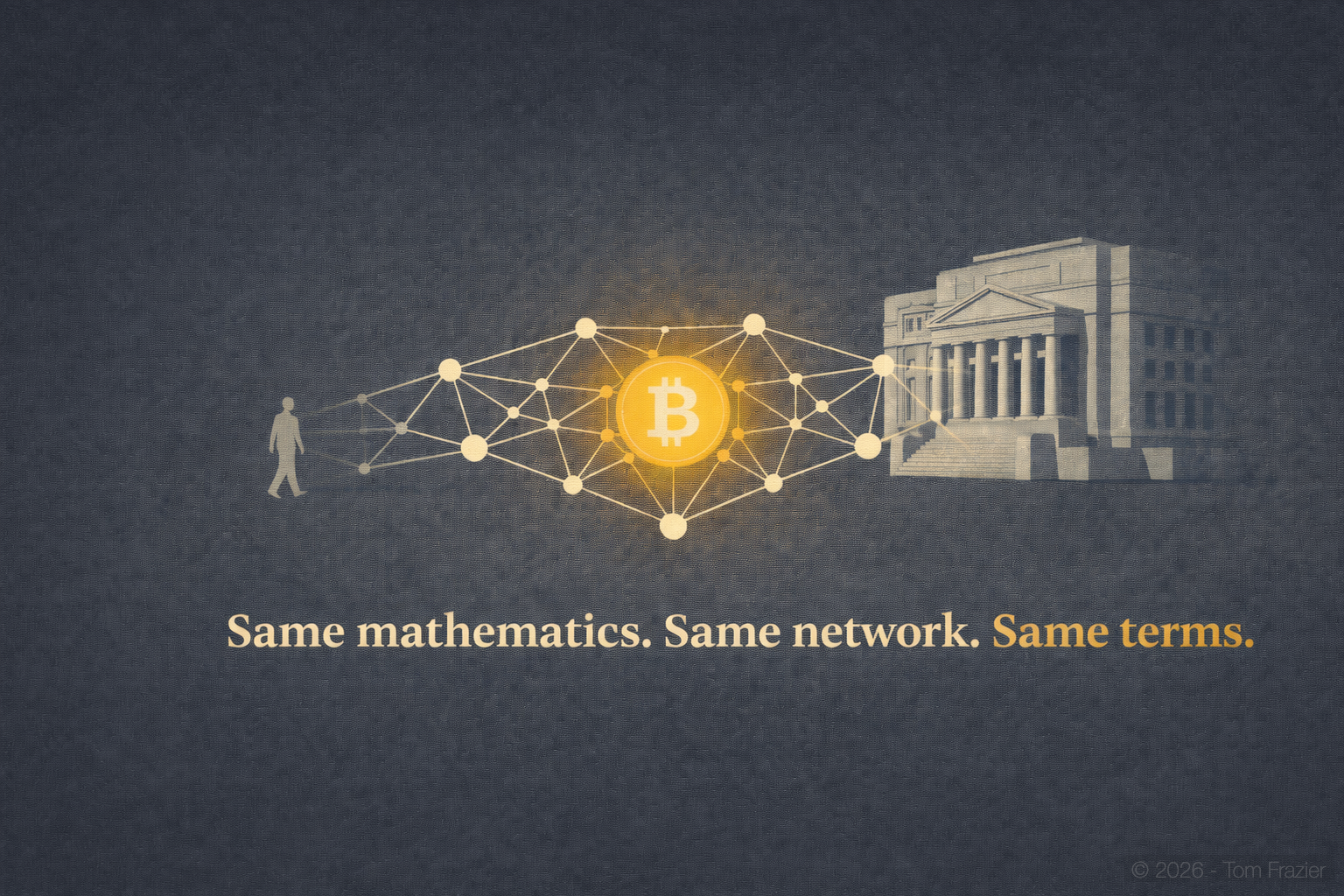
The infrastructure being built between sovereign nations is the same infrastructure available to every individual. Bitcoin does not have a privileged access tier. The protocol that a sovereign wealth fund uses to settle a billion-dollar energy trade operates on identical rules to the protocol anyone reading this can access today. Same mathematics. Same network. Same terms.
The window between now and the moment this becomes obvious to everyone is the window that historically creates the most significant advantage. Not because of speculation — though the economics of a fixed-supply asset experiencing dramatically increased institutional demand are not complicated. But because of understanding of what Bitcoin actually is and what function it serves.
I am not predicting Bitcoin replaces the dollar on a specific timeline. I am not making a price prediction of any kind. What I am pointing out is a structural argument:
- the function that reserve currencies have always served — neutral settlement infrastructure for international trade — is now being actively contested at the nation-state level.
- The dollar's ability to serve that function is declining, for reasons rooted in fiscal reality and political choices, not enemy action.
- The asset best positioned to serve that function in a genuinely neutral, mathematically consistent, politically unownable way already exists.
Every previous reserve currency transition took decades. Trusted institutions are slow to abandon familiar rails. But the direction of travel matters more than the speed. And the direction — from politically mediated settlement to mathematically mediated settlement — is now visible to anyone paying attention.
The Cold War ended when one of the competing systems collapsed under the weight of its own structural contradictions. The dollar era may end differently — not with collapse, but with quiet circumvention. Not because enemies tore it down, but because partners found a better road.
That road already exists. It should be ₿.
