


Maverick Market Maker: Become the Master of Your Domain
Most TAM slides are a lie — not intentionally, but structurally. Here's the only market sizing method that produces numbers you can actually run a business on.

Phase 3 — Growth & Scaling
How to read the market, own your category, sell with a system, build a funnel that converts, and engineer growth people actually share.
It is a Serial Entrepreneur's Playbook From Idea To Long-Term Success.
Maverick Market Maker
Create detailed market analysis, including insights on total addressable market, key market segments, growth trends, opportunities, and PESTLE analysis.
The market size slide in a pitch deck is almost always a lie. Not intentionally, but structurally. Most founders find a large number ($400B global market for X), divide it by some percentage to arrive at their "target," and present it as analysis. It isn't. It's a confidence game that fools investors who don't push hard enough, and fools the founders themselves most of all.
The reason this matters isn't fundraising. It's
that founders who misdefine their market make every downstream decision wrong
Things like where to spend, what to build, who to hire and when to expand. Market analysis isn't a one-time deliverable. It's the strategic operating system for every significant growth decision you'll make in Phase 3.
Here's how to do it properly starting from the value you create, not the universe you're hoping to claim.
Why Most TAM Slides Are Useless

Top-down market sizing works like this: take total global spend in a category, divide by the number of players, and declare your share. The problem is that every competitor is using the same number. Your SAM (serviceable addressable market) and SOM (serviceable obtainable market) become smaller versions of the same fantasy math.
The alternative is value theory and it's the only method that produces numbers a founder can actually make decisions with.
Value Theory TAM: Start With What Your Solution Is Worth
Value theory works from a simple question:
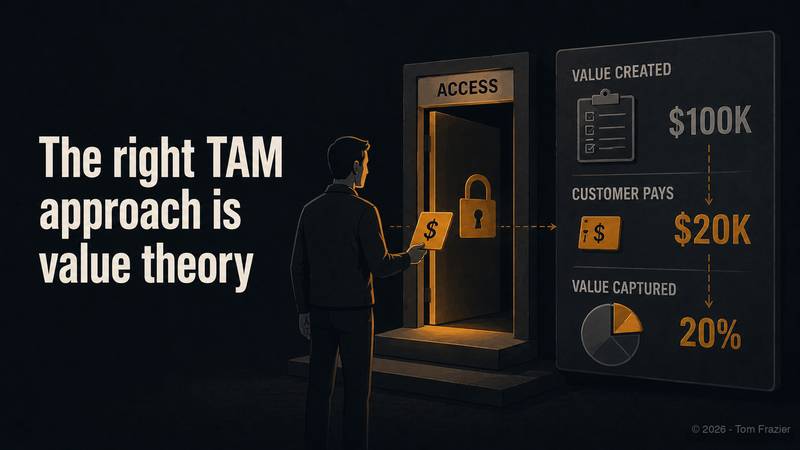
what is the economic value your solution creates for a customer, and what portion of that value would a customer reasonably pay to access?
This isn't philosophical. It's math.
The method:
- Identify the problem you're solving and quantify its cost in time, money, or risk
- Estimate your solution's net value to the customer after they pay you
- Price at a level that captures a reasonable share of that value, typically 10–30%
- Multiply by the number of customers for whom that math holds
A worked example
Suppose you're building a compliance workflow tool for mid-market healthcare providers. Also imagine the average cost of a compliance audit failure like fines, remediation, operational disruption is $280,000 for a facility of 100–500 employees. Your tool reduces audit failure probability from 23% to 7%, creating an expected $45,000 per year in avoided risk per facility. Pricing at $8,400 per year captures roughly 18% of the value created. Let's also assume the U.S. has approximately 6,000 facilities in that employee band bearing this risk profile (likely much much higher based on NAICS).

That number is smaller than a top-down slide. It's also real. It tells you something actionable: capture 10% of this market and you have a $5M ARR business. Capture 25% and you're at $12.6M. Those numbers drive hiring plans, fundraising decisions, and growth targets in a way that "$4B healthcare IT market" never will.
Assumptions to document
- Problem quantification source (industry data, customer interviews, enforcement records)
- Percentage of target companies where the problem is material and immediate
- Your value capture percentage and the competitive logic behind it
- Growth rate of the eligible customer pool
Document these explicitly. Investors who probe will respect the rigor. Founders who revisit the analysis in 12 months will thank themselves for it. For more on structuring the TAM/SAM/SOM stack, the Toptal methodology breakdown is one of the more honest treatments available.
Three Segments Worth Owning
Every market has pockets. The founders who win aren't the ones trying to serve the whole TAM; they're the ones who dominate a specific segment first, then expand from a position of strength.

Map your three highest-priority segments using this structure. For each, the value proposition statement follows a deliberate format:
"Our [relevant products and services] help(s) [name of this segment] who want to [jobs to be done] by [reducing/avoiding] [a customer pain] and [increasing/enabling] [a customer gain], unlike [competing value proposition]."
This format, from Strategyzer, forces specificity. If you can't fill it in cleanly, you don't know your segment well enough to sell to them.
Here are a those segments following on from the healthcare compliance example.
Segment 1: Early Adopters — Problem-Aware Buyers
This segment already knows they have the problem and is actively searching for a solution. Conversion economics are better here because you're not educating, you're competing.
Value proposition: "Our compliance workflow tool helps mid-market healthcare compliance officers who want to stay audit-clean without expanding their team, by reducing manual documentation time by 60% and increasing real-time audit readiness visibility, unlike spreadsheet-based tracking that fails under scrutiny."
- Demographic profile: Compliance officers, VP Operations, CFOs at 100–500 employee healthcare facilities; predominantly in heavily regulated states (CA, NY, TX, FL); median technology budget $150K–$500K per year.
- Effective reach methods: Direct outbound to compliance officer titles on LinkedIn; healthcare operations conferences (HCCA, AHLA); partner channel through healthcare attorneys and benefits consultants who are already trusted advisors with buyer access.
- Estimated TAM for this segment: ~2,000 facilities actively evaluating solutions annually. At $8,400 ARR = $16.8M addressable.
- Key conversion motivators: Regulatory risk (fines, liability), audit cycle pressure, staff attrition making the current manual process unsustainable.
- Purchasing behavior: Committee sale involving compliance officer and CFO; 60–90 day cycle; proof of concept common before commitment; annual contracts preferred.
Segment 2: Growth-Stage Operators Entering New Regulatory Territory
Companies scaling fast enough that compliance infrastructure hasn't kept pace. The pain is latent right now so they'll only feel it when the audit arrives. To this segment you're selling prevention, not relief. The sales motion is different; so is the message.
Value proposition: "Our platform helps growth-stage healthcare operators who want to scale into new markets without building a compliance team, by avoiding the operational disruption that reactive compliance creates and enabling proactive risk management, unlike hiring a full-time compliance officer at $120K+ who won't be effective for 90 days."
- Demographic profile: COOs, General Counsel, and HR Directors at 50–150 employee companies going through their first major compliance cycle; Series A/B funded is the sweet spot where budget exists and regulatory complexity has just arrived.
- Effective reach methods: Outbound triggered by hiring signals (companies posting compliance roles for the first time); VC portfolio companies via investor relationships; PEO platforms where compliance burden is a recurring pain point.
- Estimated TAM for this segment: ~3,500 companies annually hitting the growth threshold where compliance pressure arrives. At a lighter $4,800/year entry price point = $16.8M addressable.
- Key conversion motivators: Avoiding a first audit failure; risk aversion during active fundraising or M&A preparation; clear cost efficiency versus FTE alternative.
- Purchasing behavior: Founder or COO makes the call; shorter 30–45 day cycle; more price-sensitive; ROI framing against FTE cost closes the deal.
Segment 3: Enterprise Consolidation Buyers
Larger organizations (500–2,000 employees) managing multiple facilities or business lines, requiring centralized compliance visibility across the portfolio. Longer cycles, higher ACVs, deeper integration requirements.
Value proposition: "Our platform helps enterprise compliance leads at multi-facility operators who want unified risk visibility across sites, by eliminating siloed tracking that creates blind spots and enabling portfolio-level risk management, unlike point solutions that work for one location but don't scale across a distributed organization."
- Demographic profile: Chief Compliance Officers, SVPs of Operations at 500+ employee multi-site organizations; highest density in healthcare, financial services, and professional services where regulatory complexity compounds across jurisdictions.
- Effective reach methods: Enterprise sales motion; industry analyst coverage; referrals from mid-market customers who have been acquired or grown into this tier which is why the mid-market beachhead matters.
- Estimated TAM for this segment: ~800 target organizations. At $35,000 ACV with integrations and dedicated support = $28M addressable.
- Key conversion motivators: Board-level risk reporting requirements; M&A diligence preparation; audit history showing systemic gaps that point solutions failed to close.
- Purchasing behavior: Multi-stakeholder committee; 90–180 day cycle; security review and integration requirements; procurement involvement; multi-year contracts standard at scale.
Combined three-segment TAM: ~$61.6M

Each segment has a different sales motion, different messaging, and different product requirements.
Treating them as one "mid-market" bucket is how products get built that satisfy nobody completely.
The beachhead is segment 1. The expansion is segment 2. The ceiling is segment 3, reached after you've built the customer base and case study library that enterprise buyers require.
Market Growth: What the CAGR Tells You and What It Doesn't
For starters CAGR stands for 'Compound Annual Growth Rate' which is a method for measuring the expansion and contraction of something, in our case markets.
Start by projecting your TAM forward. This is not to impress anyone, but because the growth rate tells you how competitive your window is and how much time you have.
- A market growing at 3% annually is mature. You're competing for replacement share.
- A market growing at 18% annually is expanding. We can see new buyers are entering, and first-mover advantages compound.
These are fundamentally different strategic environments.
For the compliance workflow example
Healthcare regulatory complexity has increased materially. The expansion of HIPAA enforcement, the proliferation of state-level data privacy laws mirroring GDPR, and increasing CMS audit frequency all point to a growing compliance burden for mid-market operators. Historical CAGR for healthcare compliance software has tracked at 14–17% (per HIMSS and KLAS research).
Projected CAGR through 2028: 15–17%.

At 16% CAGR, a $61.6M TAM today becomes approximately $103M by 2028. That's still a focused market, not a venture-scale moonshot, but for a company building from zero, it's a credible path to $10M ARR with defensible margins before the big players wake up.
Go-to-market strategies that fit this growth environment
- Outbound-led at segment 1 (time-sensitive buyers, competitive window is open now)
- Content marketing and thought leadership for segment 2 (longer education cycle, lower cost per acquisition)
- Partner channel through benefits consultants and healthcare attorneys to leverage trusted relationships at scale
Macro and micro conditions to track
Regulatory enforcement trends directly determine market growth.
For example, when the HHS Office for Civil Rights increases audit activity, as it did materially in 2022–2023, demand spikes. When enforcement relaxes, growth plateaus. Track enforcement budgets, case resolution volume, and legislative calendars as leading indicators, not the analyst reports that always project growth regardless of what's happening on the ground.
Market Trends: Signal vs. Noise
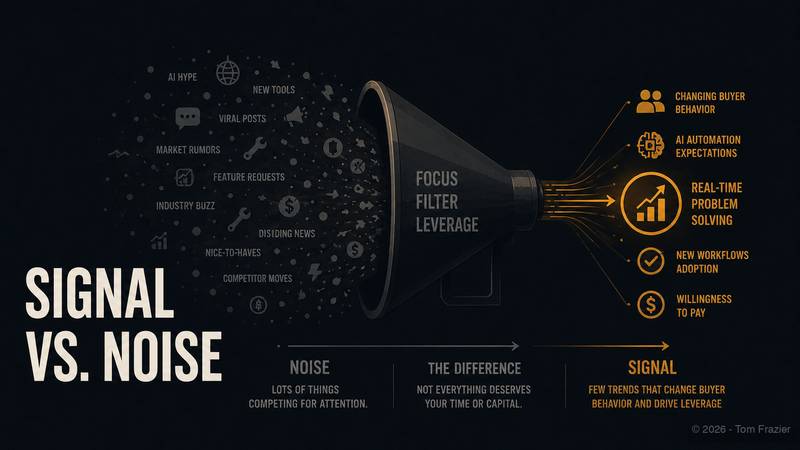
Trends worth capitalizing on are the ones changing buyer behavior right now, not emerging hypothetically in three years.
Continuing on the healthcare compliance example:
Trend 1: AI-Augmented Compliance Workflows
Buyers increasingly expect AI to surface risk patterns automatically rather than requiring manual review. Products that identify anomalies in real time are displacing those that produce static periodic reports.
Act on this: first movers building AI-native compliance workflows have a 12–18 month positioning advantage before incumbents retool their architectures.
Trend 2: Regulatory Fragmentation Across State Lines
Over 25 states now have active data privacy legislation, each with distinct requirements. Multi-jurisdiction compliance has effectively become its own product category.
Act on this: mid-market companies are currently paying legal fees to understand overlapping requirements. A product that automates jurisdictional mapping creates immediate, quantifiable ROI and the value proposition writes itself.
Trend 3: Compliance as M&A Diligence Signal
Buyers in healthcare M&A are increasingly treating compliance infrastructure as a deal signal, not just a risk item. Companies with clean audit histories and documented workflows command better multiples.
Act on this: compliance software shifts from cost center to strategic asset in the buyer's mind, unlocking higher willingness to pay and C-suite sponsorship that makes the sales cycle shorter.
Market Opportunities: Where to Play When You Can't Win by Fighting

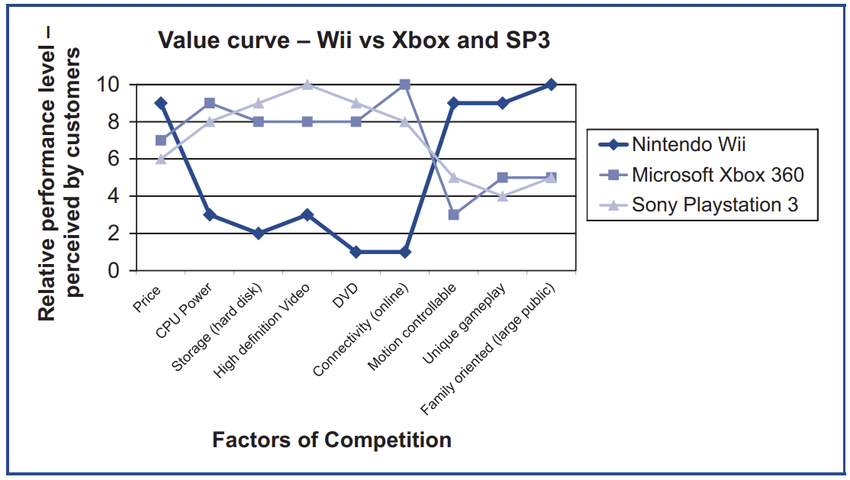
The Blue Ocean Strategy framework asks a different question than conventional competitive analysis. Instead of "how do we beat competitor X," it asks: "where is there genuine value demand that no one is currently serving well?"
The example I like to use the most for the Blue Ocean framework, using a Strategy Canvas, is when Nintendo launch the Wii platform. They focused on gameplay and disregarded many attributes others were competing on.
Four moves create Blue Ocean opportunities in any market:
Eliminate what customers hate about existing solutions. In compliance software, customers hate configuration complexity: 6-month implementations before any value is delivered. A product that ships pre-configured for the top 10 compliance frameworks eliminates the main barrier to adoption entirely.
Reduce what the market over-delivers on that buyers don't actually value. Enterprise platforms over-invest in reporting depth that mid-market buyers never use. Reducing to the 20% of reports that drive actual decisions creates a simpler, cheaper product that hits a different price point and wins on fit, not features.
Raise what customers wish was dramatically better. Real-time risk visibility. Current tools produce monthly or quarterly snapshots. Daily or continuous monitoring raises the value ceiling and creates a category of its own.
Create what buyers have resigned themselves to living without. Predictive audit risk scoring — a forward-looking signal that tells a compliance officer: "You are 73% likely to have a finding in this area based on current documentation patterns." No incumbent does this well. The first product to own this capability defines the category.
The Blue Ocean position
A pre-configured, AI-native compliance platform with predictive risk scoring, priced for mid-market, with no 6-month implementation requirement. That product doesn't compete with enterprise incumbents, it creates demand from buyers who've already given up on those products. That's the market that's yours (in our example) to define.
Market Fit: How You Change the Dynamics in Your Favor
Market fit isn't just whether customers want your product. It's about whether your entry restructures competitive dynamics in ways that compound over time.
The founders who become market masters don't just win customers, they change the market's assumptions about what's possible and what it should cost.
Define your wedge precisely
The wedge is the specific entry point where you're so much better than alternatives that customers switch and stay. For this example: pre-configured compliance frameworks for mid-market healthcare operators. Narrow enough to be genuinely superior. Wide enough to build a real business before needing to expand.
Build switching costs by design
Once a compliance team's audit history, remediation records, incident documentation, and workflow configurations are in your platform, migration costs are high. Data gravity is a moat. It doesn't happen by accident so design for it from the first customer.
Use the beachhead to expand
Compliance for healthcare is the entry. Compliance for adjacent regulated verticals — financial services, legal, education — is the expansion. The customer success model, the regulatory framework library, and the AI pattern recognition transfer directly. The second vertical costs a fraction of the first to enter. This is how focused market entry becomes scalable market ownership.
Market dynamics that shift in your favor
- Mid-market buyers previously priced out of enterprise solutions enter the market on your terms
- Incumbents are slow to respond to pre-configured simplicity because their revenue model depends on implementation fees
- Early customers become case studies that generate trust in a trust-sensitive buying environment and in compliance, trust is the primary purchase criterion
The connection between market fit and business model is direct. For a deeper treatment of business model mechanics, see Mastering Your Business Model Before the Market Does It for You.
 Tom Frazier

PESTLE: The Environmental Scan Most Operators Skip
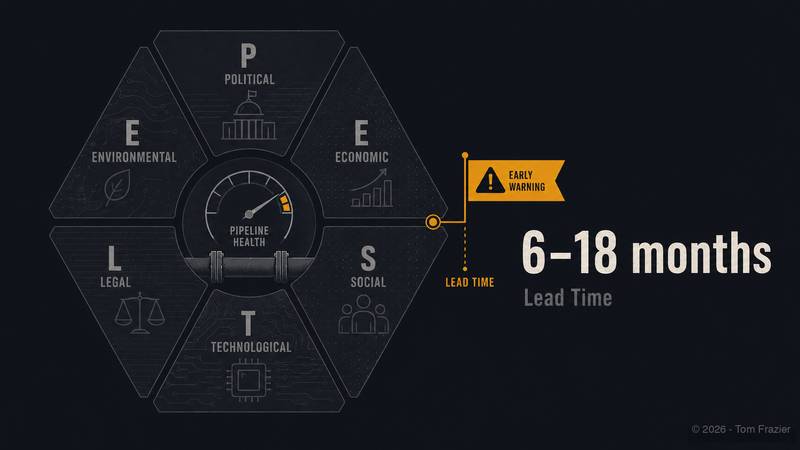
PESTLE isn't a framework exercise.
PESTLE is the external environment audit that identifies which tailwinds to accelerate into and which threats to build against before they arrive in your pipeline data.
Political
Regulatory enforcement is a political variable. Administration changes, enforcement budget allocations, and legislative priorities directly affect the urgency of compliance investment for your buyers. Map who sets enforcement policy in your target vertical and track their agenda. In healthcare compliance, HHS and CMS leadership changes are as strategically significant as any product roadmap decision.
Economic
In a cost-constrained environment, compliance software competes with headcount for the same budget line. Positioning against FTE cost is essential in a downturn. In an expansion, budgets are available and risk tolerance is higher so push growth features and premium tiers. Know which environment you're operating in and price and message accordingly. The founders who fail to adapt pitch to economic cycle leave significant revenue on the table.
Social
Workforce attitudes toward workplace regulation, data privacy expectations, and ESG reporting requirements all shift how compliance is perceived inside an organization. Companies where compliance culture is strong close faster. Companies where compliance is seen as overhead need a different ROI argument, one rooted in risk avoidance, not organizational values. Both are addressable; they require fundamentally different messaging.
Technological
AI is restructuring what compliance work actually is. Products that treat AI as a feature bolt-on are being displaced by products that treat AI as the engine. LLM capabilities are reducing the cost of parsing regulatory text and mapping requirements, which means competitive advantage now lies in the workflow layer, the data integration layer, and the user experience. Not in underlying interpretation capability that will commoditize. Build accordingly.
Legal
Your product exists inside a legal environment as well as a market one. Data handling requirements (HIPAA, GDPR, state privacy laws) apply to you as a vendor processing sensitive compliance data. Legal exposure isn't just a customer problem, it's also yours. Build your data infrastructure to be defensible before you need it to be, not after a breach reveals the gaps. This is especially true in any vertical where you're selling compliance on the strength of your own compliance posture.
Environmental
ESG reporting is increasingly becoming a compliance category itself. Companies required to report emissions, supply chain ethics, and DEI metrics need compliance infrastructure for those frameworks as much as for regulatory mandates. For software vendors in the compliance space, this represents an emerging market extension, not a distraction, with premium pricing potential because the regulatory map is still being drawn and first movers define the standard.
Using PESTLE operationally
Build an AI agent to monitor each dimension quarterly. Not in depth... a 30-minute scan per dimension is sufficient. The goal is early warning on inputs that affect your market before they show up in pipeline data. Regulatory changes typically give you 6–18 months of lead time if you're watching. Most companies find out about them when a customer calls to ask what the new rule means for their subscription. That's too late.
The Map IS the Territory
The market analysis most founders produce is a map of where they hope to be. This framework builds a map of where buyers actually are, what they're willing to pay, where growth is coming from, and what forces are shaping the terrain around them.
The founders who master their domain don't stumble into it by outworking competitors. They define the segment before competitors know it's a segment. They price for the value they create rather than the market they're trying to justify. They see regulatory and technological shifts as strategic inputs, not background noise they'll deal with later.
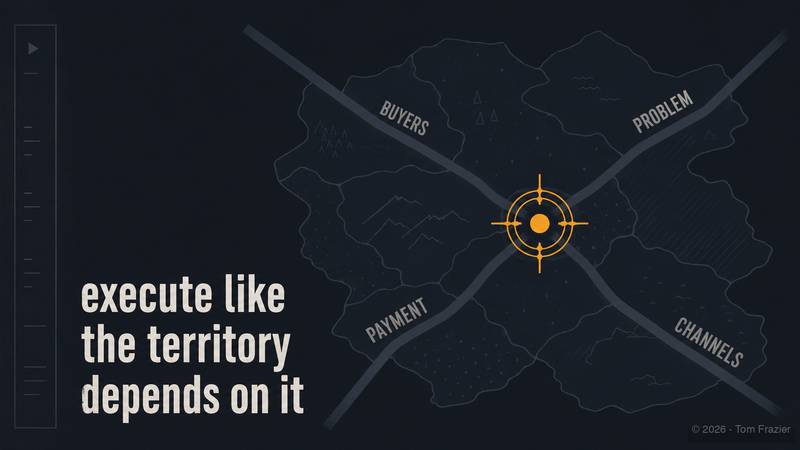
Your market isn't what your pitch deck says it is. It's the specific intersection of buyers who have the problem, can pay for the solution, and are reachable through channels you can actually afford. The founders who map that intersection precisely, and execute like the territory depends on it, become the market. The rest are in it.
This is the second article in Phase 3 — Growth & Scaling. You can access the AI tool below.
Become the Master of Your Domain With Maverick Market Maker. A free AI tool just for subscribers. ⤵️
This article is why I built the Maverick Market Maker GPT. It provides detailed market analysis, including insights on total addressable market, key market segments, growth trends, opportunities, and PESTLE analysis.
Leverage industry shifts & emerging opportunities to create powerful data-driven decisions and outcomes.
Common Questions About Maverick Market Maker
Why should I trust its market analysis over traditional methods?
Maverick Market Maker combines cutting-edge AI capabilities with extensive market research knowledge. It can rapidly analyze vast amounts of data, provide insightful market segmentation, and offer strategic recommendations.
Isn't an AI tool too generic for my specific market needs?
Maverick Market Maker can customize its research and insights based on the specific details of your market and audience, ensuring that the information provided is highly relevant and actionable for your unique market context.
How can it understand and analyze complex market trends?
Maverick Market Maker is equipped with advanced algorithms and a comprehensive database that allows it to identify and analyze complex market trends. It can dissect intricate market dynamics, recognize emerging trends, and provide strategic insights that are crucial for market positioning and growth.
Can it really help in making strategic business decisions?
Yes, Maverick Market Maker is designed to assist in strategic decision-making. It not only provides data and analysis but also interprets this information to offer strategic recommendations. This includes identifying market opportunities, suggesting go-to-market strategies, and providing a detailed PESTLE analysis to inform your business strategy.
Will it stay updated with the latest market changes and data?
Maverick Market Maker continuously integrates the latest market data and trends into its analysis. While it primarily relies on the data and knowledge provided, it's also designed to adapt and update its insights based on the most recent information available, ensuring that the market analysis remains relevant and timely for your business needs.
This post is for subscribers only
Sign up now to get access to the post.
Already a member? Sign in