

Mastering Your Business Model Before the Market Does It for You
A great idea with the wrong business model is just an expensive lesson. Here's how to use the business model canvas as a decision tool — not a fundraising slide — and find the constraint that defines your ceiling.
Phase 1 — Conceptualization & Planning
It is a Serial Entrepreneur's Playbook From Idea To Long-Term Success.
Business Model Mastery
Craft tailored value proposition statements, develop a comprehensive business model canvas, conduct detailed PESTLE analysis, and gain strategic insights on enhancing business model elements like scalability, cost structure, and market competition strategies.
I watched a human therapeutics company nearly starve for growth with a product people genuinely wanted. The product worked. Customers loved it. Revenue was real. The problem was structural.
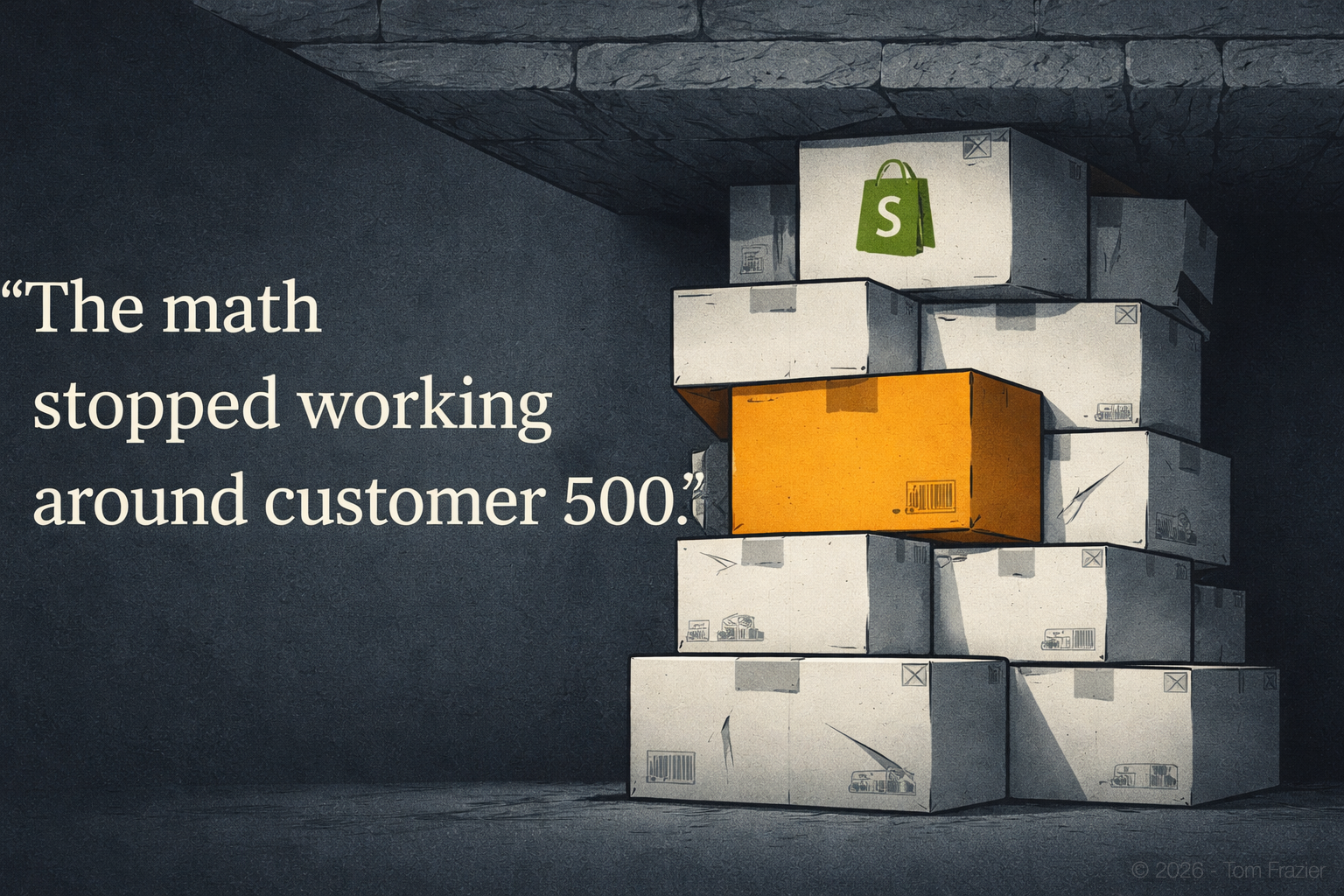
The business model was low volume, ultra-high margin, sold exclusively direct-to-consumer through a single Shopify store. Everything depended on one channel. When you are the only person talking about your product, trust grows slowly.
Scaling that model meant spending more on ads to reach more people who had never heard of you. The math stopped working around customer 500.
The company was not failing because of bad execution. It was executing well against a model that had an artificial ceiling built into it from the start.
We refactored manufacturing to enable high volume at high margin. We enlisted power users as spokespeople so someone else was talking about the product. We expanded distribution beyond Shopify to Amazon and physical retailers who already had the customer base we needed. The business went from structural constraint to actual growth.
The product only had minor improvements. The business model got an overhaul.
The Business Model Canvas Is a Decision Tool, Not a Fundraising Slide
Most founders fill in a business model canvas because an investor asked for it. They treat it like a required slide in the deck. The boxes get filled. The meeting happens. The canvas gets filed.
That approach misses the point entirely.
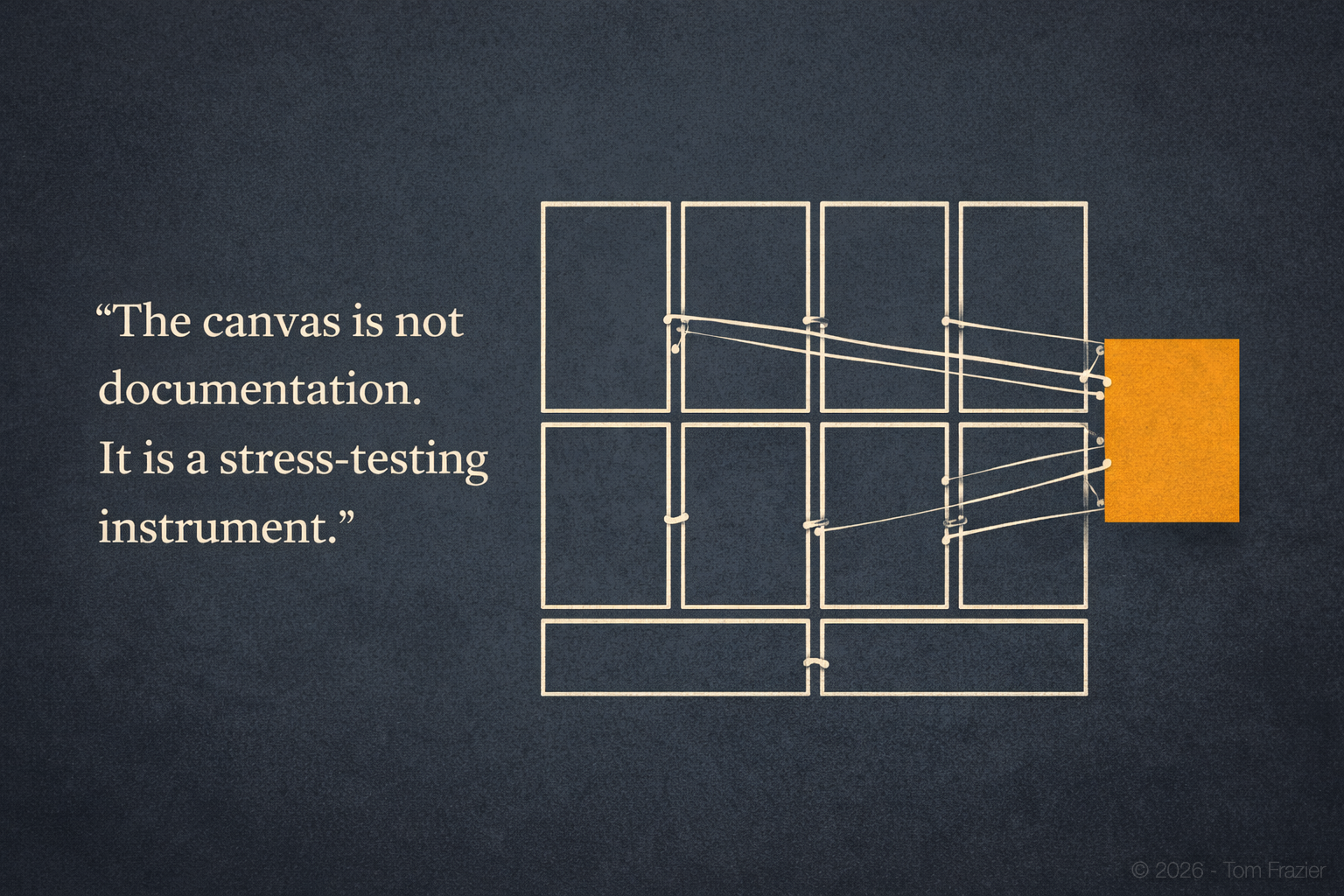
The canvas structures a conversation about how each decision affects interconnected components:
- customer segments
- value propositions
- channels
- relationships
- revenue streams
- resources
- activities
- partnerships, and
- costs.
It forces you to see the dependencies. When you change one element, three others shift. When you ignore one element, the whole structure weakens.
The canvas is not documentation. It is a stress-testing instrument.
The question is not whether you can fill in the boxes. The question is whether the model you just described can actually build a business that survives contact with reality.
The Value Proposition Is the Foundation Everything Else Builds From
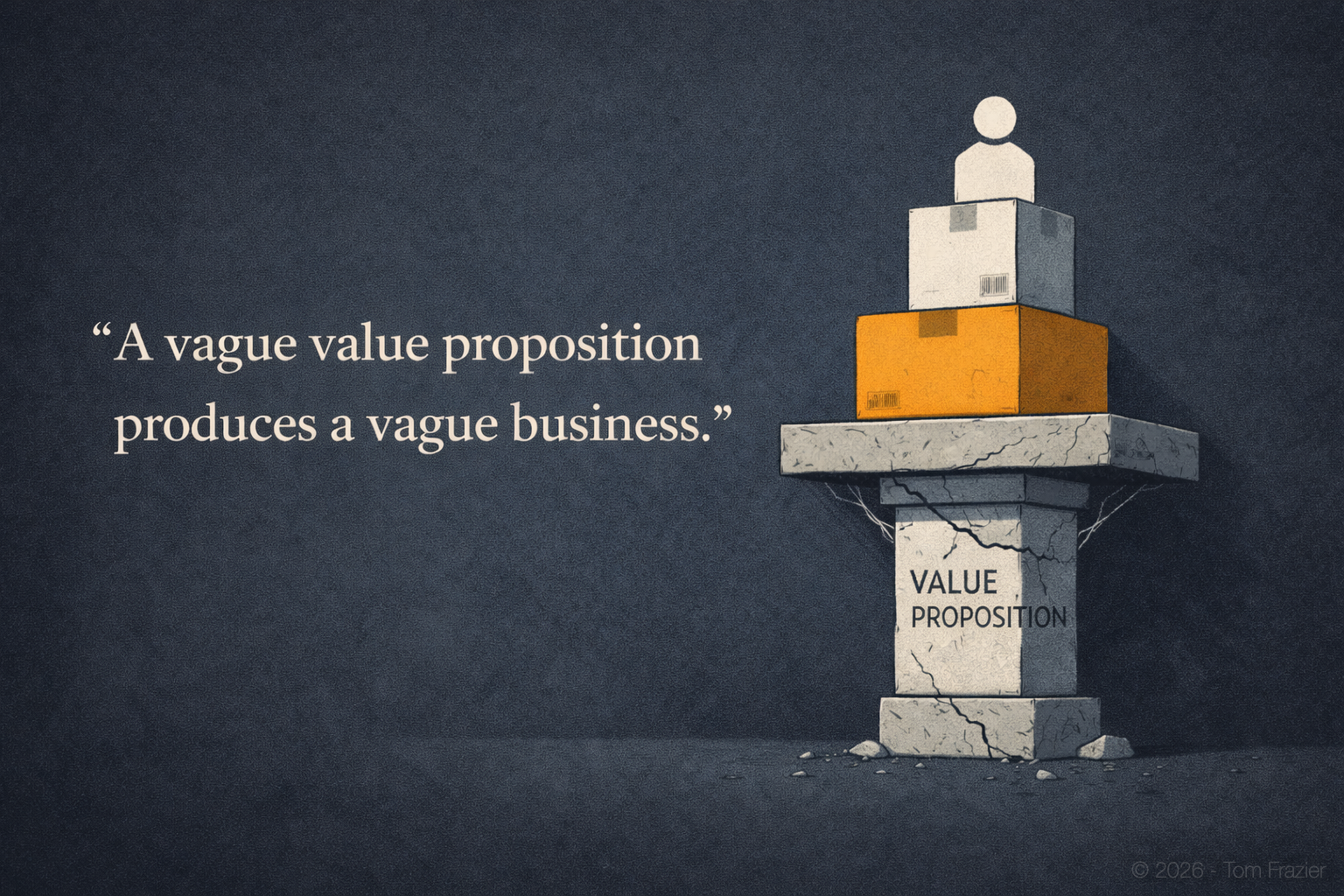
A vague value proposition produces a vague business.
When you cannot articulate exactly what job your product does, for whom, and why they should care, every downstream decision becomes a guess. Your pricing is a guess. Your channel strategy is a guess. Your cost structure is a guess.
The Strategyzer template forces the specificity most founders avoid:
Fill that in honestly and you will immediately see whether you have a real value proposition or a feature list dressed up as one.
The therapeutics company initially said: "Powerful post-workout machine." That statement could describe 1,000 products. It gave us nothing to build from.
The real value was "Modern recovery for all" so the Value Proposition Statement became "Our massage equipment helps amateur athletes who want fast effective treatment by adding home recovery technologies unlike infrequent, expensive in-person physical therapies."
That statement tells you who the customer is, what job they are hiring the product to do, and why existing alternatives fail them. Now you can make decisions. Now you know your customer acquisition strategy needs to reach people already managing chronic inflammation. Now you know your messaging needs to emphasize clinical dosing and protocol simplicity. Now you know your competitive advantage is integration, which means your cost structure needs to support compound sourcing at therapeutic levels.
Specificity at this level changes everything downstream.
Three Elements That Kill Companies When They Are Wrong
The business model canvas has nine components. Three of them determine whether your company lives or dies.
Value Proposition
If you cannot state your value proposition in one sentence that a stranger understands, you do not have one yet. You have a product looking for a problem.
The value proposition is not what your product does. It is what outcome your customer gets that they could not get before.
Cost Structure
Your cost structure determines your ceiling.
If customer acquisition costs more than customer lifetime value, you are buying revenue at a loss. A healthy ratio is 3:1 — customers should generate three times the revenue of what it costs to acquire them.
The therapeutics company had this backward. High acquisition cost through paid ads, low repeat purchase rate because the product took months to show results, no referral mechanism because customers were not talking about it. We were spending $100+ to acquire a customer worth $200 over their lifetime. The math was clear: no amount of capital could scale that model.
We fixed it by changing the cost structure. Manufacturing improvements dropped unit costs. Spokesperson partnerships dropped acquisition costs. A product ecosystem increased lifetime value. The ratio flipped. Same core product. Different model.
Revenue Streams
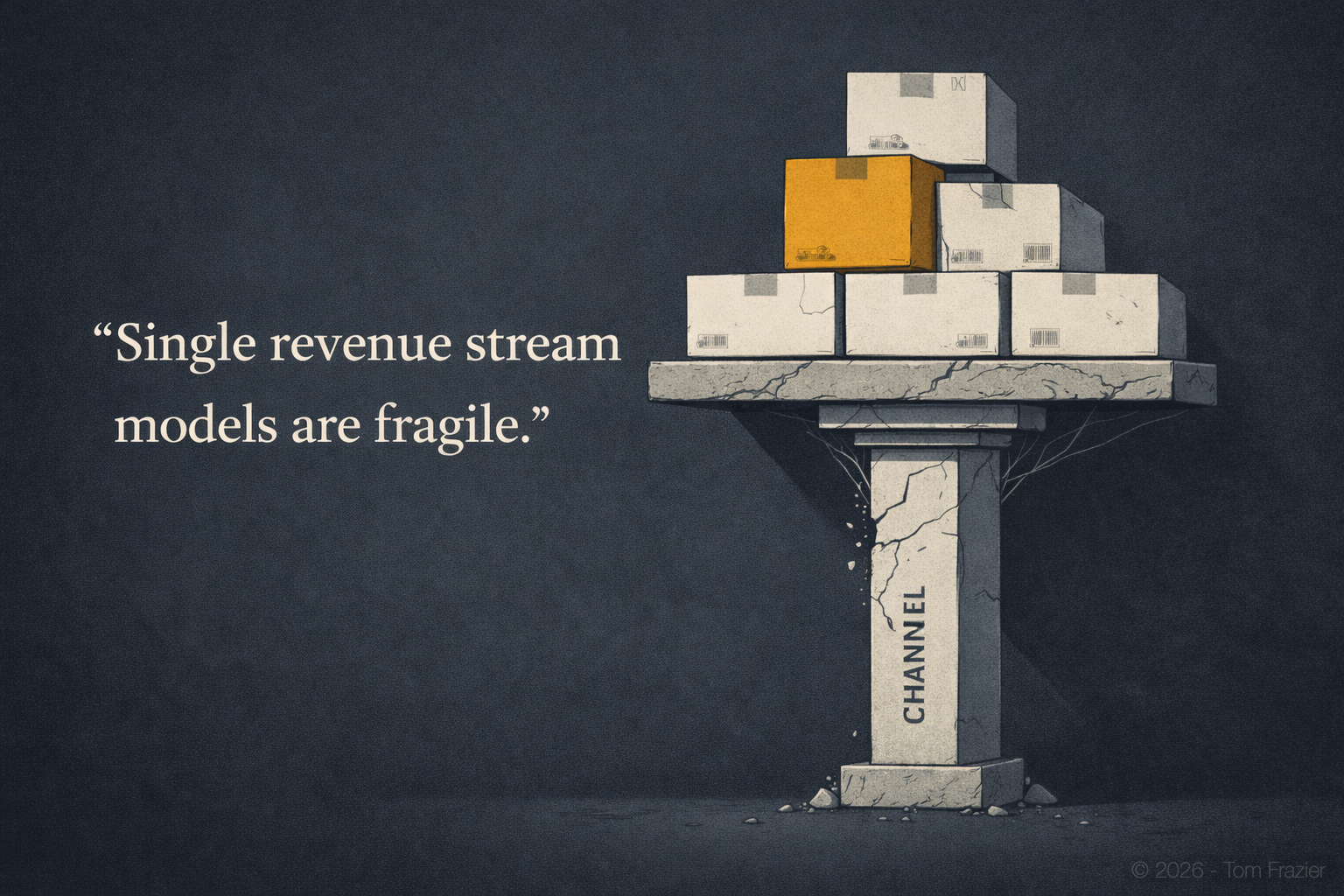
Single revenue stream models are fragile.
When everything depends on one channel, one customer type, or one pricing model, you are one market shift away from structural failure. The therapeutics company sold exclusively through Shopify. When we added Amazon, physical retail, and wholesale distribution, we did not just increase revenue — we reduced existential risk. If one channel underperformed, three others could compensate.
Diversification is not about growth. It is about survival.
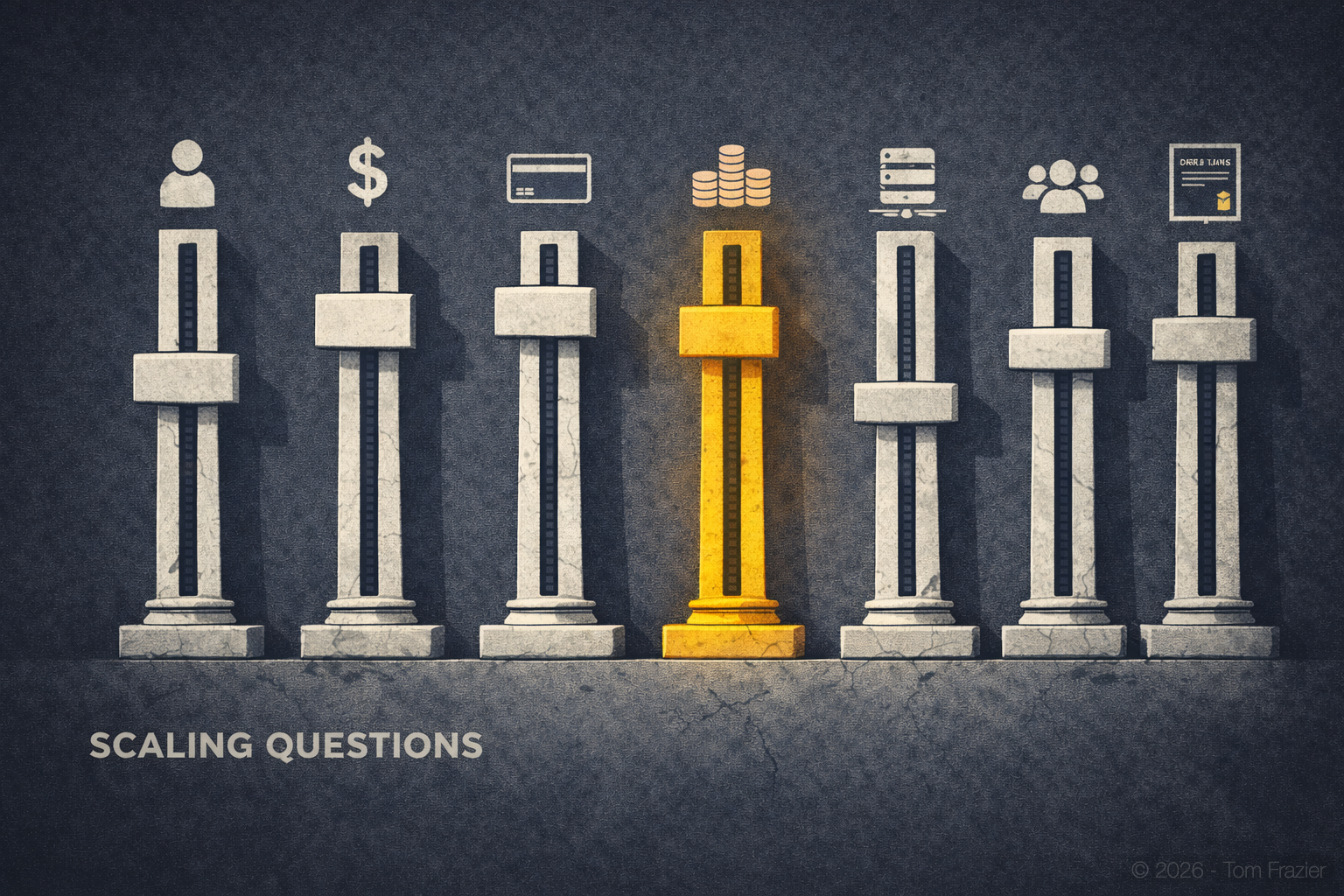
Seven Questions That Reveal Whether Your Model Can Scale
Every business model has strengths and weaknesses across seven areas. You do not need strength in all seven. You need to know which ones your model has and which ones it lacks — and which gaps will kill you before you can fix them.
Switching Costs
How hard is it for your customer to leave? If switching is free and easy, you are constantly fighting churn. If switching is expensive or complicated, you have built-in retention.
Recurring Revenues
Does money come in once or repeatedly? One-time transactions mean you are always hunting for the next customer. Recurring revenue means you can predict cash flow and invest in growth.
Earning Before Spending
Do you get paid before you incur costs? Collect payment upfront and deliver later and you have working capital. Spend first and collect later and you need external funding to bridge the gap indefinitely.
Game-Changing Cost Structure
Can you deliver the same value at radically lower cost than competitors? If your cost structure is similar to everyone else, you compete on features and marketing. If it is fundamentally different, you compete on price and still maintain margin.
Others Who Do the Work
Does your model rely on you doing everything? Platforms where users create content or marketplaces where sellers provide inventory scale faster than models where you must produce everything yourself.
Scalability
Can you serve 10x more customers without 10x more resources? Software scales. Services do not. Manufacturing scales with capital. Distribution scales with partnerships.
Protection from Competition
What stops someone from copying you? Patents, network effects, brand, proprietary data, regulatory barriers. If you have none of these, you are in a race to execute faster than everyone else — and that is a race you can lose at any time.
The therapeutics company initially had strength in two of these seven areas: switching costs once customers experienced results, and cost structure after we refactored manufacturing. It was weak in five: no recurring revenue, negative cash flow timing, no leverage from others doing the work, limited scalability, and minimal competitive protection.
We fixed three of the five. Subscription supplements added recurring revenue. Expanded distribution added scalability. The spokesperson network added leverage. We could not fix cash flow timing or competitive protection without changing the fundamental product, so we accepted those as constraints and built around them.
PESTLE: The Macro Forces That Will Find You Whether You Look or Not
PESTLE analysis sounds like a compliance exercise. It is actually a risk management tool that most founders skip until a macro force finds them.
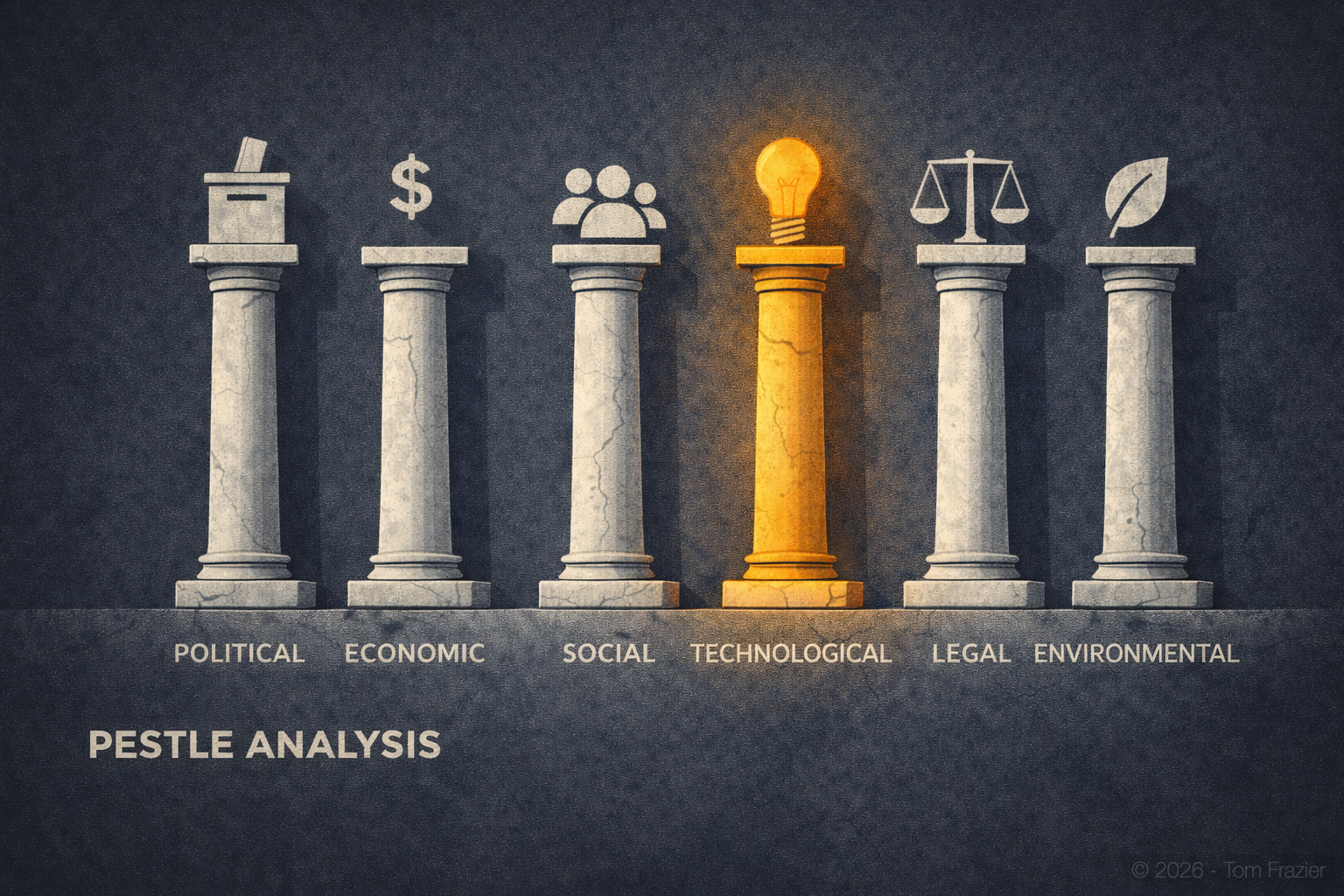
Political, Economic, Social, Technological, Legal, and Environmental forces shape whether your business model works regardless of how well you execute. The therapeutics company faced this directly. The FDA began scrutinizing supplement health claims more aggressively — companies making unsupported claims were getting warning letters that effectively shut down their marketing. Our product could avoid this but our marketing copy was written as if it did not.
But the regulatory risk was just one dimension. We also had to track economic forces — chronic condition management spending correlates strongly with healthcare cost inflation, which was shifting how our core customer thought about spending. We had to track social forces — attitudes toward alternative therapies were moving in our direction, which shaped our messaging. We had to track technological forces — subscription commerce infrastructure was maturing in ways that made our model shift viable.
None of that is compliance work. It is competitive intelligence. The founders who read the macro environment correctly build models that work with external forces rather than against them. The ones who ignore it build models that get overtaken by shifts they saw coming but chose not to plan for.
The Viability Question: Can This Model Actually Build a Business?
Founders ask the wrong question.
They ask: "Is my idea good?" The right question is: "Is this model structurally capable of building a real business?"
Those are different questions. A good idea with the wrong model is just an expensive lesson. Capital runs out because the underlying model cannot support a real business — not because the founder ran out of determination.
The viability question forces honesty:
- Can you acquire customers at a cost that allows profit?
- Can you retain customers long enough to recover acquisition costs?
- Can you scale without proportionally scaling costs?
- Can you defend against competition long enough to build a sustainable position?
- Can you survive external shocks from regulation, technology shifts, or economic changes?
If the answer to any of these is no, you do not have a viable business model. You have a project that will consume capital until someone stops funding it.
The therapeutics company initially failed several of these five tests. After refactoring manufacturing, expanding distribution, and building the spokesperson network, it passed four. The one it still failed — competitive protection — was a known constraint, planned around rather than ignored.
Viability is not binary. It is a spectrum. The question is whether your model has enough structural strength to survive long enough to fix its weaknesses. Most do not. Most founders discover that gap after they have spent the money to prove it.
The difference between a great product and a great business is the model.
Get that right first. Everything else follows.
Next up: once you have a brand promise and a business model that can deliver on it, the next question is who sits in the room making the decisions that either protect or destroy both. That is your board, most founders are unaware of its importance and opportunity for leverage.
This is the first article in Phase 1 — Conceptualization & Planning. You can move ahead to brand building and board design topics.

Design an everlasting business model with a free AI tool just for subscribers. ⤵️
This article is why I built the Business Model Master GPT. It walks you through every element in this article — value proposition statement, business model canvas, value proposition canvas by market segment, seven-area model ranking, PESTLE analysis, and a viability verdict — tailored to your specific business. It is free.
A few minute chat can save months of failure.
It will tell you whether your model has the structural strength to build a real business before you spend the next three years finding out the hard way.
Common Questions About Business Model Master GPT
How can it help if my business idea is still vague?
Business Model Master GPT can assist in clarifying and refining business ideas using structured models and frameworks, ensuring that even vague concepts are developed into well-defined business plans.
Isn't it better to consult a human expert for business model advice?
While human experts offer valuable insights, Business Model Master GPT provides an immediate, data-driven approach to business model design, leveraging extensive knowledge sources and methodologies to offer expert-level guidance efficiently.
Can it handle complex, industry-specific business challenges?
Business Model Master GPT is equipped to tackle complex and industry-specific challenges by applying a wide range of business principles, frameworks, and analytical tools, offering solutions tailored to specific business needs.
What if my business needs are too unique for standard models?
Business Model Master GPT excels in customizing business models and strategies to fit unique business needs, employing a flexible approach to ensure every aspect of the business is addressed uniquely.
How accurate and up-to-date can its business insights be?
Business Model Master GPT continuously integrates the latest business trends and data into its analysis, ensuring that the insights and recommendations provided are both current and relevant to modern market dynamics.
This post is for subscribers only
Sign up now to get access to the post.
Already a member? Sign in