


I Built a Daily Podcast Factory in a Weekend Using AI
My immediate reaction was not "let me research podcast production workflows." It was "you know what? We can actually do this." This was still very early in the AI content creation wave: 2024 felt like piecing together parts that barely fit. But the reaction was yes.
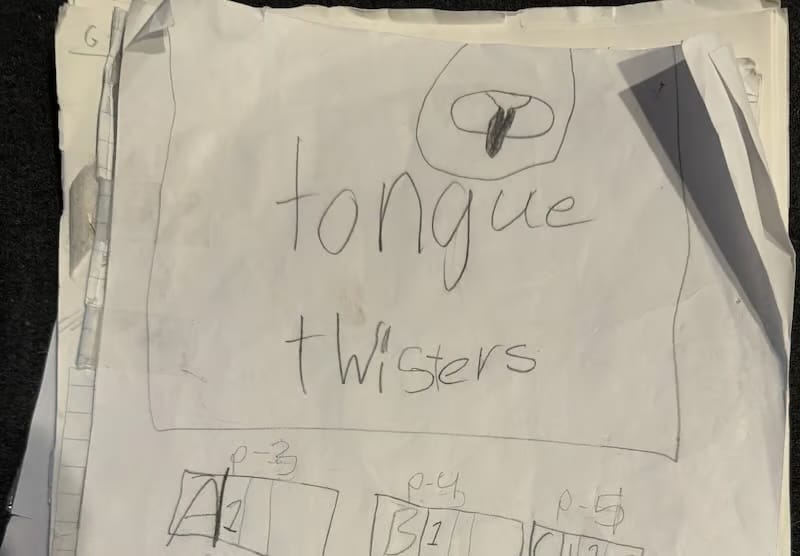
My daughter Charlotte started writing a joke book when she was five. She called it "The Tickle Pickle" because she's hilarious and that's the kind of name a five-year-old comes up with.
It sat on our kitchen counter with dozens of pages of knock-knock jokes, tongue twisters, and whatever funny thing she could remember to write down. Then we started this daily ritual: every morning while waiting for the school bus, the kids wanted five minutes of entertainment. Charlotte would bring her paperback joke book. We'd look up jokes on the Internet. We'd ask Siri to tell us jokes.
Then one rainy day in early 2024, they asked:
"Can we turn this into a podcast?"
My immediate reaction was not "let me research podcast production workflows." It was "you know what? We can actually do this." This was still very early in the AI content creation wave: 2024 felt like piecing together parts that barely fit. But the reaction was yes. Let's take something you're passionate about, have fun as a family, and build something that has not been done before.
The Existing Options Were Absolutely Terrible
We started looking for kid joke podcasts. What we found was garbage.
There were a few joke podcasts using old technology and robotic voices that sounded like they were recorded in 1997. The content was not funny for kids—more like dad jokes that made adults groan. Nothing was designed specifically for children. Nothing had good audio quality. Nothing felt like something my kids would actually want to listen to every day.
So we decided to build the very first kid joke podcast that did not sound terrible.
Here's what that actually meant: not just a podcast.
Without AI, this project does not exist.
What This Would Have Required Without AI
Let me break down what daily content production across four formats would actually require in the traditional world:
Writers to research daily themes, write age-appropriate jokes, create fun facts, and produce newsletter content. You'd need at least two writers to maintain daily output without burning out.
Voice actors to record podcast episodes. Professional voice work for kids' content requires consistency, energy, and the ability to deliver jokes with timing. You'd need to book studio time, manage schedules, and hope nobody gets sick on production day.
Illustrators to create daily coloring pages that match the theme. Custom illustrations take hours. Daily output means you'd need multiple illustrators rotating or someone working full-time just on this.
Editors to handle audio production, image formatting, blog publishing, and newsletter distribution. Someone has to make sure everything actually goes out on time.
Project managers to coordinate all these people, manage the content calendar, and keep the machine running. Daily production means continuous coordination.
You're looking at a team of 6-8 people minimum to run this operation. The biggest bottleneck to more good content always comes back to having more good writers in your roster. The Content Marketing Institute found that 61 percent of content teams find it challenging to develop content that appeals to different stages and that's for business content, not daily entertainment for kids.
The traditional approach would have cost thousands of dollars per month in freelance rates, or required full-time hires with benefits. For a family project that started as a joke book and a Siri ritual.
That's why this project would not have happened.
The Weekend Build

I built the initial system over a weekend. Not because I'm some productivity guru, but because AI converted what would be impossible operational complexity into a manageable workflow.
Here's the actual system architecture:
AI for content generation: I feed the daily theme into AI tools that research the topic, generate keyword clusters that define age-appropriate jokes, create fun facts, and write newsletter content. The AI handles the creative heavy lifting that would normally require a writing team.
AI for voices: Instead of booking voice actors and studio time, AI voices deliver the jokes with consistent quality and timing. AI-generated voices maintain uniform tone, clarity, and pronunciation eliminating the inconsistencies that come from human fatigue, health, or mood. This matters when you're producing content every single day.

AI for images: Daily coloring pages get generated through AI image tools. What would take an illustrator 2-3 hours per image happens in seconds. Side note: we've built what is arguably the world's largest pickle image collection through this process which is not something I ever thought I would imagine being a part of especially because I don't even like pickles!

AI for blog posts: Each episode gets a matching blog post with the jokes, fun facts, and additional context for parents. AI handles the formatting and publishing workflow.
The system runs daily without falling apart. That's the part that matters.
This Is Not a One-Time Project
Building something once is different from building something that has to work every single day.
Most AI content stories focus on one-off projects—someone used AI to write a blog post, generate an image, or create a video. Cool. But daily production is a different category of difficulty. The system has to be reliable. The quality has to stay consistent. The workflow cannot require constant manual intervention or the whole thing collapses.
This is where AI reveals its actual value as system leverage rather than a fancy automation trick.
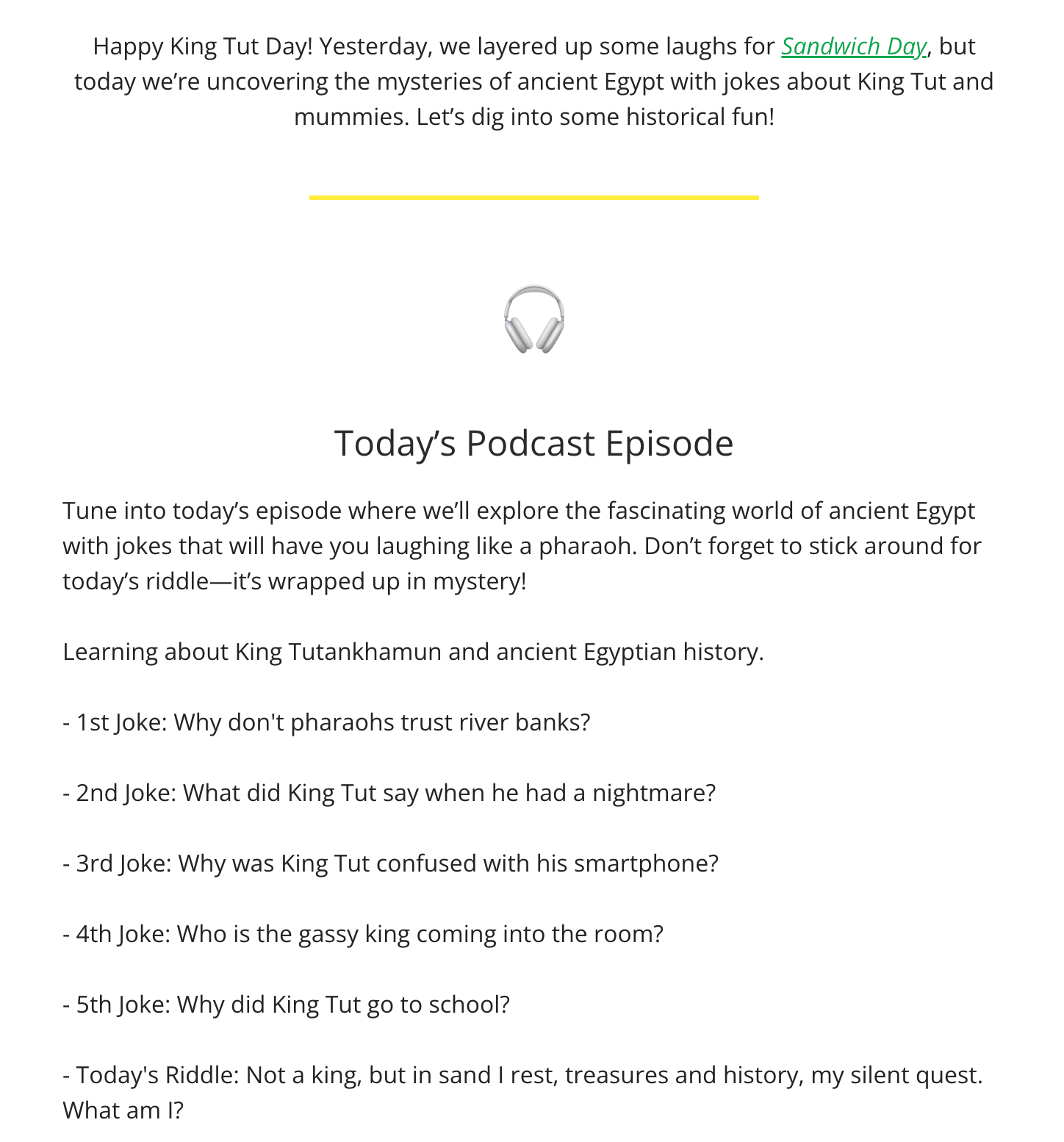
We produced content every day for nearly a year. The podcast hit 250,000 downloads in just over six months. The newsletter went out to parents who wanted a fresh way to connect daily with their kids through humor and learning. The coloring pages give families something to do together.
None of this would survive if the AI system was unreliable or if I had to manually manage every step. The compound effect of daily output only works when the system actually compounds when today's content builds on yesterday's without requiring exponentially more effort.
56% of top-performing content teams report more efficient workflows through AI, and 55% see measurable improvement in optimization results. But those numbers hide the real insight: AI does not just make things faster. It makes things possible that were structurally impossible before.
Was it perfect? Of course not. It was a side project to build with children. But it required very little effort and gave thousands and thousands of people joy every single day.
What I'm Seeing That Most People Miss
The pattern I'm observing: AI functions as system leverage that makes one focused operator more effective than a distributed team without integration.
Traditional content operations scale through personnel multiplication. You need more output, you hire more people. But research shows that large groups produce less than small groups, or produce lower-quality outcomes. As team size increases, process loss increases, effectively limiting the growth of productivity.
Jeff Bezos famously instituted a "two-pizza rule" at Amazon. Any team that could not be fed by two pizzas was too big. When Facebook purchased WhatsApp for $19 billion, the company's 32 engineers had created a platform used by 450 million users.
Small teams move faster. They iterate at higher frequency. They innovate more.
AI amplifies this advantage. Instead of needing a team to coordinate across writing, voice work, illustration, and editing, one operator with the right system design can produce output that matches or exceeds traditional team quality.
The Tickle Pickle proves this at scale. Daily production across four content formats. 250,000 downloads. Consistent quality that keeps kids and parents coming back. One person running the operation.
This is not about AI replacing jobs. It's about AI collapsing the barrier between "I have an idea" and "I run a daily content operation."
The Execution Lesson
Most operators are still planning instead of building.
They're researching the perfect workflow. They're waiting to understand AI better before they start. They're analyzing case studies and reading articles about how other people used AI to create content.
Meanwhile, the barrier just collapsed.
What would have required significantly month investment (with very little financial return) and a coordinated team now requires a weekend to build the system and weekly execution to maintain a daily product. The gap between theoretical understanding and operational reality has never been smaller.
But you have to actually build the thing.
I did not start with a perfect system. I started with a rainy day, two kids who wanted a podcast, and a willingness to piece together AI tools that barely fit. The system got better through daily use. The workflow improved through iteration. The quality increased through compound learning.
That's how this actually works. You build, you learn what breaks, you fix it, you build more. The AI handles the operational complexity that would normally require a team. You handle the system design and daily execution.
The Tickle Pickle exists because I built it instead of planning it.
What are you planning that you could be building right now?


