


Stop Searching for the Signal. Start Four AI Projects.
AI adoption is the biggest challenge for most businesses. Instead of chasing one use case, run four AI projects across a simple risk and implementation framework to build capability, reduce downside, and accelerate the real problem, adoption.
Everyone agrees AI is important. Nobody agrees on where to start. And that gap — between knowing it matters and knowing what to do on Monday morning — is where most companies stall.
In fact, adoption is now squarely the number one problem to solve for.
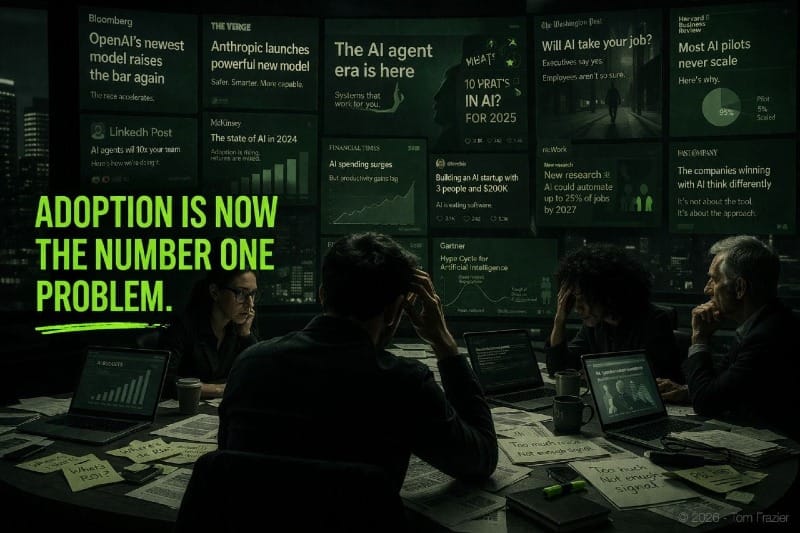
The noise is real. Vendor pitches, analyst reports, conference keynotes, LinkedIn posts from people who've never run a P&L. The advice is everywhere. Almost none of it is actionable for an operator running a real business with real constraints.
The answer isn't to find the perfect AI project. It's to run four of them simultaneously, chosen across a simple quadrant, and let the portfolio do the work.
The Quadrant That Solves The Biggest Problem — Adoption
Two axes.
The x-axis is risk — low on the left, high on the right. The y-axis is implementation type — operational at the bottom (work the business is already doing), new initiatives at the top (things that weren't viable or justifiable before AI).
Four quadrants. One project in each. Running at the same time.
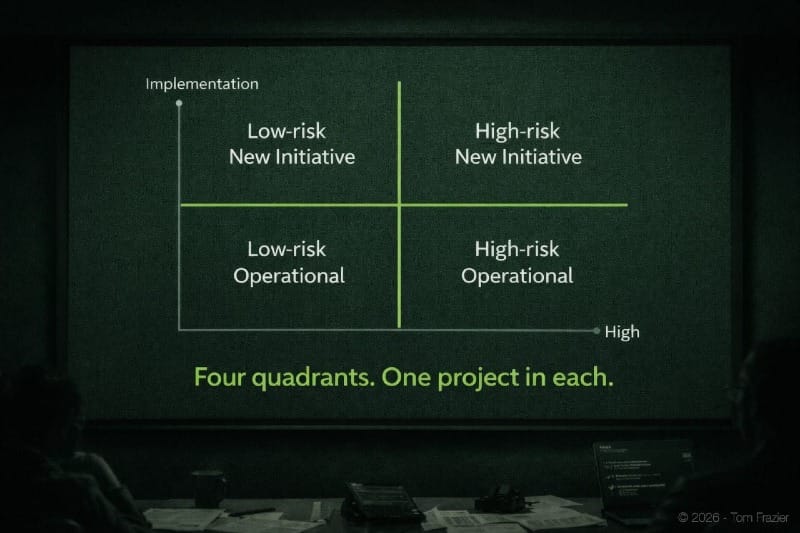
Each quadrant asks a specific question about the business:
The time saver.
Where does high-volume, repetitive work consume time or money at a rate that's quietly painful? AI compresses the resource cost of work that's already happening. If the implementation doesn't work, the loss is a few weeks. If it does, the efficiency compounds permanently.
The money saver.
Where does the business carry meaningful downside exposure in its normal operations — places where things go wrong and when they do, it's expensive or damaging? The goal here isn't cost reduction. It's improving reliability in something that already matters. This quadrant is defined by what's at stake in the business, not by implementation complexity.
The 50/50 project.
What has the business never been able to do — or never been willing to invest in — because the ROI case was too thin or the execution too resource-intensive without AI? Even if this project fails, the cost is low. It's a real bet with a manageable downside.
The ambition project.
A capability, product, or market position that was out of reach before. This one requires the most oversight and carries the most exposure — and the most upside. This is the project that could change the shape of the business.
Why Four at Once is not Crazy
Running four projects simultaneously instead of sequencing them is a deliberate choice, and it's the right one.
It forces cross-functional exposure. One project per quadrant almost guarantees you'll touch multiple teams — operations, risk, product, customer. AI adoption doesn't happen in a single department. It spreads from successful implementations. Four projects running at once means four different pockets of the organization are developing firsthand experience at the same time.
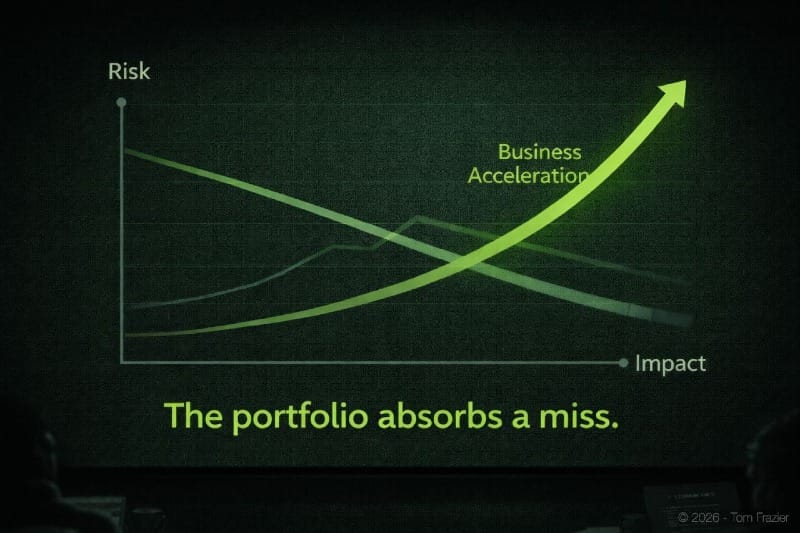
It structures survivable failure. Not all four will work. That's expected. Intelligence is hard. The portfolio absorbs a miss. If the high-risk initiative stalls, the efficiency project is probably already paying back. The business doesn't bet its credibility on a single outcome.
It introduces two new things to the organization simultaneously.
New initiatives are energizing — people show up differently when there's something genuinely new in front of them.
Pairing that with operational improvements grounds it in business reality without killing the momentum. It also provides a mechanism for CEOs and leadership teams to start measuring intelligence independently from technology.
 Tom Frazier
Most importantly: the real objective of this exercise isn't any individual project outcome. It's adoption. It's building the organizational muscle to work with AI — to develop judgment about when to use it, how to verify it, and how to integrate it into the way work actually gets done. That capability doesn't install. It accumulates through repeated exposure to real projects that succeed and fail and teach the organization something either way.
The Objection Worth Taking Seriously
The standard pushback is that running four projects at once dilutes focus, and that a company would be better served going deep on one high-conviction bet before expanding.
That argument would hold if the goal were maximizing the return on a single AI implementation. It doesn't hold when the goal is building organizational capability. A single project, however successful, produces a local outcome. It upskills one team, builds confidence in one department, and generates one proof point. The rest of the organization watches from a distance.
Four simultaneous projects — deliberately spanning operations and initiative, low risk and high — produce a distributed outcome. Multiple teams develop firsthand experience. Multiple failure modes get stress-tested. The organization learns faster because more of it is learning at the same time.
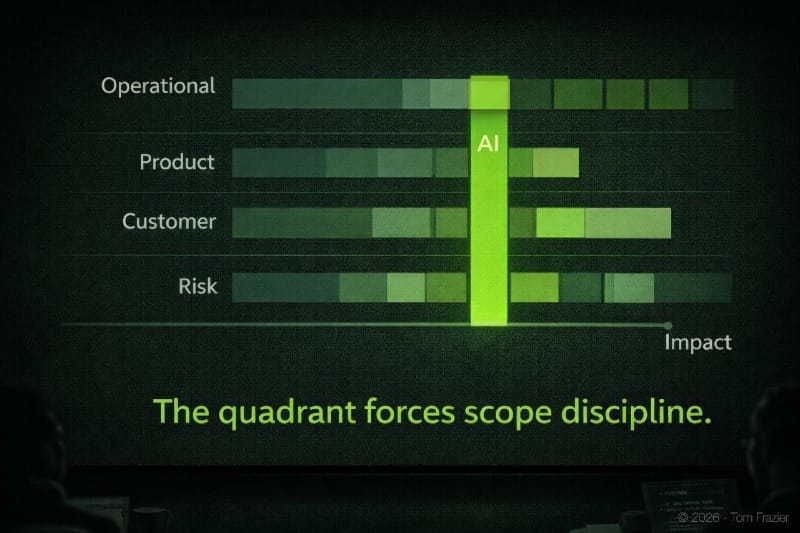
The focus argument also assumes that running four well-scoped projects is as demanding as running four poorly scoped ones. It isn't. The quadrant forces scope discipline. Each project has a specific mandate defined by its position. That's the mechanism for keeping the portfolio manageable.
Example One: An Amazon Agency
An Amazon agency helps brands grow and scale on the platform — catalog management, advertising, logistics strategy, brand protection. Margins are thin, work is highly repeatable in some areas and genuinely strategic in others.
Bottom-left (Low-risk / Operational) — Listing Optimization at Scale
The agency manages hundreds of ASINs across dozens of clients. Updating titles, bullets, and backend keywords is work that eats associate hours. AI-assisted listing copy generation — fed by competitive research and brand guidelines — compresses what used to take hours per ASIN into minutes. If the outputs need editing, they still save time. The efficiency compounds across every client in the portfolio.
Bottom-right (High-risk / Operational) — Brand Hijacking and Counterfeit Detection
Brand protection failures are expensive and relationship-damaging. An AI-powered monitoring system that continuously scans for listing hijacks, unauthorized sellers, and counterfeit indicators — then routes alerts with recommended actions — reduces the window between a threat appearing and someone responding. The high-risk label is about what's at stake in the business when detection is slow, not about the implementation itself.
Top-left (Low-risk / New Initiative) — Automated Competitor Intelligence Briefings
Clients ask for competitive context consistently. The agency has never had the bandwidth to deliver it at meaningful depth. An AI-generated weekly briefing pulling pricing trends, review velocity, sponsored ad presence, and inventory signals for each client's top competitors is now buildable without adding headcount. If clients don't engage with it, the cost of the experiment is low. If they value it, it becomes a service differentiator that scales without marginal cost.
Top-right (High-risk / New Initiative) — Predictive Inventory and Ad Spend Optimization
Stockouts and overspend are two of the most expensive problems an Amazon brand faces, and they're often correlated. A model that integrates sales velocity, seasonal signals, and ad performance data to generate forward-looking inventory and budget recommendations — actively managed by the agency on behalf of clients — represents a meaningful capability shift. It's not a dashboard. It's a managed service layer the agency didn't have before. Building it right requires real investment. If it works, it's a defensible revenue line with pricing power.
Example Two: A Regional Telco or MVNO
A regional telco or MVNO operates with high operational complexity, regulatory exposure, thin margins on core services, and perpetual pressure to reduce churn while growing ARPU.
The scale is different from the agency; the quadrant logic is identical.
Bottom-left (Low-risk / Operational) — Customer Service Triage and First-Response Automation
High-volume contact center interactions — billing questions, plan changes, basic troubleshooting — are expensive to staff and slow to resolve. AI-assisted triage and first-response handling, integrated into existing ticketing infrastructure, reduces handle time and frees agents for escalations. Human oversight stays in the loop for complex issues. The efficiency gain across millions of annual contacts is material without requiring a platform overhaul.
Bottom-right (High-risk / Operational) — Network Anomaly Detection and Predictive Failure Routing
Network degradation events are expensive — in customer satisfaction, SLA penalties, and engineering response costs. AI-driven anomaly detection that identifies early signals of infrastructure stress before they become outages, and prioritizes remediation routing to NOC teams, reduces both the frequency and severity of incidents. This is the clearest illustration of the high-risk operational target: a place where the business already carries significant downside, and AI improves the reliability of what's already happening.
Top-left (Low-risk / New Initiative) — Personalized Plan Recommendation Engine
The telco holds substantial data on customer behavior — usage patterns, device profiles, payment history, service interactions — and rarely uses it to proactively surface better-fit plans to existing customers. An AI recommendation engine that triggers upsell and plan-switch offers based on individual customer signals, delivered through the app or via outbound messaging, is buildable without large infrastructure investment. A modest lift in ARPU conversion makes the project worthwhile. A poor result costs limited downside.
Top-right (High-risk / New Initiative) — Churn Prediction and Retention Intervention at Scale
Churn is the central business problem for any subscription telco. Predicting which customers are likely to leave — and triggering personalized retention actions before they do — has been a stated priority for years. AI makes it viable at a granularity and speed that wasn't operationally achievable before. Done well, this becomes a core business system that changes the unit economics of retention. Done poorly, it burns budget and produces false confidence. That is the high-risk / high-reward profile the top-right quadrant is built for.
The Real Goal Isn't the Projects
100% of companies should be introducing AI systemically right now.
Not because every project will work — they won't. Not because the ROI is always immediately obvious — it isn't. But because adoption is more important than any individual outcome, and the companies that delay adoption are not gaining safety. They're falling behind on organizational capability that takes time to build.
The businesses that will be structurally differentiated in three years are not the ones that found the single best AI use case in 2026. They're the ones whose people developed working fluency with AI — who built judgment about when to use it, how to verify it, and how to integrate it into the actual flow of work. That doesn't happen from the top down through policy. It happens through exposure, through repetition, through a series of real projects that succeed and fail and leave the organization more capable regardless of outcome.
The quadrant is the mechanism. Four projects. Four mandates. Running simultaneously.
But the shift it's pointing toward is larger than any implementation.
Modern companies have been built on three pillars: people, process, and technology. Hire the right people. Build the right processes. Deploy the right technology. That framework built every significant enterprise of the last thirty years.
It is no longer a sufficient operating model.
Tom Frazier
The organizations figuring this out are adding a fourth pillar: intelligence. Not AI as a technology layer — that's still the third pillar. Intelligence as a distinct operational capacity. The ability to learn, synthesize, recommend, and act with a consistency and speed no human team can match unaided — and to build that capacity into the organization as a durable structural advantage.
People. Process. Technology. Intelligence.
That's the operating model of what comes next. The quadrant is how you start moving toward it — deliberately, with scoped projects, inside the real business, starting now.


